A community group had sued to prevent the construction of a bridge in Clara Coffey Park in New York City. The court ruled in the favor of the city's plans.


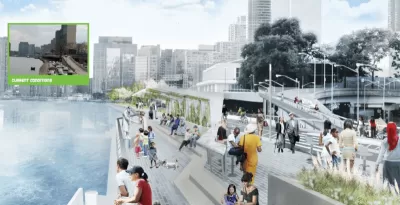
"The [New York] state Supreme Court’s Appellate Division has rejected a lawsuit that sought to stop the erection of a pedestrian and bicycle bridge over a Midtown Manhattan park," reports Eve Kessler.
Calling the court decision a "victory for city agencies over the 'Not in My Back Yard' crowd," Kessler explains that the decision by the Appellate Division sets a precedent that infrastructure is an entirely appropriate use of parkland, and could pave the way for similar victories in the future.
"The bridge — which would span the FDR Drive to connect Sutton Place South at East 54th Street to an as yet unbuilt part of the East River Esplanade — is part of the larger East River Greenway, a mammoth, multi-year project to create waterfront access around Manhattan for residential recreation," according to Kessler.
The group on the other side of the issue, the Cannon Point Preservation Corporation, "sued the city last year claiming the bridge would illegally seize parkland in a vest-pocket greensward, Clara Coffey Park."
Read the full story: Court Swats Away NIMBY Anti-Bike-Path Claim on East Side

Bikelash Strikes Again in New York City
New York City, which earlier this decade ago experienced wild controversy surrounding the addition of bike lanes and bikeshare to city streets, is once again faced with a battle of drivers versus bike lanes.
[Update] Plug Finally Pulled on the Pier 55 Project in Manhattan
A splashy proposed park to replace Pier 54 in New York City, designed by a starchitect and proposed by a famous billionaire, couldn't weather the storm of controversy in New York City.
Never Built New York: The Pier 55 Park Project for the Hudson River
The Pier 55 proposal made a big splash in New York when it was proposed in 2014, but now it appears headed for the trash bin of history.

Planetizen Federal Action Tracker
A weekly monitor of how Trump’s orders and actions are impacting planners and planning in America.

California plans to bury El Niño’s downpour
If the state plays its cards right, it may be able to store a billion acre-feet of El Niño’s water in aquifers.

Chicago breaks ground on $3 billion megadevelopment
The new neighborhood, titled Foundry Park, will one day host 3,700 residences.

Satanic Place Names
From streams and lakes to valleys and canyons, I mapped more than 1,000 places named after the Devil.

California High-Speed Rail Authority CEO resigns after $600,000 scandal
Under Ian Choudri, the authority used taxpayer dollars to fund first class flights and trips to nightclubs.

Want to study the Missouri River? Soon, you may need unanimous approval from 10 states
Legislation would require 10 governors’ permission to study or build projects moving water outside the basin.

FREE Course: Walkable City 1: Why Walkability?
After describing his path towards focusing on walkability as the essence of good planning, Jeff Speck marches through his five principal reasons for making more walkable places.
Reinventing Malls: Planning Alchemy—Turning Gray Fields Into Gold
The course focuses on the opportunities and imperatives that shape reinvention of mall sites.

City of Rosemead
Rutgers University, Edward J. Bloustein School of Planning and Public Policy
One Hundred Miles
Hunter College, City University of New York (CUNY)
The Architects Foundation
University of Cincinnati Online
City of Cambridge
Montrose County
The Pocatello Development Authority