Mayor Bill de Blasio had been reluctant to adopt the open streets model growing in popularity around the world and in the United States, but Monday morning changed all of that.


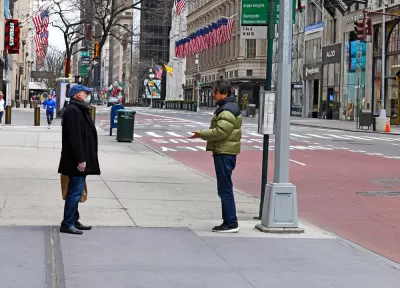
New York City Mayor Bill de Blasio "committed to opening up 100 miles of streets for socially responsible recreation during the COVID-19 crisis," according to breaking news reported by Gersh Kuntzman this morning. Mayor de Blasio's commitment expands on a proposal previously working through the City Council to convert 75 miles of street in the city to open streets to pedestrians and people on bikes during the pandemic.
The announcement comes one day after the New York Times editorial board called on the city to open more recreational space for people during the stay-at-home-orders of the pandemic.
Planetizen will continue to update this post as more details become available.
Update: more background on the politics leading to the announcement, and the details of how the City Council was planning to choose open streets, are available in an article by Caroline Spivack.
Read the full story: BREAKING: De Blasio Commits to 100 Miles of ‘Open Streets’


Planetizen Federal Action Tracker
A weekly monitor of how Trump’s orders and actions are impacting planners and planning in America.

California plans to bury El Niño’s downpour
If the state plays its cards right, it may be able to store a billion acre-feet of El Niño’s water in aquifers.

Chicago breaks ground on $3 billion megadevelopment
The new neighborhood, titled Foundry Park, will one day host 3,700 residences.

Satanic Place Names
From streams and lakes to valleys and canyons, I mapped more than 1,000 places named after the Devil.

California High-Speed Rail Authority CEO resigns after $600,000 scandal
Under Ian Choudri, the authority used taxpayer dollars to fund first class flights and trips to nightclubs.

Want to study the Missouri River? Soon, you may need unanimous approval from 10 states
Legislation would require 10 governors’ permission to study or build projects moving water outside the basin.

FREE Course: Walkable City 1: Why Walkability?
After describing his path towards focusing on walkability as the essence of good planning, Jeff Speck marches through his five principal reasons for making more walkable places.
Reinventing Malls: Planning Alchemy—Turning Gray Fields Into Gold
The course focuses on the opportunities and imperatives that shape reinvention of mall sites.

City of Rosemead
Rutgers University, Edward J. Bloustein School of Planning and Public Policy
One Hundred Miles
Hunter College, City University of New York (CUNY)
The Architects Foundation
University of Cincinnati Online
City of Cambridge
Montrose County
The Pocatello Development Authority