Successful urban highway deconstruction projects have swapped highways for boulevards and saw economic, public health, and urban design benefits. Will more cities opt for highway removal programs over reconstruction?


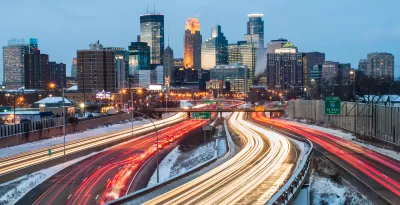
Decades-old urban highways in the U.S. are showing their age. In some cases, factors like deteriorating overpasses, unsafe expressway to city street transitions, and proximity to residential neighborhoods are guiding planners to implement fixes guided by modern safety standards and the prioritization of walkable and bikeable urban spaces.
Plans ranging from highway removal to underground relocation are underway across the country and have already seen wins in terms of economic revitalization, public health, and urban design. Steep construction costs and difficulty in securing funding, however, is making the process of reconstruction or removal challenging for many cities.
"While the federal government underwrote most of the cost of building the interstate system in the 1950s and 1960s, state and local governments now provide about 80 percent of public infrastructure funding. With perspectives on land use, transit, and equity also evolving, many cities are finding themselves at a crossroads when it comes to highways: remove or rebuild?," writes Kathleen McCormick.
The Congress for the New Urbanism (CNU), a long-time proponent of highway removal, published the 2019 Freeways Without Futures report, detailing case studies of removal projects in New Orleans, Tampa, Dallas, Austin, Portland, Louisville, Denver, Syracuse, Oakland, and Buffalo.
The Senate-led Environment and Public Works Committee approved the America’s Transportation Infrastructure Act of 2019, a five-year program allocating up to an 80% federal subsidy for planning, technical assistance, and capital construction related to the removal of highways in U.S. cities. In response, CNU is preparing a tool kit and best practices guide to provide cities with such tools as "design standards, transportation network concepts, engineering specifications, and metrics to measure success," says CNU board member and Nelson\Nygaard principal and transit planner Larry Gould.
As planners begin to share their experience and understand the benefits of highway removal, it is becoming increasingly clear that the benefits of removal outweigh those of reconstruction.
FULL STORY: How Urban Highway Removal Is Changing Our Cities


10 U.S. Cities Launch Anti-Displacement Network
More than half of American tenants are rent-burdened, putting them at risk of displacement. A national collaboration with PolicyLink hopes to help.

Austin Scores Highest on Pandemic Recovery; Bay Area and Baltimore Lowest
The Bay Area Council and CBRE created an economic tracker to measure how well the nation's 25 largest metropolitan areas have recovered from the public health restrictions imposed on their regions at the onset of the pandemic.
2020 Population Growth Rates for the 50 Biggest U.S. Cities
The Census Bureau released new data on May 27 that includes the first four months of the pandemic. Seattle tops the growth rate at 2.2% from July 1, 2019, to July 1, 2020, while Baltimore and San Francisco land at the bottom with -1.4%.

Planetizen Federal Action Tracker
A weekly monitor of how Trump’s orders and actions are impacting planners and planning in America.

The state-sanctioned urbicide of Austin
People don’t kill cities. Freeways do.

US to reduce Colorado River water deliveries to Mexico
A new Colorado Treaty amendment reduces Mexico’s Colorado River water allocation by 250,000 acre feet.

5 New England states march closer to 800 megawatt wind energy project
Securing federal approval for the project may be complicated under the Trump administration, which has historically been hostile towards domestic wind power.

Baltimore to break ground on $50 million Transit Priority Project
The project will bring faster bus trips, safer streets and better bike connections to Baltimore.

Airbnb launches $250 million 'last-dollar financing' housing accelerator, makes first investment in Austin
The company will put $6.4 million towards affordable housing development in Texas’ capital.

FREE Course: Walkable City 1: Why Walkability?
After describing his path towards focusing on walkability as the essence of good planning, Jeff Speck marches through his five principal reasons for making more walkable places.
Reinventing Malls: Planning Alchemy—Turning Gray Fields Into Gold
The course focuses on the opportunities and imperatives that shape reinvention of mall sites.

Eagle County Government
Harvard University Graduate School of Design
Nashville Planning Department
The Architects Foundation
University of Cincinnati Online
The Pocatello Development Authority
The Urban Renewal Agency of the City of Pocatello
Journal of the American Planning Association