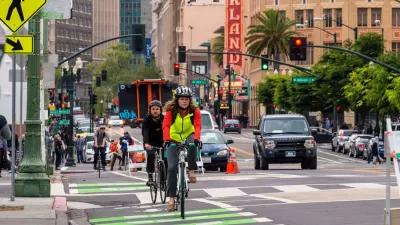
Suddenly, cars aren't the first priority on 10 percent of the roadway in Oakland, California.


[Headline and story updated on April 13, 2020 to better describe the "Oakland Slow Streets" program.]
"Cars will soon be banned from 74 miles of Oakland's residential streets during the coronavirus-inpsired [sic] shelter-in-place, a move bicycle advocates wish would happen in other cities," report Allie Rasmus and Lisa Fernandez.
"The emergency measure, called 'Oakland Slow Streets,' will banish motorized vehicles from 10% of the roadway space in Oakland," according to the article.
Update: cars will not be entirely banished from the streets. Rather, cars will be required to travel at no faster than 10 mph while giving priority to pedestrians and people on bikes, according ot additional information reported by Roger Rudick.
The Oakland Slow Streets program moves Oakland far into the lead of the national trend of cities blocking cars from streets to allow more space for pedestrians and people on bikes. Minneapolis previously opened 18 miles of streets.
Rachel Swan provides additional coverage of the Oakland Slow Streets program in a paywalled article for the San Francisco Chronicle.
Read the full story: Oakland to close 74 miles of streets to cars, paving way for pedestrians and bicyclists
How Oakland Is Fixing its Pandemic Planning Equity Problem
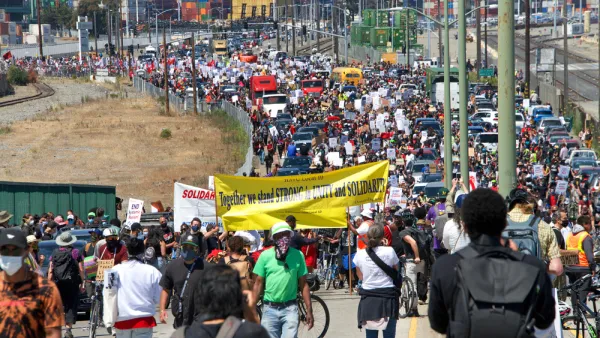
The Oakland Slow Streets program, one of the most controversial developments of the early pandemic, has evolved to become the Essential Places initiative, thanks to new planning practices and a commitment to equity in Oakland, California.
Watch Oakland's Slow Streets Program in Action
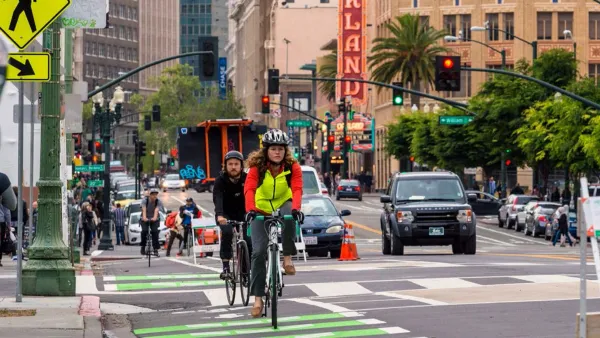
Oakland offers a model for other streets looking to provide new space for pedestrians and people on bikes to get exercise at a space physical distance.
The Slow Streets Reckoning
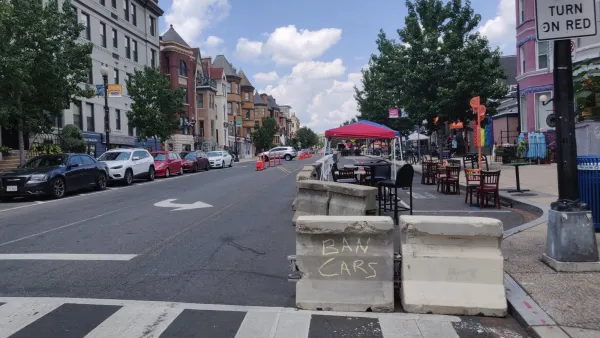
Slow streets programs provided a quick short-term solution and paved the way for some permanent street closures and realignments. Now, these programs are getting a second look as community groups react to the changes.

Washington state to charge fee to drivers with fuel-efficient cars
Revenue from the fee will go towards supporting the state’s highways.

Illinois considers spending $1 billion in taxpayer money on data center
A quantum computing campus and data center are currently under construction in Chicago.

Trump to blast ‘hydrocarbon highway’ through ‘world’s longest art gallery’
Environmental and historic preservation groups are suing to stop the project.

Boston City Council votes to no longer mandate parking in residential developments
The Boston Zoning Commission still needs to approve the proposal.

Passengers in New York, California lift off in air taxis
Two air taxi companies have received a Special Airworthiness Market Survey Certificate, which allows them to service passengers.

MTA to upgrade subway signals for entire network by 2050
This is the first time New York City has planned to modernize subway signals in the Bronx.

FREE Course: Walkable City 1: Why Walkability?
After describing his path towards focusing on walkability as the essence of good planning, Jeff Speck marches through his five principal reasons for making more walkable places.
Reinventing Malls: Planning Alchemy—Turning Gray Fields Into Gold
The course focuses on the opportunities and imperatives that shape reinvention of mall sites.

City of Charlotte
City of Rosemead
Rutgers University, Edward J. Bloustein School of Planning and Public Policy
University of Michigan School for Environment and Sustainability (SEAS)
Hunter College, City University of New York (CUNY)
The Architects Foundation
University District Partnership