The U.S. has much higher traffic fatality rates than peer countries due to automobile dependency and sprawl. Better planning can reduce these human sacrifices.



Ancient Canaanites were known for human sacrifices to their god Baal. The Greek historian Diodorus Siculus describes hundreds of children being sacrificed one year in Carthage:
“They selected two hundred of the noblest children and sacrificed them publicly; and others who were under suspicion sacrificed themselves voluntarily, in a number not less than three hundred. There was in their city a bronze image of Cronus, extending its hands, palms up and sloping toward the ground, so that each of the children when placed thereupon rolled down and fell into a sort of gaping pit filled with fire.”
North Americans have a modern version of this gruesome image. The U.S. has a much higher traffic fatality rate than peer countries largely due to automobile dependency and sprawl which force residents to drive more annual miles at higher speed than they would otherwise choose, resulting in tens of thousands of annual gruesome but preventable traffic deaths and disabilities.
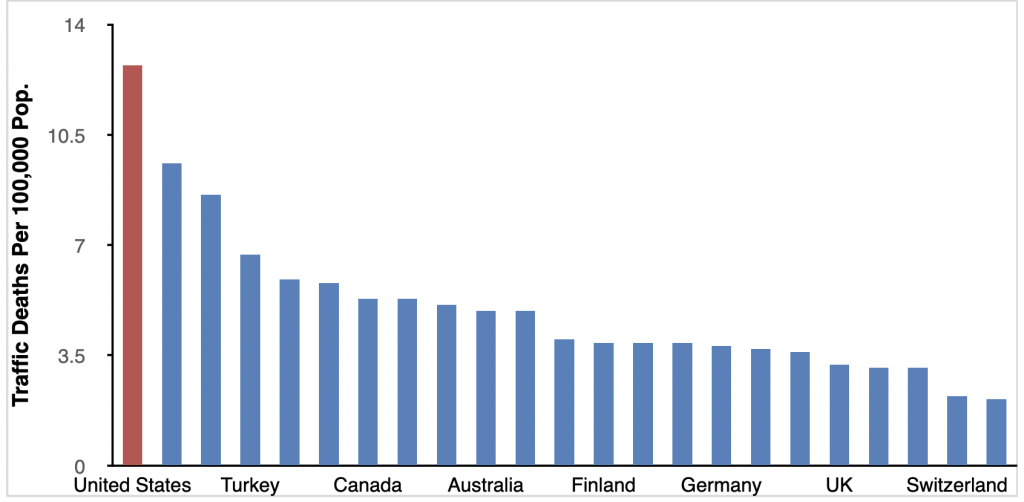
Last year the U.S. had 116 traffic deaths per million residents, comparted with 44 deaths per million residents in Europe. (Note that sources vary in how they measure traffic deaths. For this analysis I used the lower-bound estimate of 39,345 deaths reported by the National Highway Traffic Safety Administration, which only considers traffic deaths within 30 days of a crash that occurs on public roads, rather than the 44,680 traffic deaths reported by the National Safety Council which also includes deaths in parking lots and driveways that occur within a year of a collision. Measured this way, in 2024 the U.S. had 134 traffic deaths per million residents.)
Traffic Death Rates by Country (WHO 2023)
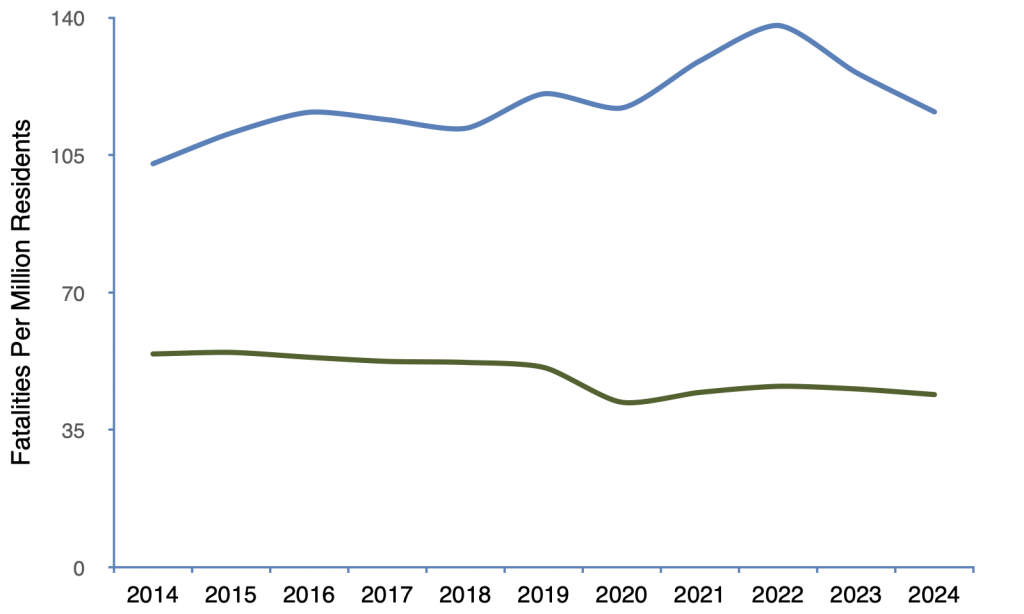
This reflects long-term trends. During the last decade traffic death rates increased in the U.S. while they declined in Europe, as illustrated below.
US Versus European Traffic Fatality Trends (IIHS 2024; European Commission 2023)
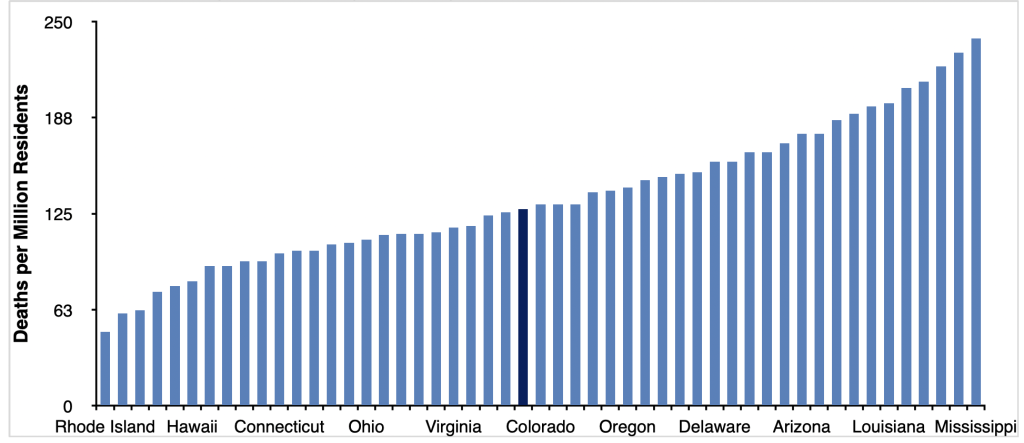
The figure below compares traffic fatality rates by U.S. states. Despite similar vehicle and road design standards, the highest ranking states have about five times the death rate as the the lowest-ranking states.
Traffic Fatality Rates by U.S. States (IIHS 2024)
U.S. traffic death rates are much higher than in Europe.
Traffic Fatality Rates by European Countries (European Commission 2023)
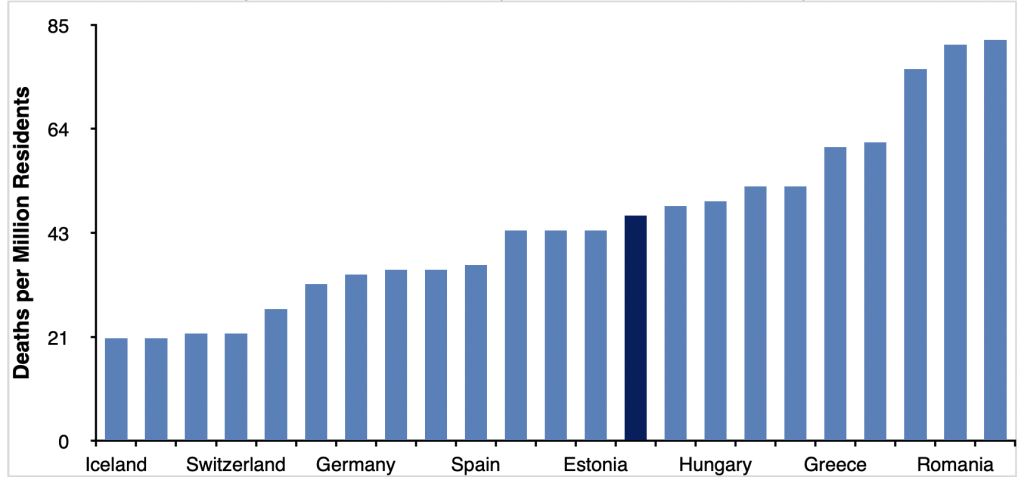
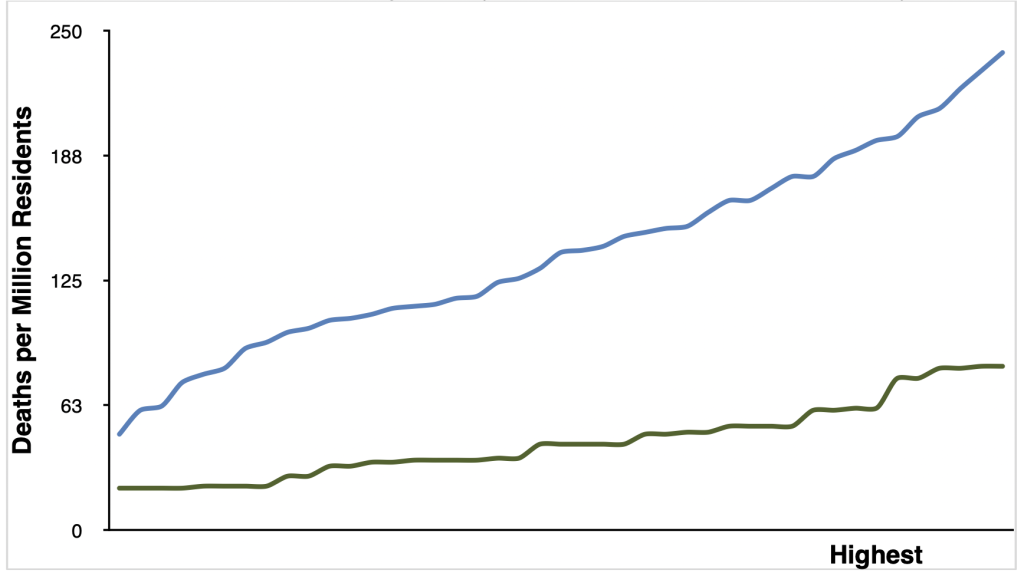
To make these easier to compare I present U.S. and European crash ranges as line graphs using the same scale. This shows that the most dangerous countries in Europe have traffic fatality rates comparable to the lowest death rates among U.S. states (about 50 to 80 fatalities per million residents).
US Versus European Traffic Death Rates (IIHS 2024; European Commission 2023)
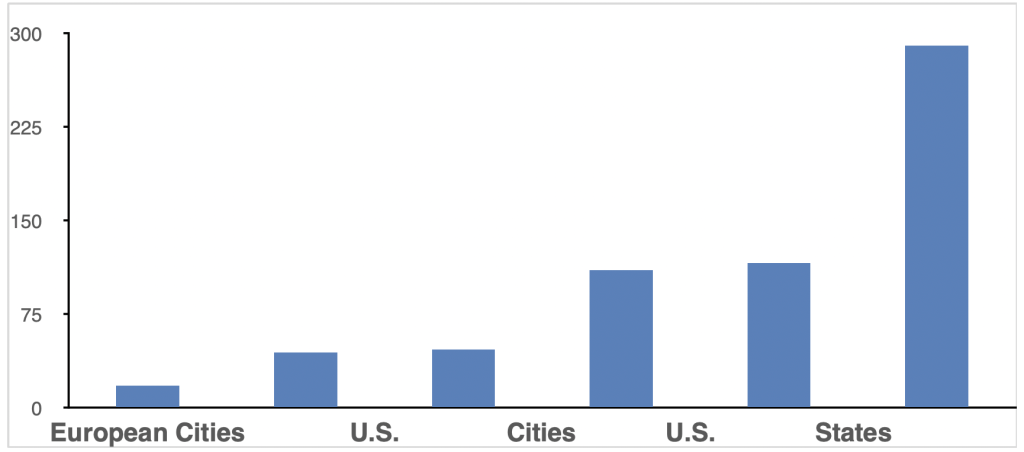
There are similar ranges within countries. In both the U.S. and Europe residents of compact, multimodal communities (that is, transit-oriented developments and 15-minute neighborhoods) have about a fifth of the traffic death rates as in automobile-dependent, sprawled areas. The following graph compares crash fatality rate estimates. Sprawled areas have an order of magnitude higher traffic fatality rates than in compact, multimodal communities.
Traffic Fatality Rates Compared
Several factors help explain these large disparities in fatality rates.
- Europeans drive fewer annual miles than in the U.S. which reduces their risk exposure.
- The European Union requires all cities to implement Sustainable Urban Mobility Plans (SUMPs) that support multimodal planning and transportation demand management.
- The European Union vehicle safety standards protect pedestrians as well as occupants.
- European vehicles are smaller which reduces total risks.
- European countries appear to be more committed to traffic safety programs, such as Vision Zero, which integrate safety into all transportation policies and planning decisions. The EU’s Sustainable and Smart Mobility Strategy includes policies that prioritize lower urban speed limits, pedestrian zones, physical separation between bicycle and car traffic, plus data-based traffic enforcement and education to affect behavior.
I am writing this column during a family holiday in The Netherlands, so I’ll use it as an example. That country has 35 traffic deaths per million residents, less than a third of the U.S., and Amsterdam had only about 20 deaths per million residents, much lower than U.S. cities. Dutch traffic actually seems dangerous because the huge number of bicyclists who almost never wear helmets and often flaunt traffic rules — carrying passengers, riding on sidewalks and inebriated, for example — but it is actually much safer due to low automobile use and traffic speeds. Most European neighborhoods and some older North American neighborhoods (those that developed before 1950, or built recently with New Urbanist principles) have low traffic risk.
These cities are not just safer and healthier, they are also more affordable and livable. Although European cities have relatively high housing costs, as in North America, this is more than offset by lower transportation costs. Low- and moderate-income European households typically spend less than 10 percent of their incomes on transportation, about half of their peers in the U.S.
What can North American planners do to reduce excessive traffic deaths and injuries? My report, A New Traffic Safety Paradigm, summarizes research on ways to increase traffic safety. North American transportation agencies currently apply various older strategies, which should not be ignored, but to achieve additional crash reductions they need new strategies, such as those listed in the following table. The older strategies are targeted programs applied after most major transportation and land use planning decisions are made. New strategies include structural reforms involving more multimodal transportation planning, more compact development, transportation demand management incentives and parking policy reforms. This recognizes that all types of planning decisions affect transportation safety, and that many policies can increase safety in addition to other economic, social and environmental benefits.
Old and New Paradigm Traffic Safety Strategies
Old |
New |
|
|
The new paradigm expands traffic safety strategies to include structural reforms that increase transport system diversity and efficiency. They tend to provide many economic, social and environmental benefits in addition to safety.
What do you think? Are North Americans ready to reduce current human sacrifices to automobile dependency and sprawl?


Planetizen Federal Action Tracker
A weekly monitor of how Trump’s orders and actions are impacting planners and planning in America.

The state-sanctioned urbicide of Austin
People don’t kill cities. Freeways do.

US to reduce Colorado River water deliveries to Mexico
A new Colorado Treaty amendment reduces Mexico’s Colorado River water allocation by 250,000 acre feet.

Nation's most wind-powered state turns to coal as data centers increase energy demand
For the first time in decades, Iowa has increased its generation of coal power.

NYC cools commuters with city's first rain garden above a bus stop
New York City officials say the plants in the rain garden can absorb 16 gallons of rainwater during heavy storms.

Brightline West’s future may rely on $6 billion federal loan
The company has until Nov. 2 to make a $400 million equity investment into its proposed high-speed rail line.

FREE Course: Walkable City 1: Why Walkability?
After describing his path towards focusing on walkability as the essence of good planning, Jeff Speck marches through his five principal reasons for making more walkable places.
Reinventing Malls: Planning Alchemy—Turning Gray Fields Into Gold
The course focuses on the opportunities and imperatives that shape reinvention of mall sites.

Greater Baltimore Committee
Eagle County Government
Harvard University Graduate School of Design
The Architects Foundation
University of Cincinnati Online
The Pocatello Development Authority
The Urban Renewal Agency of the City of Pocatello
Journal of the American Planning Association

