The president spoke briefly about infrastructure in his third State of the Union address last Tuesday, urging Congress to pass the bipartisan America’s Transportation Infrastructure Act of 2019. Michigan Gov. Gretchen Whitmer had a lot more to say.


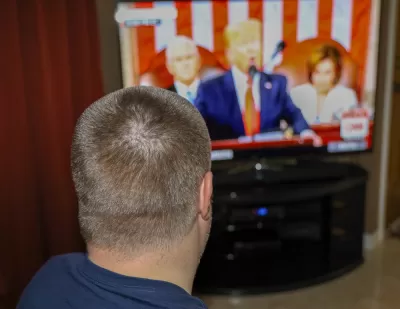
"During an address delivered on the eve of the final day of his Senate impeachment trial, the focus of the president’s infrastructure messaging was a five-year highway reauthorization measure that left key questions about long-term funding unanswered," reports Eugene Mulero for Transport Topics.
“We must also rebuild America’s infrastructure,” Trump said Feb. 4 before asking the lawmakers to pass Sen. John Barrasso’s highway bill to “invest in new roads, bridges and tunnels all across our land.”
Last year, Barrasso, a Wyoming Republican and chairman of the Environment and Public Works Committee, led the bipartisan passage of a measure meant to update the 2015 FAST Act highway law.
[See Planetizen: Climate Gets a Mention in First Committee's Approval of Federal Transportation Bill, Aug 1, 2019]
The FAST Act expires on Sept. 30 of this year, so there is some urgency to move the bill as fuel taxes will expire without the passage of either the full reauthorization or a short term extension, usually in the form of a few months, which would need to be funded. Without an increase in fuel taxes, the Mass Transit Account will be exhausted in 2021, with the Highway Account to follow in 2022, according to the Peter G. Peterson Foundation.
"While the Senate bill proposed $287 billion, a climate change plan and an aggressive streamlining of the environmental permitting process, it stopped short of addressing the Highway Trust Fund’s looming insolvency," adds Mulero. He also referenced the House Democrats' $760 billion infrastructure plan, proposed without funding, which "they said was dependent on the president’s input on highway funding."
Democrats' response
"In the Democrats’ formal response to the State of the Union, Michigan Gov. Gretchen Whitmer highlighted congressional Democrats’ recent big-picture infrastructure plan," adds Mulero. "She also noted legislatures in states such as Illinois and New Jersey, which opted to rehabilitate transportation corridors and multimodal facilities." ABC News has the 10+ minute video; Michigan Radio the transcript.
“All across the country, Democratic leaders are rebuilding bridges, fixing roads, expanding broadband and cleaning up drinking water. Everyone in this country benefits when we invest in infrastructure,” Whitmer said.
Why Whitmer?
"The choice highlights the central role Michigan and the industrial Midwest are expected to play in the presidential election this year," reported Rick Pluta of Michigan Radio (NPR affiliate).
House Speaker Nancy Pelosi and Senate Democratic Leader Chuck Schumer announced Whitmer will deliver the response and described her as a model to be emulated. Their statement praised Whitmer’s work for clean drinking water in the wake of the Flint water crisis.
Also, her still-unfulfilled campaign promise to “fix the damn roads” in a state where under-investment and freeze-and-thaw weather cycles wreak havoc on asphalt and concrete.
The reason for Whitmer's lack of progress on the campaign promise to fix roads is not at all uncommon—raising transportation funding is never easy, particularly when state government is divided. Whitmer has been pushing a 45-cents per gallon gas tax increase, while the Republicans, who control both chambers of the legislature, have resisted it.
See NPR's annotated transcript of Whitman's response for fact check, commentary, and analysis. In addition to infrastructure, Whitman addressed health care and education.
Related in Planetizen:
-
Democrats Reveal a $760 Billion Transportation Framework, January 30, 2020
FULL STORY: President Trump Calls On Congress to Advance Sen. Barrasso’s Highway Bill

Federal Lawmakers Target Electric Vehicles in Transportation Reauthorization
How will motorists who don't pay gas taxes fund road upkeep? That's one of the questions that the Senate Environment & Public Works Committee hopes to answer this summer as they work to reauthorize the FAST Act before it expires on Sept. 30, 2020.
Bipartisan Support for Federal Diesel Emissions Reduction Bill
Established in 2005 to reduce toxic diesel emissions, the Diesel Emissions Reductions Act expired in 2016. A bipartisan effort appears to be in place to see it reauthorized this year.
Senate Committee Will 'DRIVE' Transportation Reauthorization
The Senate's DRIVE Act is shaping up to be the first six-year transportation reauthorization bill since 2009. Notwithstanding the acronym, it's not all that bad, writes Tanya Snyder of Streetsblog USA. Finding funding for it is another story.

The state-sanctioned urbicide of Austin
People don’t kill cities. Freeways do.

US to reduce Colorado River water deliveries to Mexico
A new Colorado Treaty amendment reduces Mexico’s Colorado River water allocation by 250,000 acre feet.

New Jersey’s second-largest city bans standalone data centers
Jersey City will continue to allow co-location facilities, such as those meant for research institutions that store their own data.

Amtrak not solely to blame for New Jersey commuter rail's unreliability, report finds
A new study from the Garden State Initiative found that NJ Transit’s budget grew 20% across a 4 year period, but reliability declined significantly over the same period.

EPA erases limits on planet-warming pollution from power plants
Under Monday’s plan, power plants would still have some limits on how much mercury, arsenic and other contaminants they can emit.

Phoenix announces new on-demand transit service, more frequent RAPID buses
Both new services will launch in October, and are part of Phoenix's Project Effective Access Solutions for Easing Congestion.

FREE Course: Walkable City 1: Why Walkability?
After describing his path towards focusing on walkability as the essence of good planning, Jeff Speck marches through his five principal reasons for making more walkable places.
Reinventing Malls: Planning Alchemy—Turning Gray Fields Into Gold
The course focuses on the opportunities and imperatives that shape reinvention of mall sites.

Eagle County Government
Harvard University Graduate School of Design
Nashville Planning Department
The Architects Foundation
University of Cincinnati Online
The Pocatello Development Authority
The Urban Renewal Agency of the City of Pocatello
Journal of the American Planning Association