A new bill would grant the Wyoming Transportation Commission the authority to impose tolls on all lanes of over 400 miles of I-80 to fund infrastructure needs on the roadway.


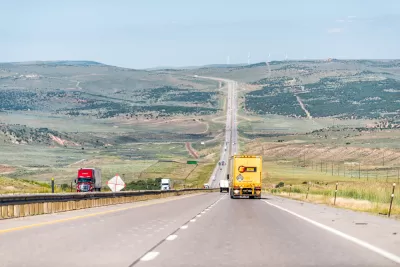
"Senate File 6 is being sponsored by the Joint Highways, Transportation and Military Affairs Committee," reports Doug Randall for KGAB News on Jan. 9. "The idea of making I-80 a toll road in Wyoming has been discussed for at least a decade, but so far no such proposal has won final approval from state lawmakers."
A shortfall in the state transportation budget prompted the committee on August 13 to narrowly endorse sponsoring a tolling proposal for Interstate 80, which was assigned a legislative file number on Dec. 10. According to Ramsey Scott, the Wyoming Tribune Eagle's state government reporter, "Wyoming first studied the idea of tolling I-80 back in 2008 and 2009, but the Legislature shelved that study and its recommendations in 2010."
[Wyoming Department of Transportation] WYDOT again studied the issue in 2017, as one of several options to make up a growing deficit in highway maintenance funding.
Committee co-chairman Sen. Michael Von Flatern, R-Gillette, has been a major proponent of tolling I-80 and said Wyoming has already spent years studying the issue. Instead, the Legislature should start to act on putting into motion a viable way to pay for infrastructure needs along I-80.
"The Wyoming Trucking Association opposes the bill and argues that truckers would simply find another route to avoid the toll," notes the source article by CDLLife.com, an online initiative supportive of truck drivers.
The Wyoming Department of Transportation currently spends around $60 million per year on maintaining I-80, but they say that they need another $40 million per year to maintain the interstate infrastructure.
The article also included key parts of the legislation:
The tolled configuration will allow interstate 80 to be maintained and to be operated in a way that will reduce traffic congestion, delays, hazards, injuries and fatalities. To carry out these purposes, it is necessary to authorize the Wyoming transportation commission, with legislative oversight, to create and supervise a tolling program within the department of transportation to impose tolls...
Federal approval needed
State departments of transportation are prohibited from adding tolls to interstate highways without approval from the Federal Highway Administration (FHWA). From the August post:
Should the tolling legislation pass next year, WYDOT would likely apply for a waiver under the Interstate System Reconstruction and Rehabilitation Pilot Program to "fund needed reconstruction or rehabilitation on Interstate corridors that could not otherwise be adequately maintained or functionally improved without the collection of tolls" (per FHWA).
Pennsylvania's application to FHWA
Wyoming is not the first state to consider tolling Interstate 80, which crosses the nation from San Francisco to Teaneck, New Jersey. Over a decade ago, Pennsylvania applied to FHWA, also under the Interstate System Reconstruction and Rehabilitation Pilot Program to fund reconstruction, plus more spending.
"In July 2007, Governor Ed Rendell [D] signed Act 44 into law, requiring the Pennsylvania Turnpike Commission to provide annual payments to PennDOT to help fund projects and transit operation in every county in the state," notes the commission's webpage on the legislation.
Under Act 44, Pennsylvania made an application to the Federal Highway Administration for permission to place tolls (I-80). The Commission was to install and manage toll collection on I-80. The tolls would have funded I-80’s reconstruction and funded Commission payments to PennDOT.
In April 2010, the FHWA declined Pennsylvania's request "because the application did not meet the federal requirement that toll revenues be used exclusively for the facility being tolled," notes the FHWA press release.
Wyoming's SF 6 explicitly requires that all toll revenues received from the project shall be deposited into a special account and that they "shall be expended only for the repayment of debt for the project."
The Wyoming legislature convenes February 10 for a budget session.
The August post also updated interstate tolling proposals in Oregon, Virginia, Wisconsin, Indiana, Connecticut, and Rhode Island.
Additional reading:
- Wyoming bill would greenlight I-80 tolls, Land Line, Dec. 26, 2019
- Five questions on toll roads with Wyoming Senator Michael Von Flatern, Cowboy State Daily, October 2, 2019
Related in Planetizen:
-
Wyoming Reports Road Improvements From 10-Cent Gas Tax Increase, October 5, 2014
- Interstate Tolling, the Third Rail of Transportation User Fees, Finds Fans, August 2, 2013
- 'Keep Freeways Free' Legislation Introduced (in response to Pennsylvania legislation to toll I-80), February 24, 2009
Read the full story: Wyoming lawmakers plot to add tolls on I-80
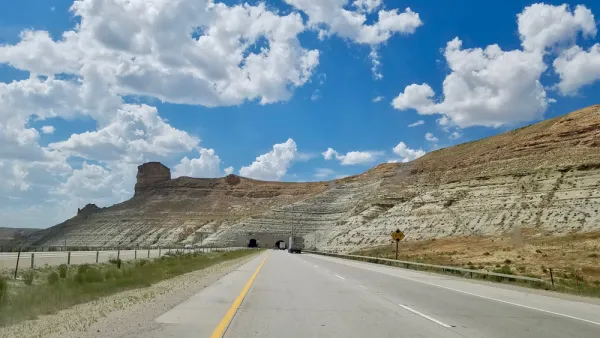
High Cost of Maintenance Prompts Wyoming Legislators to Consider Tolling I-80
Over the objections of the oil and trucking industries, an interim committee voted to allow the Wyoming legislature to determine whether to toll all lanes on Interstate 80 due to a shortfall in the state transportation budget.
Tolls, Not Gas and Sales Taxes, Will Fund I-81 Improvements in Virginia
Democratic Gov. Ralph Northam announced he is backing Republican legislation to toll all lanes of Interstate 81 to fund $2.2 billion in improvements along the 325-mile corridor, heavily used by trucks, from West Virginia to Tennessee.
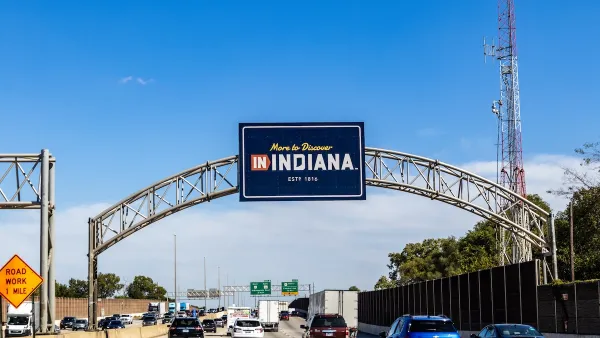
Indiana Proposes Tolls on Interstate Freeways
If the state’s request is approved by the FHWA, it would be the first to charge tolls on interstates within its borders.

Planetizen Federal Action Tracker
A weekly monitor of how Trump’s orders and actions are impacting planners and planning in America.

California plans to bury El Niño’s downpour
If the state plays its cards right, it may be able to store a billion acre-feet of El Niño’s water in aquifers.

Desperate measures: Advocates weigh draining Lake Powell to fill Colorado River
Draining the reservoir could reduce evaporation losses by a couple hundred thousand acre-feet.

Chicago voters approve permanent festival grounds, penalty for vacant property owners
Currently, major summer and fall festivals take over public parks for weeks at a time, drawing criticism from nearby residents

NYC votes to cut outdoor dining red tape, speed up permitting
New York City also voted to allow the Department of Transportation to begin work on urgent projects before notifying elected officials.

California appears to reject Prop. 45
The proposition would have expanded the projects that qualify for a streamlined environmental review, effectively paring down the California Environmental Quality Act.

FREE Course: Walkable City 1: Why Walkability?
After describing his path towards focusing on walkability as the essence of good planning, Jeff Speck marches through his five principal reasons for making more walkable places.
Reinventing Malls: Planning Alchemy—Turning Gray Fields Into Gold
The course focuses on the opportunities and imperatives that shape reinvention of mall sites.

City of Rosemead
Rutgers University, Edward J. Bloustein School of Planning and Public Policy
One Hundred Miles
Hunter College, City University of New York (CUNY)
The Architects Foundation
University of Cincinnati Online
City of Cambridge
Montrose County
The Pocatello Development Authority