An elevated highway destroyed an African American community in Syracuse, New York. Is just removing it enough?


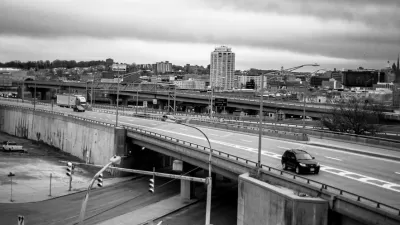
Robert Samuels reports on possible plans to bring down a section of Interstate 81, an elevated highway in Syracuse, New York. African Americans started moving to the city’s south side in the 1900s, and the area was a thriving community. However, redlining eventually led to disinvestment and blight.
In the late 1950s, large swaths of the south side were razed to clear land for construction of the interstate highway system. "Homes and wealth were lost. Ninety percent of the structures in the 15th Ward were torn down, according to documents for the county’s historic society. Between 400 and 500 businesses were gone. Around 1,200 families were displaced," writes Samuels.
In the past, discussions about reparations have not focused on the impacts of infrastructure like Interstate 81. Residents say that taking down the highway is not sufficient, and community reinvestment should also be part of undoing the damage of urban renewal and other large-scale projects. "If the reparations debate in this country continues to move beyond handing out checks, the ensuing debate over Interstate 81 presages a bevy of challenges that await," notes Samuels.
Read the full story: In Syracuse, a road and reparations

Santa Monica Offers Affordable Housing to Residents Displaced by Freeway Construction
A new program seeks to make restitution for the damage inflicted on Black communities by highway construction and urban renewal.
How Federal Funds Can Benefit Freeway Removal Projects
The recently passed infrastructure bill dedicates $1 billion to freeway removal and capping, but the sum is only a 'first step' toward redressing the injustices perpetuated by urban highway projects.
The Foundational Myth of America's Interstate Highway System
The erroneous belief that the negative impacts of interstate highways are simply "unintended consequences" fails to demand accountability for the project's failures.

Planetizen Federal Action Tracker
A weekly monitor of how Trump’s orders and actions are impacting planners and planning in America.

California plans to bury El Niño’s downpour
If the state plays its cards right, it may be able to store a billion acre-feet of El Niño’s water in aquifers.

Chicago breaks ground on $3 billion megadevelopment
The new neighborhood, titled Foundry Park, will one day host 3,700 residences.

Satanic Place Names
From streams and lakes to valleys and canyons, I mapped more than 1,000 places named after the Devil.

California High-Speed Rail Authority CEO resigns after $600,000 scandal
Under Ian Choudri, the authority used taxpayer dollars to fund first class flights and trips to nightclubs.

Want to study the Missouri River? Soon, you may need unanimous approval from 10 states
Legislation would require 10 governors’ permission to study or build projects moving water outside the basin.

FREE Course: Walkable City 1: Why Walkability?
After describing his path towards focusing on walkability as the essence of good planning, Jeff Speck marches through his five principal reasons for making more walkable places.
Reinventing Malls: Planning Alchemy—Turning Gray Fields Into Gold
The course focuses on the opportunities and imperatives that shape reinvention of mall sites.

City of Rosemead
Rutgers University, Edward J. Bloustein School of Planning and Public Policy
One Hundred Miles
Hunter College, City University of New York (CUNY)
The Architects Foundation
University of Cincinnati Online
City of Cambridge
Montrose County
The Pocatello Development Authority