A new program seeks to make restitution for the damage inflicted on Black communities by highway construction and urban renewal.


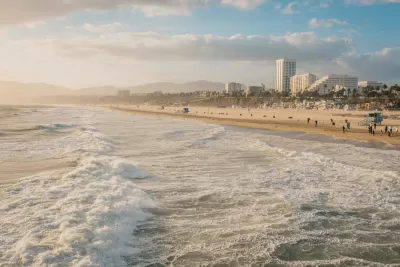
In yet another acknowledgement of the harm done to predominantly Black communities by more than a half-century of urban renewal and freeway construction programs, the beachside city of Santa Monica "will offer affordable housing to those forced out by freeway construction and those removed in the late 1950s when the city bulldozed another Black area, Belmar Triangle, to build the Santa Monica Civic Auditorium." As reported by Liam Dillon, the program will give preference on the city's affordable housing wait list to qualifying families, including the children and grandchildren of displaced residents.
"Nationwide, more than 1 million people lost their homes in just the first two decades of interstate construction alone. Early on, highway planners targeted many Black neighborhoods for destruction, and displaced families often received little compensation." But while the program is an important step, city leaders acknowledge it can't make up for the loss of homes, livelihoods, and generational wealth caused by displacement.
Elsewhere in the country, the city of Evanston, Illinois has created a reparations program for Black residents, and Portland, Oregon offers priority in the city's affordable housing programs to families who experienced displacement in that city, while a proposed bill in the California state legislature would ban freeway expansion in historically underserved communities.
FULL STORY: Santa Monica’s message to people evicted long ago for the 10 Freeway: Come home


California Bill Could Ban Freeway Expansions in Underserved Neighborhoods
A proposed bill in the California State Legislature would bar the state from funding road construction in communities at risk for displacement and health impacts.
How Federal Funds Can Benefit Freeway Removal Projects
The recently passed infrastructure bill dedicates $1 billion to freeway removal and capping, but the sum is only a 'first step' toward redressing the injustices perpetuated by urban highway projects.
Dead End: Nine Highways Ready for Retirement
The Freeways Without Futures report describes the nation’s most promising highway removal proposals.

Planetizen Federal Action Tracker
A weekly monitor of how Trump’s orders and actions are impacting planners and planning in America.

The state-sanctioned urbicide of Austin
People don’t kill cities. Freeways do.

US to reduce Colorado River water deliveries to Mexico
A new Colorado Treaty amendment reduces Mexico’s Colorado River water allocation by 250,000 acre feet.

Baltimore to break ground on $50 million Transit Priority Project
The project will bring faster bus trips, safer streets and better bike connections to Baltimore.

Airbnb launches $250 million 'last-dollar financing' housing accelerator, makes first investment in Austin
The company will put $6.4 million towards affordable housing development in Texas’ capital.

Guerilla urbanists are building DIY bus stop benches in Chicago
A before-and-after of one of the bus stops with a new bench. The new benches are not officially sanctioned or permitted, but the residents who placed them hope they will be the start of a network of DIY benches across the city.

FREE Course: Walkable City 1: Why Walkability?
After describing his path towards focusing on walkability as the essence of good planning, Jeff Speck marches through his five principal reasons for making more walkable places.
Reinventing Malls: Planning Alchemy—Turning Gray Fields Into Gold
The course focuses on the opportunities and imperatives that shape reinvention of mall sites.

Eagle County Government
Harvard University Graduate School of Design
Nashville Planning Department
The Architects Foundation
University of Cincinnati Online
The Pocatello Development Authority
The Urban Renewal Agency of the City of Pocatello
Journal of the American Planning Association