Multiple sources analyze the green credentials of the campaign platforms of the remaining field of Democrats vying for the highest office in the land and find one conspicuous absence: plans for reducing driving.


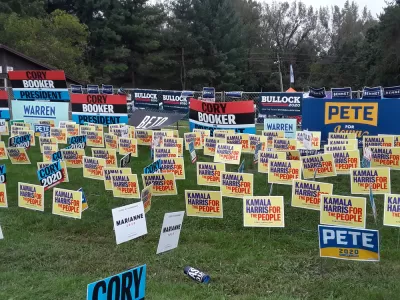
A post written by Emily Mangan for the Transportation for America blog digs into the climate plans of the remaining Democratic candidates for president to see if there's substance on the subject of transportation achieve meaningful reductions in greenhouse gas emissions. Mangan's verdict: Democratic candidates aren't doing nearly enough to address emissions by focusing on improvements to transportation technology.
"Emissions won’t drop fast enough if we pin all our hopes on EVs," writes Mangan. "We need to reduce the amount and distance people drive through better land use and by promoting transit, walking, and biking. Today, our federal policy incentivizes high speed, long distance driving—rewarding states that increase both with more money—and makes it far too difficult to build communities which provide people with transportation choice."
The analysis shared by Mangan lists the positions of the eight leading contenders for the Democratic nomination on each of the following agendas: electrifying vehicles, reducing driving, promoting bikeable and walkable communities, investing in transit, and supporting passenger rail. One thing all candidates have in common:
These plans are all missing any meaningful discussion and understanding of how land use and transportation are inextricably linked, likely because we tend to think that the federal government plays no role in land use decisions.
But federal transportation policy drives local land use decisions. Where we build roads and highways influences where developers build houses and stores. When we give states a blank check to build a new highway while giving them a minuscule amount for transit (if they can jump through all the regulatory hoops we apply to transit funding), we’re encouraging more sprawl. As houses, businesses, parks, and other daily destinations spread everyday apart, people are forced to drive further and further [sic], increasing our emissions in the process.
A separate article by Michael Hobbs for the Huffington Post examines similar themes, calling the Democrats' lack of attention to transportation as a leading source of greenhouse gas emissions a "baffling blind spot."
Noting how American exceptionalism manifest in car culture, Hobbs writes that the country's "unique enthusiasm for the automobile has become one of the greatest challenges to solving climate change."
Hobbs cites projections by the United Nations Intergovernmental Panel on Climate Change that calls on the United States to both electrify its private vehicle fleet and significantly reduce driving—just as Transportation fro America does above. More endemic sources of expertise also back up the appeal: "In 2018, the California Air Resources Board estimated [pdf] that even a tenfold increase in electric vehicle sales would still require residents to drive 25 percent fewer miles each year to reach the state’s emissions targets."
The Democratic candidates for president aren't the only way politicians are failing the need to reduce driving to achieve the goals of transportation. Hobbs also notes that the $287 billion highway bill [pdf] that passed out of the Senate Environment and Public Works Committee, with the support of Green New Deal co-sponsor Sen. Ed Markey (D-Mass.), only devotes $ billion to the maintenance of existing roads—the rest goes to new construction, which encourages people to drive more.
Elaborating on these themes, Hobbs also gets to the brass tacks of why Democrats aren't talking about reducing car use: because it's politically unpopular.
FULL STORY: Do climate plans do enough on transportation?


Town Hall Spotlights Democrats' Climate Change Proposals
Critics of the earliest Democratic candidate debates have noted a conspicuous lack of substantive and concentrated discussion on one of the great existential threats of the era: climate change. Neglect of the subject could change soon.
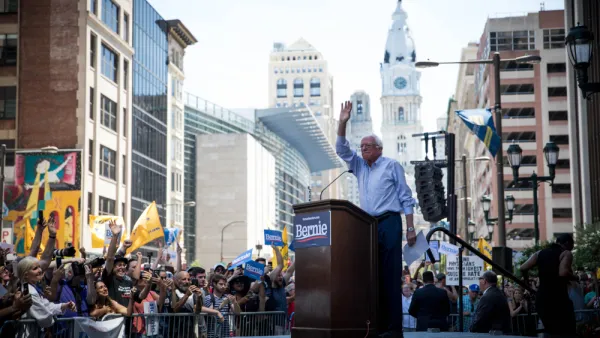
Message to Candidates: Don't Forget Car Dependence When Tackling Fossil Fuels
Car dependence will have to end for the most ambitious climate plans put forward by Democratic candidates for president to have the desired effect.
Urban Planning and the Democratic Debate Field
The Democratic Party will hold a two-day debate event, starting tonight. It's time to brush up on the positions of the leading candidates on policies and politics relate to housing, climate change, and infrastructure.

The state-sanctioned urbicide of Austin
People don’t kill cities. Freeways do.

US to reduce Colorado River water deliveries to Mexico
A new Colorado Treaty amendment reduces Mexico’s Colorado River water allocation by 250,000 acre feet.

New Jersey’s second-largest city bans standalone data centers
Jersey City will continue to allow co-location facilities, such as those meant for research institutions that store their own data.

Amtrak not solely to blame for New Jersey commuter rail's unreliability, report finds
A new study from the Garden State Initiative found that NJ Transit’s budget grew 20% across a 4 year period, but reliability declined significantly over the same period.

EPA erases limits on planet-warming pollution from power plants
Under Monday’s plan, power plants would still have some limits on how much mercury, arsenic and other contaminants they can emit.

Phoenix announces new on-demand transit service, more frequent RAPID buses
Both new services will launch in October, and are part of Phoenix's Project Effective Access Solutions for Easing Congestion.

FREE Course: Walkable City 1: Why Walkability?
After describing his path towards focusing on walkability as the essence of good planning, Jeff Speck marches through his five principal reasons for making more walkable places.
Reinventing Malls: Planning Alchemy—Turning Gray Fields Into Gold
The course focuses on the opportunities and imperatives that shape reinvention of mall sites.

Eagle County Government
Harvard University Graduate School of Design
Nashville Planning Department
The Architects Foundation
University of Cincinnati Online
The Pocatello Development Authority
The Urban Renewal Agency of the City of Pocatello
Journal of the American Planning Association