Move over Minneapolis. An Indiana college town joins the avant-garde of planning innovation by nearing the finish line with a new Unified Development Ordinance that would allow duplexes, triplexes, and fourplexes in single-family neighborhoods.


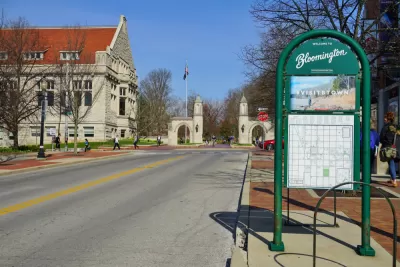
"The battle of the '-plexes' carried on Tuesday as Bloomington residents debated the appropriateness of du-, tri- and quadplexes in traditionally single-family neighborhoods," according to an article by Kurt Christian in an article that is behind a paywall.
The Bloomington, Indiana City Council is considering a new Unified Development Ordinance (UDO) to overhaul it's planning vision and enforcement tools, with assistance from Clarion Associates. The Bloomington Plan Commission has already voted unanimous support for the UDO.
For coverage of the UDO process that isn't hidden behind a paywall, see an article by Alex Eady from Mary 2019, when controversy was already dogging the UDO process.
The city of Bloomington's efforts to allow new density in single-family residential neighborhoods places the college town among the avant-garde of cities (Minneapolis was the first example) and states (like Oregon) allowing for multiple units to be built on parcels previously zoned exclusively for single-family zoning.
Bloomington's website for the UDO update includes a lot of information about the status of the process, recent amendments, and remaining steps for full adoption and implementation.
Read the full story: Debate over prevalence of multiplex development rages on


Missing Middle Density Will Take More Than Zoning Changes
Looking for change in the housing supply? "Don't stop at the zoning code and think you're done. There's so much work left to do."

Zoning Reforms Underwhelm in Minneapolis as Development Market Holds Course
As one of the first city's to comprehensively allow for residential density, Minneapolis was probably hoping for more than what it's achieved so far.
Connecting Sprawl to Inequality and Climate Change
The consequences of more than a century of planning and zoning are gaining more attention in the media as the country struggles through a pandemic. Will these lessons win new political support for more density in residential neighborhoods?

Planetizen Federal Action Tracker
A weekly monitor of how Trump’s orders and actions are impacting planners and planning in America.

California plans to bury El Niño’s downpour
If the state plays its cards right, it may be able to store a billion acre-feet of El Niño’s water in aquifers.

Desperate measures: Advocates weigh draining Lake Powell to fill Colorado River
Draining the reservoir could reduce evaporation losses by a couple hundred thousand acre-feet.

How a Chicago-sized wind farm beat the odds and powered on
The project spanned five presidential administrations and a standoff with a U.S. military base.

MTA gives itself 30 days to transform pit into basketball court
The site has been under construction since 2022; the city originally estimated it would finish the court in 2024.

Non-stop party: Chicago voters weigh permanent festival grounds
A stable place for bleachers, stages and drainage may streamline the setup and teardown of large events.

FREE Course: Walkable City 1: Why Walkability?
After describing his path towards focusing on walkability as the essence of good planning, Jeff Speck marches through his five principal reasons for making more walkable places.
Reinventing Malls: Planning Alchemy—Turning Gray Fields Into Gold
The course focuses on the opportunities and imperatives that shape reinvention of mall sites.

City of Rosemead
Rutgers University, Edward J. Bloustein School of Planning and Public Policy
One Hundred Miles
Hunter College, City University of New York (CUNY)
The Architects Foundation
University of Cincinnati Online
City of Cambridge
Montrose County
The Pocatello Development Authority