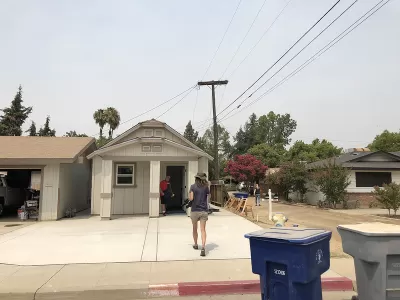
For years, the California legislators have been passing bills to allow accessory dwelling units on single-family residential lots. These laws haven't attracted the same attention as other failed laws, but their effect is significant.


Liam Dillon explains the below-the-radar approach to achieving new density statewide in California—instead of the measures proposed by failed legislation that would force dense zoning around transit lines, like SB 827 in 2018 and SB 50 in 2019.
Over the past four years, according to Dillon, "a suite of smaller proposals has quietly chipped away at zoning only for single-family homes, attracting comparably little blowback."
The most recent of these (comparably) consequential but (relatively) clandestine laws were signed by California Governor Gavin Newsom on October 9, 2019. The new laws include "legislation that will allow property owners to build a backyard home of at least 800-square-feet as well as convert a garage, office or spare room into a third living space."
So it might now be as direct as the new comprehensive plan that will allow for three-plexes in all of Minneapolis, but the effect is the same. "The result is a patchwork of legislation that achieves much of what those pushing for more growth in the state have long wanted, allowing as many as three homes on parcels in most single-family neighborhoods across California," writes Dillon.
Ben Metcalf, former director of the state’s Department of Housing and Community Development, is quoted in the article saying the effect of this patchwork has brought the state to the "precipice of single-family zoning functionally not existing."
Dillon also cites Los Angeles as an example of the power that legislation to legalize the construction of accessory dwelling units can have on the building industry: "In Los Angeles, annual permit applications for backyard homes have increased more than 2,000% since the initial state laws took effect. Since 2017, the city has received almost 13,300 requests to build the units."
More specific details of one of the bills signed by Governor Newsom, AB 881, can be found in a separate article by Madeleine Pauker.
FULL STORY: How lawmakers are upending the California lifestyle to fight a housing shortage


Scott Wiener Hasn't Quit the Statewide Density Cause Yet
California State Senator has released draft legislation to follow up on the previous SB 50, which in turn followed up on SB 827. The new bill, SB 902, promises a "light touch."
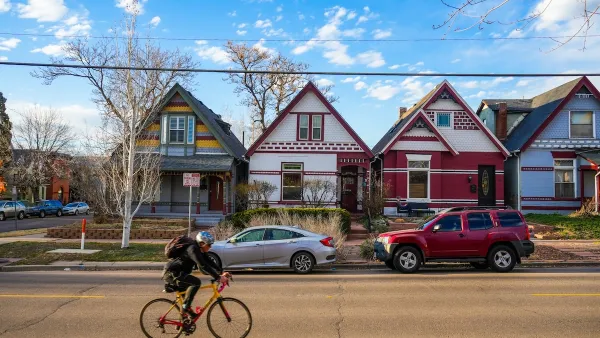
Amidst Colorado Affordability Crisis, Just 3% of Residential Land Zoned for Multifamily Housing
A new report suggests loosening restrictive zoning laws on multifamily development could help bring down high housing costs.
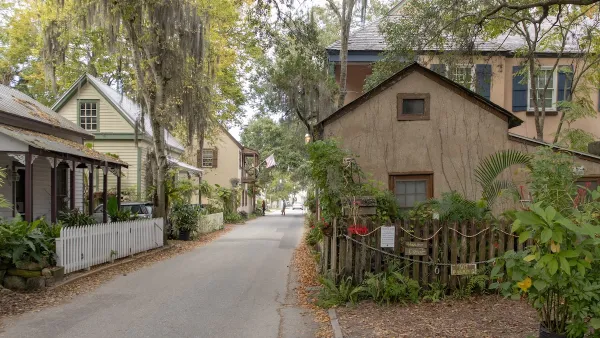
Florida Considers Legalizing ADUs
Current state law allows — but doesn’t require — cities to permit accessory dwelling units in single-family residential neighborhoods.

Planetizen Federal Action Tracker
A weekly monitor of how Trump’s orders and actions are impacting planners and planning in America.

The state-sanctioned urbicide of Austin
People don’t kill cities. Freeways do.

US to reduce Colorado River water deliveries to Mexico
A new Colorado Treaty amendment reduces Mexico’s Colorado River water allocation by 250,000 acre feet.

5 New England states march closer to 800 megawatt wind energy project
Securing federal approval for the project may be complicated under the Trump administration, which has historically been hostile towards domestic wind power.

Baltimore to break ground on $50 million Transit Priority Project
The project will bring faster bus trips, safer streets and better bike connections to Baltimore.

Airbnb launches $250 million 'last-dollar financing' housing accelerator, makes first investment in Austin
The company will put $6.4 million towards affordable housing development in Texas’ capital.

FREE Course: Walkable City 1: Why Walkability?
After describing his path towards focusing on walkability as the essence of good planning, Jeff Speck marches through his five principal reasons for making more walkable places.
Reinventing Malls: Planning Alchemy—Turning Gray Fields Into Gold
The course focuses on the opportunities and imperatives that shape reinvention of mall sites.

Eagle County Government
Harvard University Graduate School of Design
Nashville Planning Department
The Architects Foundation
University of Cincinnati Online
The Pocatello Development Authority
The Urban Renewal Agency of the City of Pocatello
Journal of the American Planning Association