"I realize that we are in crisis politically as well as sustainably. But…"



In a controversial decision earlier this month, the Washington, D.C. Historic Preservation Review Board decided against allowing front-facing solar panels on the sloped roofs of rowhomes.
David Alpert reports on the debate that took place during the hearing, noting the board's attempt at reconciling historic preservation and the climate crisis. Washington, D.C. has a new clean energy law, "[requiring] the District to reach 100% renewable energy by 2032 including 10% from locally-generated solar power." That wasn't enough to sway the board's decision in favor of allowing solar power on sloped roofs.
It's fairly clear how Alpert feels about the decision, and the talking points of the residents and board members who opposed the proposal (there is no shortage of rhetorical gymnastics in the soundbites included in the article). There's a call to action include toward the end of the article: "Barring action from the DC Council or stronger intervention by the Bowser administration, residents may have to make their voices heard when the preservation offices releases new guidelines [sic] in the coming weeks. Calcott said they anticipate a hearing before HPRB in December."
FULL STORY: Grappling with the climate crisis, DC’s preservation board rejects front-facing solar panels

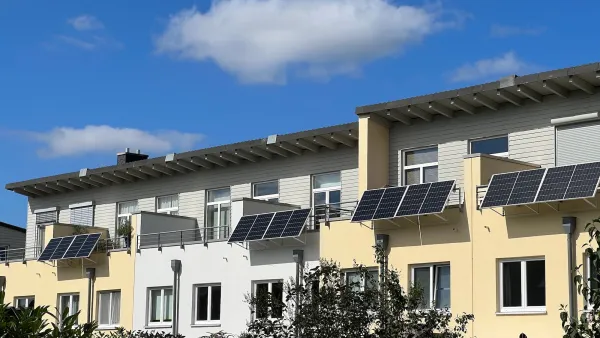
28 States and DC Could Legalize ‘Balcony Solar’
Plug-in solar panels, which are becoming popular across Europe, live in a regulatory gray area in the United States.
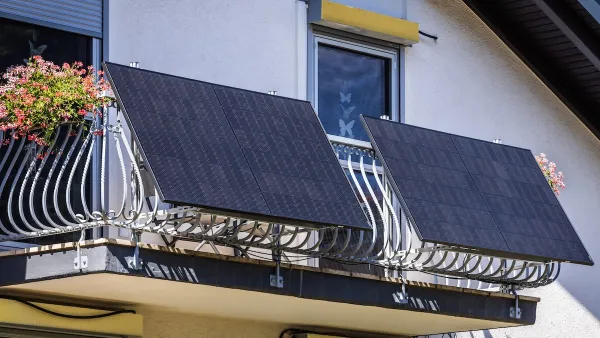
Bay Area Embraces ‘Balcony Solar’
Popular in Germany, wall- or balcony-mounted solar panels come at a lower cost and face fewer regulatory hurdles than rooftop solar, but their legal status in California is murky.
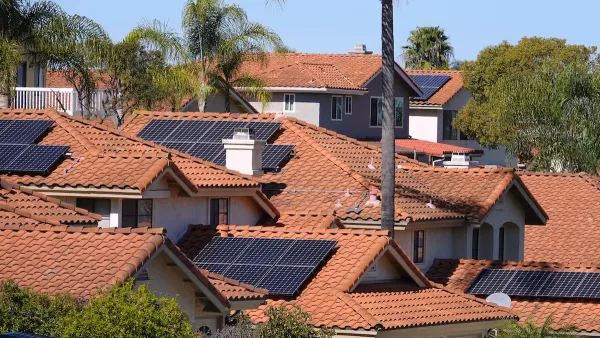
California Leads in Solar Rooftops
A combination of state and local incentives and building code mandates has helped California far outpace other states in residential rooftop solar permits.

Planetizen Federal Action Tracker
A weekly monitor of how Trump’s orders and actions are impacting planners and planning in America.

The state-sanctioned urbicide of Austin
People don’t kill cities. Freeways do.

US to reduce Colorado River water deliveries to Mexico
A new Colorado Treaty amendment reduces Mexico’s Colorado River water allocation by 250,000 acre feet.

Mamdani overhauls NYC's Vision Zero plan with 100 new policy goals
The overhaul aims to reduce traffic deaths and make streets safer for pedestrians, cyclists and drivers through lower speed limits, new safety infrastructure and more.

Amtrak not solely to blame for New Jersey commuter rail's unreliability, report finds
A new study from the Garden State Initiative found that NJ Transit’s budget grew 20% across a 4 year period, but reliability declined significantly over the same period.

EPA erases limits on planet-warming pollution from power plants
Under Monday’s plan, power plants would still have some limits on how much mercury, arsenic and other contaminants they can emit.

FREE Course: Walkable City 1: Why Walkability?
After describing his path towards focusing on walkability as the essence of good planning, Jeff Speck marches through his five principal reasons for making more walkable places.
Reinventing Malls: Planning Alchemy—Turning Gray Fields Into Gold
The course focuses on the opportunities and imperatives that shape reinvention of mall sites.

Eagle County Government
Harvard University Graduate School of Design
Nashville Planning Department
The Architects Foundation
University of Cincinnati Online
The Pocatello Development Authority
The Urban Renewal Agency of the City of Pocatello
Journal of the American Planning Association