Transportation for America, one of the leading advocacy organizations for multi-modal funding at the federal level, has announced a drastic change to its agenda.


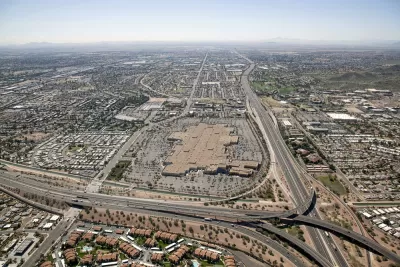
"Transportation for America is no longer asking Congress to provide an increase in money for [the] federal transportation program."
That's the perhaps surprising revelation at the heart of a recent article by Beth Osbourne, who also states the reasoning behind the announcement:
Why in the world would we just pour more money into a program that is “devoid of any broad, ambitious vision for the future, and [in which] more spending has only led to more roads, more traffic, more pollution, more inequality, and a lack of transportation options,” as I wrote in the Washington Post during Infrastructure Week?
What the program should be about is accountability to the American taxpayer—making a few clear, concrete, measurable promises and then delivering on them. The program should focus on what we’re getting for the funds we’re spending—not simply whether or not money gets spent and how much there was.
Osbourne promises more details about the organization's new principles next week.
FULL STORY: Why we are no longer advocating for Congress to increase transportation funding

New for 2019: A Congressional Caucus for Public Transit
A new congressional caucus has been formed under the assumption that federal transportation policy is regressive and discriminatory.
Report: Caltrans Models, Which Guide Billions in Transportation Funding, are Inaccurate and Outdated
Many of the predictive models used by California’s transportation agency fail to account for post-pandemic travel patterns and induced demand.
Freedom to Move: Investing in Transportation Choices for a Clean, Prosperous, and Just Future
This Union of Concerned Scientists study examines why and how to improve resource-efficient travel options to achieve diverse goals. It estimates that more efficient transport could save up to $201 billion in energy and $128 billion in health costs.

Planetizen Federal Action Tracker
A weekly monitor of how Trump’s orders and actions are impacting planners and planning in America.

The state-sanctioned urbicide of Austin
People don’t kill cities. Freeways do.

US to reduce Colorado River water deliveries to Mexico
A new Colorado Treaty amendment reduces Mexico’s Colorado River water allocation by 250,000 acre feet.

5 New England states march closer to 800 megawatt wind energy project
Securing federal approval for the project may be complicated under the Trump administration, which has historically been hostile towards domestic wind power.

Baltimore to break ground on $50 million Transit Priority Project
The project will bring faster bus trips, safer streets and better bike connections to Baltimore.

Airbnb launches $250 million 'last-dollar financing' housing accelerator, makes first investment in Austin
The company will put $6.4 million towards affordable housing development in Texas’ capital.

FREE Course: Walkable City 1: Why Walkability?
After describing his path towards focusing on walkability as the essence of good planning, Jeff Speck marches through his five principal reasons for making more walkable places.
Reinventing Malls: Planning Alchemy—Turning Gray Fields Into Gold
The course focuses on the opportunities and imperatives that shape reinvention of mall sites.

Eagle County Government
Harvard University Graduate School of Design
Nashville Planning Department
The Architects Foundation
University of Cincinnati Online
The Pocatello Development Authority
The Urban Renewal Agency of the City of Pocatello
Journal of the American Planning Association