There won't be many places left to sleep for the massive population of homeless living in the city of Los Angeles.


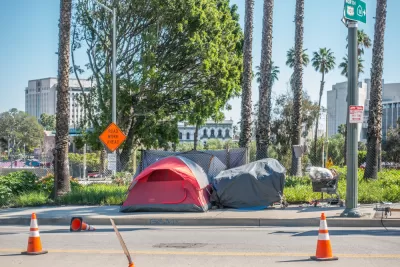
"A plan under consideration at City Hall would ban sleeping on streets and sidewalks within 500 feet of schools, parks, day-care facilities and some popular venues, eliminating at least a quarter of Los Angeles for homeless people trying to bed down at night," according to an L.A. Times feature by Matt Stiles, Ryan Menezes, and Emily Alpert Reyes.
The article includes an interactive map to illustrate the scope of the law, created by analysis performed by the L.A. Times team. In the whole city, there are 836 parks, 1,482 public and private schools, 1,161 day-care centers, nine special venues, and 43 homeless services that would be subject to a 500-foot buffer if the law is approved.
"Taken together, the buffers cover 124 square miles, about a quarter of the city," according to the article. "The estimate almost certainly understates the proposal's full potential."
The map allows analysis in the aggregate as well as at the neighborhood level. The article provides case studies in Venice, Hollywood, Koreatown, Downtown, Skid Row, and more.
If approved, the law would be the latest legal setback for the rights of the homeless to sleep on the streets. Los Angeles recently prohibited sleeping in cars, vans, and RVs, for instance.
FULL STORY: L.A. might ban homeless people from sleeping on many streets. What about your block?

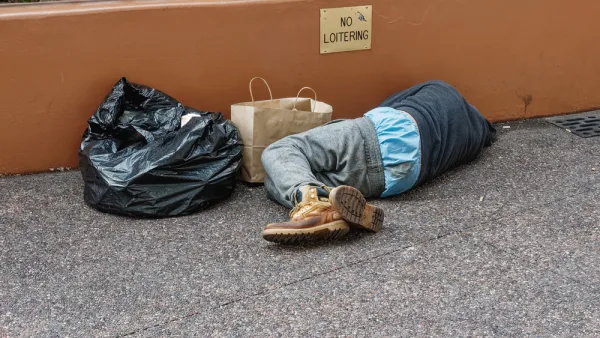
Las Vegas Approves Homeless Camping Ban
The city of Las Vegas has approved a law that prohibits the homeless from camping in large swaths of the city. The measure provoked the opposition on most of the public in attendance at a City Council hearing this week.
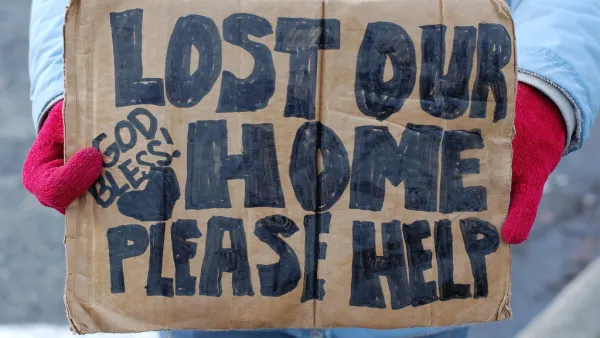
Cities Still Sweeping Away Homeless Camps, Despite Legal Challenges
Denver and Los Angeles kicked the new year off by committing to the enforcement of a sleeping ban and sweeping away a large homeless encampment, respectively.
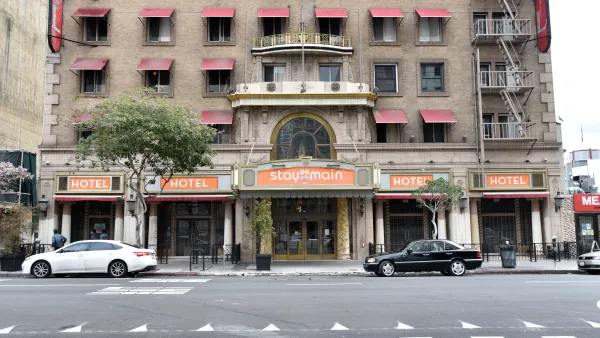
$150 Million for L.A.’s Unhoused People Go Unspent
The city returned nearly $150 million in federal funding directed to providing shelter and supportive services to the Department of Housing and Urban Development.

The state-sanctioned urbicide of Austin
People don’t kill cities. Freeways do.

US to reduce Colorado River water deliveries to Mexico
A new Colorado Treaty amendment reduces Mexico’s Colorado River water allocation by 250,000 acre feet.

New Jersey’s second-largest city bans standalone data centers
Jersey City will continue to allow co-location facilities, such as those meant for research institutions that store their own data.

Amtrak not solely to blame for New Jersey commuter rail's unreliability, report finds
A new study from the Garden State Initiative found that NJ Transit’s budget grew 20% across a 4 year period, but reliability declined significantly over the same period.

EPA erases limits on planet-warming pollution from power plants
Under Monday’s plan, power plants would still have some limits on how much mercury, arsenic and other contaminants they can emit.

Phoenix announces new on-demand transit service, more frequent RAPID buses
Both new services will launch in October, and are part of Phoenix's Project Effective Access Solutions for Easing Congestion.

FREE Course: Walkable City 1: Why Walkability?
After describing his path towards focusing on walkability as the essence of good planning, Jeff Speck marches through his five principal reasons for making more walkable places.
Reinventing Malls: Planning Alchemy—Turning Gray Fields Into Gold
The course focuses on the opportunities and imperatives that shape reinvention of mall sites.

Eagle County Government
Harvard University Graduate School of Design
Nashville Planning Department
The Architects Foundation
University of Cincinnati Online
The Pocatello Development Authority
The Urban Renewal Agency of the City of Pocatello
Journal of the American Planning Association