In key areas like jobs and housing, the numbers show a definite Motor City rebound since the recession. But a closer look reveals uneven gains and weakness next to state averages.


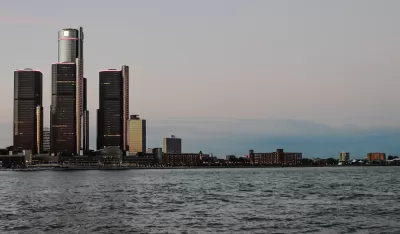
The Detroit recovery narrative depends on positive citywide trends in the years since the Great Recession, like higher home sale prices and lower jobless rates. But as John Gallagher points out, "the problem with those upbeat statistics is that the deeper we dive into the data, the less sure we are of what story data tell us."
"It's not just that data cannot capture ephemeral concepts like hope, resilience and racial justice. It's also that it's too easy to cherry-pick statistics that make one's case while ignoring inconvenient facts."
One of those facts, Gallagher writes, is that Detroit's jobless rate remains at least twice that of the state of Michigan and the nation as a whole. And most of those new jobs have emerged downtown, not across the city as a whole.
Detroit's housing market tells "a similar story." Though sale prices have risen since the recession, they're still below state averages. And while new homes are going up, "the vast majority of those new residential units being built are found in and around the downtown core, not in Detroit's distressed neighborhoods." Mortgage loans are rare or nonexistent in most parts of Detroit. Renting, cash purchases, and land contracts remain the norm.
Read the full story: Detroit can't cherry-pick statistics, ignore inconvenient facts

Dan Gilbert in His Own Words
At a recent public appearance, Dan Gilbert gave rare insight into the business success of Quicken Loans and its connection to the revitalization of Detroit.

Backers Still Optimistic on Detroit Placemaking
After three years, an ambitious placemaking plan for downtown Detroit has delivered results, but not as quickly as its architects hoped.

Economic Recovery in Legacy Cities
Americans living in legacy cities face a unique set of challenges and opportunities in recovering from the COVID-19 pandemic. Several local, state, and federal support strategies could aid these cities in recouping losses.

Planetizen Federal Action Tracker
A weekly monitor of how Trump’s orders and actions are impacting planners and planning in America.

California plans to bury El Niño’s downpour
If the state plays its cards right, it may be able to store a billion acre-feet of El Niño’s water in aquifers.

Desperate measures: Advocates weigh draining Lake Powell to fill Colorado River
Draining the reservoir could reduce evaporation losses by a couple hundred thousand acre-feet.

Mamdani’s pied-à-terre tax survives legal challenge
A panel of judges found that the plaintiffs failed to demonstrate injury as a result of New York City's implementation of the tax.

Eastern Nebraska is running out of electricity
Data centers and electrification are straining eastern Nebraska’s grid, throttling economic development.

Seattle passes record-breaking transit services expansion
Proposition 1 will double the city’s transit tax to add 95,000 more bus trips and preserve 180,000 bus trips annually.

FREE Course: Walkable City 1: Why Walkability?
After describing his path towards focusing on walkability as the essence of good planning, Jeff Speck marches through his five principal reasons for making more walkable places.
Reinventing Malls: Planning Alchemy—Turning Gray Fields Into Gold
The course focuses on the opportunities and imperatives that shape reinvention of mall sites.

City of Rosemead
Rutgers University, Edward J. Bloustein School of Planning and Public Policy
One Hundred Miles
University of Michigan School for Environment and Sustainability (SEAS)
Hunter College, City University of New York (CUNY)
The Architects Foundation
City of Cambridge
Montrose County
The Pocatello Development Authority