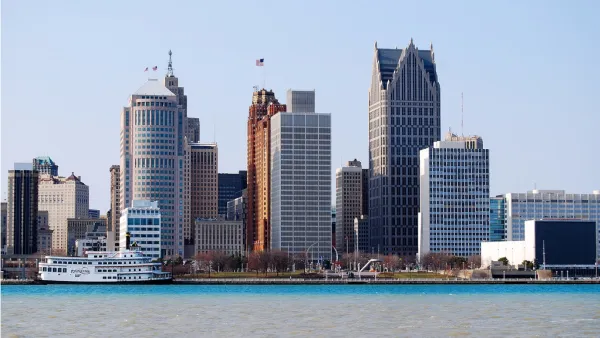
At a recent public appearance, Dan Gilbert gave rare insight into the business success of Quicken Loans and its connection to the revitalization of Detroit.



JC Reindl provides a dispatch from the proceedings at theNorth American International Auto Show at Cobo Center in downtown Detroit, where Dan Gilbert, owner of Quicken Loans and famed investor in Detroit's revitalization, sat down for a rare in-depth interview with Bloomberg's Betty Liu.
According to Rendl, the conversation went into great detail on the growth of Quicken in the mortgage industry—the company recently surpassed Wells Fargo as the largest direct-to-consumer mortgage lender in the nation.
"Yet being No. 1 in mortgages is a lot different than being tops in other industries, such as automotive. In the highly fragmented mortgage sector, where prospective borrowers can visit some 30,000 bank branches and credit unions across the country for a home loan, Quicken's commands a market share of just 5.4%," explains Reindl. Still, Gilbert hopes the company's focus on technology, exemplified by the Rocket Mortgage mobile and online brand, could help grow that market share to 10 percent.
A key aspect of the public interest in Dan Gilbert's business dealings are tied up in Detroit's interest in Dan Gilbert's business dealings. With 13,000 employees in Detroit, if Quicken sputters, so too could Detroit, according to the article.
Another angle of interest to planners is the lingering concerns about mortgage lending in the wake of the sub-prime crisis and Great Recession of a decade ago. "Some market observers have raised concerns about the possible risks and dangers of nonbank mortgage lenders, contending that such firms are vulnerable to sudden dry ups in their short-term credit lines," according to Reindl. "Gilbert insists that Quicken is well capitalized and less risky than many banks." Moody's also has faith in the company, raising Quicken's bond rating in December.
FULL STORY: How Dan Gilbert has made Quicken Loans thrive in mortgage industry


Digging Into the Data on Detroit's 'Recovery'
In key areas like jobs and housing, the numbers show a definite Motor City rebound since the recession. But a closer look reveals uneven gains and weakness next to state averages.

Backers Still Optimistic on Detroit Placemaking
After three years, an ambitious placemaking plan for downtown Detroit has delivered results, but not as quickly as its architects hoped.
Dan Gilbert's Detroit Buying Spree Continues
The Quicken Loans founder and real estate mogul now controls 78 downtown properties. His investment choices can set the tone for life in what used to be an abandoned city center.

The state-sanctioned urbicide of Austin
People don’t kill cities. Freeways do.

US to reduce Colorado River water deliveries to Mexico
A new Colorado Treaty amendment reduces Mexico’s Colorado River water allocation by 250,000 acre feet.

New Jersey’s second-largest city bans standalone data centers
Jersey City will continue to allow co-location facilities, such as those meant for research institutions that store their own data.

Amtrak not solely to blame for New Jersey commuter rail's unreliability, report finds
A new study from the Garden State Initiative found that NJ Transit’s budget grew 20% across a 4 year period, but reliability declined significantly over the same period.

EPA erases limits on planet-warming pollution from power plants
Under Monday’s plan, power plants would still have some limits on how much mercury, arsenic and other contaminants they can emit.

Phoenix announces new on-demand transit service, more frequent RAPID buses
Both new services will launch in October, and are part of Phoenix's Project Effective Access Solutions for Easing Congestion.

FREE Course: Walkable City 1: Why Walkability?
After describing his path towards focusing on walkability as the essence of good planning, Jeff Speck marches through his five principal reasons for making more walkable places.
Reinventing Malls: Planning Alchemy—Turning Gray Fields Into Gold
The course focuses on the opportunities and imperatives that shape reinvention of mall sites.

Eagle County Government
Harvard University Graduate School of Design
Nashville Planning Department
The Architects Foundation
University of Cincinnati Online
The Pocatello Development Authority
The Urban Renewal Agency of the City of Pocatello
Journal of the American Planning Association