Due to the adoption of the Zero-Emission Vehicle standard by the state's air quality commission last week, there will be a much greater selection of electric vehicles available for interested Colorado consumers. Sales should reach 5% by 2023.


Democratic Gov. Jared Polis' first executive order [pdf] issued after taking office in January was intended to get more electric vehicles (EVs) on the road. Last Friday, the Air Quality Control Commission voted 8-1 to do just that by adopting a zero-emission vehicle (ZEV) standard based on California's long-standing ZEV program.
"[W]e got it done within a few short months,” said Polis in a statement on Aug. 16 about the commission's action in response to his executive order. “It’s only the beginning. Colorado must continue to reduce smog and increase consumer choice.”
The emphasis on air quality, even more so than achieving greenhouse gas emission reduction targets, caught this correspondent by surprise as it was repeated by other officials and in much of the media coverage.
"The new zero-emission standard requires automakers to sell more than 5 percent zero-emission vehicles by 2023 and more than 6 percent zero-emission vehicles by 2025," according to the commission, a policy-making body within the Colorado Department of Public Health and Environment. "The standard is based on a matrix of credits given for each electric vehicle sold, depending on the vehicle’s zero-emission range."
“The zero-emission standard does not compel anyone to buy an electric vehicle, said Garry Kaufman, director of the Air Pollution Control Division at the department. "It only requires manufacturers to increase ZEV sales from 2.6 percent to 6.23 percent."
"[T]he standard is expected to result in manufacturers selling a wider range of models in Colorado, including SUVs and light trucks," reports Betsy Lillian editor of NGT News (source article).
Goals: Improve air quality and reduce greenhouse gas emissions
As noted above, Colorado officials and Gov. Polis stressed the importance of improving air quality, particularly "to reduce ozone pollution as quickly as possible, as the state continues to work to meet the federal ozone pollution standard," states the Air Quality Commission's press release.
“We are committed to a state where Coloradans can zip up into the mountains in a zero-emitting vehicle and go for a hike without coughing and wheezing from ozone," said John Putnam, environmental programs director at the Department of Public Health and Environment.
Western Resource Advocates led with the air quality improvements expected from the ZEV standard in their Aug. 16 article aptly titled, "Colorado Adopts Zero-Emission Vehicle Standard to Improve Air Quality and Combat Climate Change."
The U.S. Environmental Protection Agency this month announced plans to reclassify the Denver metropolitan area and northern Front Range as a “serious” violator of federal health standards due to elevated ozone levels that fail to meet air quality requirements.
Landmark climate legislation
In addition to reducing ozone pollution, the ZEV program will help to achieve the new greenhouse gas (GHG) emission-reduction goals set by House Bill 19-1261: Climate Action Plan To Reduce Pollution, signed by Gov. Polis on May 30.
Colorado shall have statewide goals to reduce 2025 greenhouse gas emissions by at least 26%, 2030 greenhouse gas emissions by at least 50%, and 2050 greenhouse gas emissions by at least 90% of the levels of statewide greenhouse gas emissions that existed in 2005.
HB19-1261 was only one of 11 clean energy bills signed by Polis at the end of May. "This has been a really great legislative session for climate and clean energy in Colorado," Sam Gilchrist, western campaigns director for the Natural Resources Defense Council, told Utility Dive. "So Colorado is really on a good path forward."
With the commission's vote, the Centennial State becomes the tenth state to adopt the California ZEV standard, reports Mark Kane for Inside EVs, joining Connecticut, Maine, Maryland, Massachusetts, New Jersey, New York, Oregon, Rhode Island, and Vermont.
California has unique authority under Section 209 of the Clean Air Act to maintain motor vehicle emission standards that are stricter than the federal standards, as long as the U.S. Environmental Protection Agency has issued a waiver, according to the Center for Climate and Energy Solutions (C2ES).
Electric pickups needed
Two news videos on the new ZEV standard appear in the Inside EVs article. CBS Denver goes beyond the ZEV program and explores potential fees on transportation network companies and encouraging them to use ZEVs. Colorado Public Television explores the political angle of the commission's vote.
"This is a big win for the governor," states Patricia Calhoun, editor of Westword, a Denver publication. "It's also a big win for whoever wants to make electric-powered trucks because that's 58 percent of (the light-duty vehicles) that people want to buy in Colorado. And you can't really get them," referring to light trucks, a category that includes SUVs, that are electrically powered.
Related in Planetizen:
-
New Colorado Governor's First Executive Order: Get More EVs on the Road, January 23, 2019
-
The States Leading the Adoption of Electric Vehicles, June 7, 2015
FULL STORY: Colorado Adopts Zero-Emission Vehicle Standard

New Colorado Governor's First Executive Order: Get More EVs on the Road
Colorado will join California and nine other states in requiring that a percentage of new light-duty vehicle sales are zero-emissions, thanks to the first executive order signed by Democratic Gov. Jared Polis on Jan. 17.
Gov. Jerry Brown Signs 16 Bills to Spur Sales of New and Used Electric Vehicles
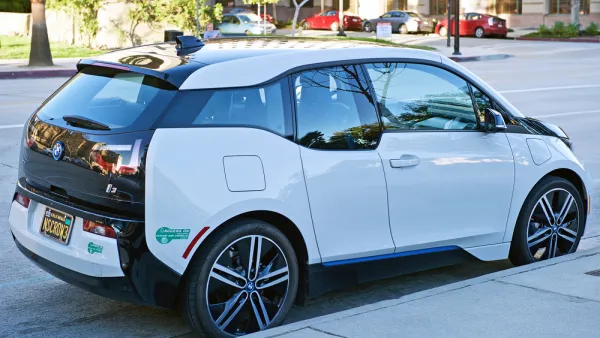
On the second day of the Global Climate Action Summit, co-host Gov. Jerry Brown signed 16 bills onboard a new plug-in hybrid electric ferry in San Francisco Bay to spur sales of zero-emission vehicles and reduce greenhouse gas emissions.
Another EPA Rollback, Tailor-Made for Gov. Walker and Southeast Wisconsin
Politics and economics win over public health in Racine County as the EPA exempted the area around the Foxconn's massive facility from meeting stricter ozone pollution standards, saving the company from investing in smog-reducing equipment.

Planetizen Federal Action Tracker
A weekly monitor of how Trump’s orders and actions are impacting planners and planning in America.

The state-sanctioned urbicide of Austin
People don’t kill cities. Freeways do.

US to reduce Colorado River water deliveries to Mexico
A new Colorado Treaty amendment reduces Mexico’s Colorado River water allocation by 250,000 acre feet.

Mamdani overhauls NYC's Vision Zero plan with 100 new policy goals
The overhaul aims to reduce traffic deaths and make streets safer for pedestrians, cyclists and drivers through lower speed limits, new safety infrastructure and more.

Amtrak not solely to blame for New Jersey commuter rail's unreliability, report finds
A new study from the Garden State Initiative found that NJ Transit’s budget grew 20% across a 4 year period, but reliability declined significantly over the same period.

EPA erases limits on planet-warming pollution from power plants
Under Monday’s plan, power plants would still have some limits on how much mercury, arsenic and other contaminants they can emit.

FREE Course: Walkable City 1: Why Walkability?
After describing his path towards focusing on walkability as the essence of good planning, Jeff Speck marches through his five principal reasons for making more walkable places.
Reinventing Malls: Planning Alchemy—Turning Gray Fields Into Gold
The course focuses on the opportunities and imperatives that shape reinvention of mall sites.

Eagle County Government
Harvard University Graduate School of Design
Nashville Planning Department
The Architects Foundation
University of Cincinnati Online
The Pocatello Development Authority
The Urban Renewal Agency of the City of Pocatello
Journal of the American Planning Association