President Donald Trump has low opinions on the state of a few very specific cities.


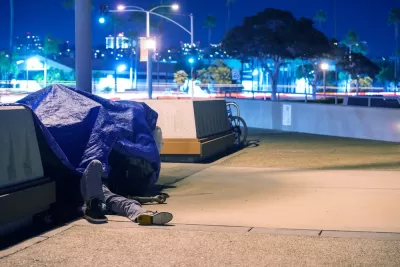
"President Trump said Monday that he wanted to address the crisis of people on the streets, telling Fox News in an interview that his administration 'may intercede' to clean up cities such as Washington, San Francisco and Los Angeles," report Eli Rosenberg and Alex Horton.
"The president made the remarks in an interview he taped in Japan with Fox News host Tucker Carlson, after Carlson asked him about cities in Japan, which Carlson said are clean and free from graffiti and junkies.' U.S. cities, by comparison, have a problem with 'filth,' Carlson noted."
The rest of the interview raised a lot of eyebrows, and made some columnists question the extent of Trump's awareness about urban policies or the state of American cities, beyond scoring political points against the Liberal leadership of cities without much concern for the people, by his own description, suffering the ills of drug addiction, mental illness, or homelessness.
Michael D. Shear, for instance, described President Trump's remarks as "puzzling," especially the part where the president said the problem started two years ago. Not only does Shear say that President Trump is wrong in his description on the history of homelessness, he's also willing to point out the Trump administration's less-than-action-packed record on the issue. "As president, Mr. Trump has given little indication that homelessness in America is a priority for his administration," writes Shear. President Trump says in the administration "may intercede and do something to get that whole thing cleaned up," but, as noted by Shear, "he did not elaborate on what actions he or the government might take," and "Officials at the White House and the Department of Housing and Urban Development declined to comment on what the president was talking about."
FULL STORY: Trump paints a dark picture of homelessness in cities: ‘We may intercede’

White House Report on 'The State of Homelessness in America' Criticized
Shortly after a tumultuous visit to California focusing on the homelessness crisis in San Francisco and Los Angeles, Trump administration has released a report on homelessness that is already facing criticism.
Managing Unsheltered Homelessness in San Jose
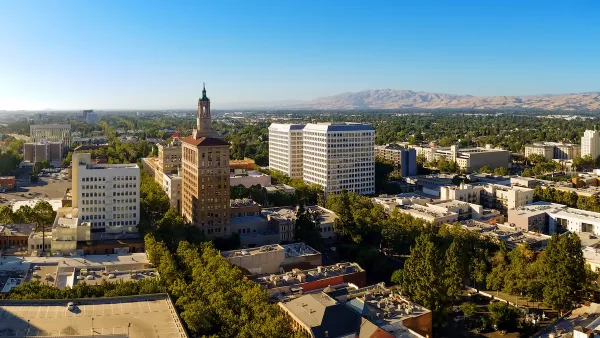
As California and other Western states await a SCOTUS ruling that will greatly affect how cities deal with tent encampments, a new stakeholder is causing big changes in how Northern California's largest city deals with its unsheltered population.
HUD Grants Total $315 Million for Continuum of Care for the Unhoused
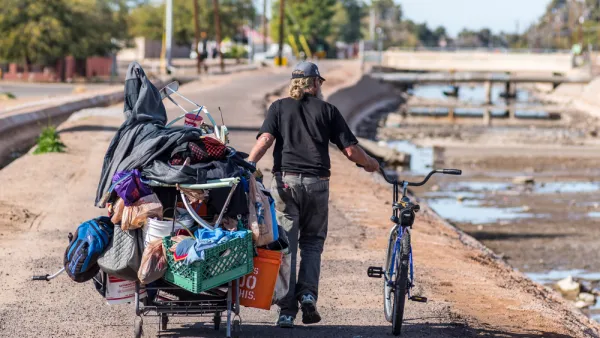
An unprecedented federal grant program, announced earlier this month, will support continuum of care for the unhoused in unsheltered and rural settings.

Planetizen Federal Action Tracker
A weekly monitor of how Trump’s orders and actions are impacting planners and planning in America.

The state-sanctioned urbicide of Austin
People don’t kill cities. Freeways do.

US to reduce Colorado River water deliveries to Mexico
A new Colorado Treaty amendment reduces Mexico’s Colorado River water allocation by 250,000 acre feet.

5 New England states march closer to 800 megawatt wind energy project
Securing federal approval for the project may be complicated under the Trump administration, which has historically been hostile towards domestic wind power.

Baltimore to break ground on $50 million Transit Priority Project
The project will bring faster bus trips, safer streets and better bike connections to Baltimore.

Airbnb launches $250 million 'last-dollar financing' housing accelerator, makes first investment in Austin
The company will put $6.4 million towards affordable housing development in Texas’ capital.

FREE Course: Walkable City 1: Why Walkability?
After describing his path towards focusing on walkability as the essence of good planning, Jeff Speck marches through his five principal reasons for making more walkable places.
Reinventing Malls: Planning Alchemy—Turning Gray Fields Into Gold
The course focuses on the opportunities and imperatives that shape reinvention of mall sites.

Eagle County Government
Harvard University Graduate School of Design
Nashville Planning Department
The Architects Foundation
University of Cincinnati Online
The Pocatello Development Authority
The Urban Renewal Agency of the City of Pocatello
Journal of the American Planning Association