An unprecedented federal grant program, announced earlier this month, will support continuum of care for the unhoused in unsheltered and rural settings.


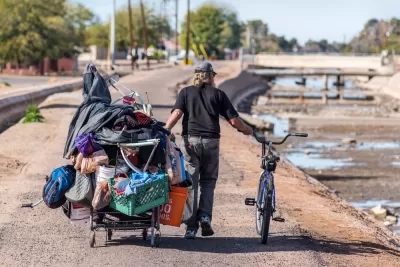
The U.S. Department of Housing and Urban Development (HUD) on February 2 announced $315 million in Continuum of Care grants to address homelessness in unsheltered and rural communities.
The $315 million in grant funding will be spread across 46 communities, in a “first-of-its-kind package of resources to help communities provide housing and supportive services to people in unsheltered settings and people experiencing homelessness in rural areas,” according to a HUD press release.
“With these grants and vouchers, HUD is filling this gap and giving communities the resources and tools to improve housing and health outcomes for people on the streets, in encampments, under bridges, and in rural areas,” said HUD Secretary Marcia Fudge in statement.
To achieve these goals, the grant program funds communities through Continuums of Care—otherwise known as organizations that coordinate local implementation of homelessness response systems.
A complete list of funding winners can be found online.
An article by Molly Bolan for Route-Fifty provides more detail and context for the recent grant funding.
FULL STORY: HUD AWARDS $315 MILLION IN HISTORIC GRANTS TO ADDRESS UNSHELTERED AND RURAL HOMELESSNESS

HUD suspends federal funds for LA homelessness agency
HUD is freezing LA's access to Continuum of Care funds after allegations of fraud at the county's homelessness agency.

Local Governments Sue HUD Over Funding Cuts
A new lawsuit alleges that the Trump administration’s revised guidelines for housing and homelessness assistance funds will decimate key programs.

How New Orleans is Reaching Unhoused Residents
A new city office brings together resources to offer wrap-around services and housing to the most vulnerable residents.

Planetizen Federal Action Tracker
A weekly monitor of how Trump’s orders and actions are impacting planners and planning in America.

The state-sanctioned urbicide of Austin
People don’t kill cities. Freeways do.

US to reduce Colorado River water deliveries to Mexico
A new Colorado Treaty amendment reduces Mexico’s Colorado River water allocation by 250,000 acre feet.

5 New England states march closer to 800 megawatt wind energy project
Securing federal approval for the project may be complicated under the Trump administration, which has historically been hostile towards domestic wind power.

Baltimore to break ground on $50 million Transit Priority Project
The project will bring faster bus trips, safer streets and better bike connections to Baltimore.

Airbnb launches $250 million 'last-dollar financing' housing accelerator, makes first investment in Austin
The company will put $6.4 million towards affordable housing development in Texas’ capital.

FREE Course: Walkable City 1: Why Walkability?
After describing his path towards focusing on walkability as the essence of good planning, Jeff Speck marches through his five principal reasons for making more walkable places.
Reinventing Malls: Planning Alchemy—Turning Gray Fields Into Gold
The course focuses on the opportunities and imperatives that shape reinvention of mall sites.

Eagle County Government
Harvard University Graduate School of Design
Nashville Planning Department
The Architects Foundation
University of Cincinnati Online
The Pocatello Development Authority
The Urban Renewal Agency of the City of Pocatello
Journal of the American Planning Association