As California and other Western states await a SCOTUS ruling that will greatly affect how cities deal with tent encampments, a new stakeholder is causing big changes in how Northern California's largest city deals with its unsheltered population.


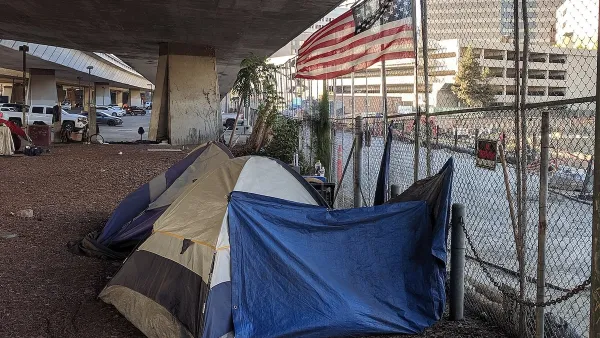
Cities in Western states await what is expected to be a landmark ruling on homelessness by the U.S. Supreme Court in the case, City of Grants Pass, Oregon v. Johnson, this week or early next week, specifically how they are permitted to deal with encampments found on public streets and parks.
[Related in Planetizen: Supreme Court to Reconsider Martin v. Boise, January 15, 2024]
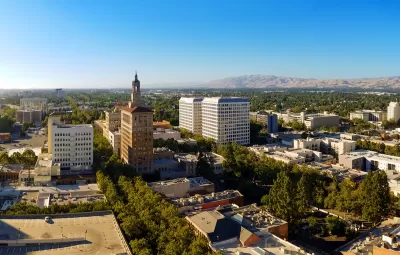
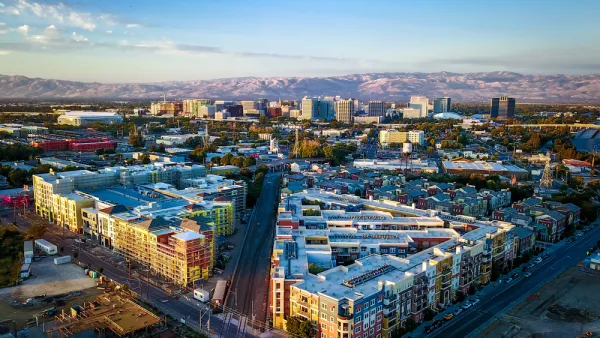
In the San Francisco Bay Area, meanwhile, an unexpected development has forced the city of San Jose to be more proactive in dealing with homeless encampments. But first, some demographic data on homelessness to consider.
Disproportionate homelessness in the Golden State
California's homeless population is outsized, not at all proportional to its total population.
California's population on July 1, 2023 was estimated to be just below 39 million, according to the U.S. Census Bureau's release on Dec. 19, 2023 [also see “Population Losers,” Planetizen, Dec. 28.] While California lost population for a fourth consecutive year, the nation continued to grow, reaching nearly 335 million people [also see Planetizen: Southern States Lead US Population Growth, Dec. 21, 2023].
California, with less than 12% of the nation's population, has “28% of the nation’s total homeless population... up nearly 40% from five years ago,” reported Marisa Kendall, who covers California’s homelessness crisis for CalMatters, on Jan. 26, 2024.
The U.S. Department of Housing and Urban Development, which requires the counts every other year, compiles the data from across the country into an annual report [pdf] submitted to Congress. Last year, the department tallied 181,399 unhoused Californians.
Unsheltered homelessness
Sam Levin, a Los Angeles-based correspondent for Guardian US, reported the federal homelessness data slightly differently than Kendall on Dec. 19, 2023:
California counted 181,399 people experiencing homelessness in January. Of those, 123,423 people (68%) were “unsheltered”, meaning living outside in tents, cars or other makeshift shelters, as opposed to indoor shelters or temporary set-ups. At 68%, the state has a greater share of its homeless population living outdoors than any other state and accounts for 49% of all people living on the streets in the US.
[Recommended reading: Addressing Unsheltered Homelessness in California [pdf], August 2021, a report by California State University, Sacramento]
By comparison, only 4.9 percent of the New York State homeless population is unsheltered, writes Levin.
The five major US metro areas with the highest rates of unsheltered people were all in California: the San Jose region (75% of its homeless population was living on the streets), Los Angeles (73%), the Oakland region (73%), Long Beach (72%) and Sacramento (72%). And the two suburban regions with the nation’s highest unsheltered rates were El Dorado county in northern California (89%) and Imperial county (88%) along the Mexico border.
New state player in homelessness in San Jose
When it comes to housing and homelessness in California, the major state agency that cities deal with is the Department of Housing and Community Development. The new player in the Santa Clara County is also a state agency, but one not normally associated with the state's homelessness crisis.
“At the direction of state regulators pushing the city to clean up its creeks and rivers, councilmembers voted unanimously this week to continue evaluating eight properties as potential locations for the managed camps, dubbed ‘safe sleeping sites’ or ‘basic needs sites,’” reported Ethan Varian, a Bay Area News Group reporter covering housing for The Mercury News and East Bay Times, on June 20.
Who are these “state regulators” that are forcing the San Jose City Council to take action on particular homeless encampments?
The state agency forcing the city to act is the San Francisco Bay Regional Water Quality Control Board, which has recently increased pressure on cities across the region to move encampments away from sensitive waterways.
And why? How did this arcane agency that seemingly has little if anything to do with homelessness command such power?
After three rejections, the water board recently approved the city’s plan to drastically reduce the amount of trash and pollution flowing into its 140 miles of creeks and rivers. If local officials fail to meet their commitments to clean up the waterways by June 2025, the agency could fine the city tens of thousands of dollars per day.
In short, homelessness in the South Bay is no longer just a housing issue but an environmental issue that must be addressed immediately or San Jose will be subject to substantial financial penalties. It changes the focus from “solving homelessness” to managing it.
Managing homelessness
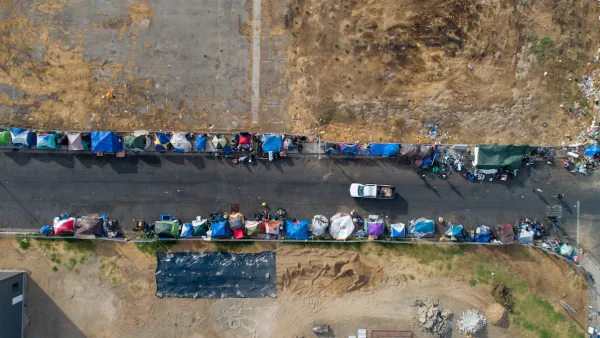
Managing homelessness for San Jose means relocating 500 unsheltered residents living along creeks and rivers to 'sanctioned encampment sites,' writes Varian for The Mercury News. And it must do so by June 2025.
The sites, which would host around 100 to 150 people each, could provide individual tents, food, toilets, showers, laundry and case management services, with at least limited site security or monitoring.
Selecting the sites is no easy task due to community resistance, which Varian details in his reporting. And it will need to find more sites as the number of homeless residents camping along sensitive waterways that need to removed has been estimated at 1,000.
Meanwhile, a U.S. Supreme Court ruling awaits this week or next that may remove restrictions for all jurisdictions in nine Western states in dealing with tent encampments.

San Jose Mayor Takes Dual Approach to Unsheltered Homeless Population
In a commentary published in The Mercury News, Mayor Matt Mahan describes a shelter and law enforcement approach to ending targeted homeless encampments within Northern California's largest city.
Supreme Court Upholds Unhoused Sleeping Ban
The decision sets the stage for what could be a fierce battle over homelessness policy.
Eviction Prevention Program Sees Success in San Jose
Fighting a continued rise in homelessness in the region, a county program is successfully helping families avoid eviction.

The state-sanctioned urbicide of Austin
People don’t kill cities. Freeways do.

US to reduce Colorado River water deliveries to Mexico
A new Colorado Treaty amendment reduces Mexico’s Colorado River water allocation by 250,000 acre feet.

New Jersey’s second-largest city bans standalone data centers
Jersey City will continue to allow co-location facilities, such as those meant for research institutions that store their own data.

Amtrak not solely to blame for New Jersey commuter rail's unreliability, report finds
A new study from the Garden State Initiative found that NJ Transit’s budget grew 20% across a 4 year period, but reliability declined significantly over the same period.

EPA erases limits on planet-warming pollution from power plants
Under Monday’s plan, power plants would still have some limits on how much mercury, arsenic and other contaminants they can emit.

Phoenix announces new on-demand transit service, more frequent RAPID buses
Both new services will launch in October, and are part of Phoenix's Project Effective Access Solutions for Easing Congestion.

FREE Course: Walkable City 1: Why Walkability?
After describing his path towards focusing on walkability as the essence of good planning, Jeff Speck marches through his five principal reasons for making more walkable places.
Reinventing Malls: Planning Alchemy—Turning Gray Fields Into Gold
The course focuses on the opportunities and imperatives that shape reinvention of mall sites.

Eagle County Government
Harvard University Graduate School of Design
Nashville Planning Department
The Architects Foundation
University of Cincinnati Online
The Pocatello Development Authority
The Urban Renewal Agency of the City of Pocatello
Journal of the American Planning Association

