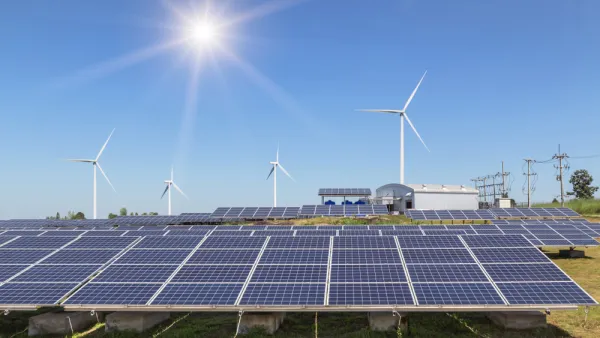
California is setting records for the amount of solar energy it can’t use, but this cushion might be a good thing: it means the state won’t need to depend as heavily on fossil fuels as a stopgap.



The state of California has increased its solar energy production, and now it often has more than it can use. "The state’s fleet of solar farms and rooftop panels frequently generate more electricity than Californians use during the middle of the day — a phenomenon that has sent lawmakers and some climate advocates scrambling to find ways to save the extra sunlight rather than let it go to waste," Sammy Roth reports for the Los Angeles Times.
While this may seem wasteful, a study from the academic journal, Solar Energy, suggests it might actually be prudent to build oversupply into the system. "Solar power has gotten so inexpensive that overbuilding it will probably be the cheapest way to keep the lights on during cloudy or overcast days — cheaper than relying entirely on batteries," Roth explains. Maintaining an oversupply of power is nothing new for utilities, who always need to maintain some cushion. Generating that cushion with solar energy, is a new practice for utilities.
FULL STORY: California has too much solar power. That might be good for ratepayers

Bill Gates's Coalition of Rich Investors Buying In to Energy Storage
To reach goals in reducing emissions, Gates's group is looking to invest in technology that can provide energy in efficient ways by supplying clean power when the sun isn't shining and the wind isn't blowing.

Zoning Stands in the Way of Renewable Energy
Renewable energy is cheap as ever, but zoning isn’t keeping up with the market.

How Renewable Projects Are Threatening a Crucial Carbon Sink
The sprawling Mojave Desert plays a key role in carbon sequestration, storing around 10 percent of California’s carbon. But the fragile ecosystem is threatened by large-scale renewable energy projects.

The state-sanctioned urbicide of Austin
People don’t kill cities. Freeways do.

US to reduce Colorado River water deliveries to Mexico
A new Colorado Treaty amendment reduces Mexico’s Colorado River water allocation by 250,000 acre feet.

New Jersey’s second-largest city bans standalone data centers
Jersey City will continue to allow co-location facilities, such as those meant for research institutions that store their own data.

Amtrak not solely to blame for New Jersey commuter rail's unreliability, report finds
A new study from the Garden State Initiative found that NJ Transit’s budget grew 20% across a 4 year period, but reliability declined significantly over the same period.

EPA erases limits on planet-warming pollution from power plants
Under Monday’s plan, power plants would still have some limits on how much mercury, arsenic and other contaminants they can emit.

Phoenix announces new on-demand transit service, more frequent RAPID buses
Both new services will launch in October, and are part of Phoenix's Project Effective Access Solutions for Easing Congestion.

FREE Course: Walkable City 1: Why Walkability?
After describing his path towards focusing on walkability as the essence of good planning, Jeff Speck marches through his five principal reasons for making more walkable places.
Reinventing Malls: Planning Alchemy—Turning Gray Fields Into Gold
The course focuses on the opportunities and imperatives that shape reinvention of mall sites.

Eagle County Government
Harvard University Graduate School of Design
Nashville Planning Department
The Architects Foundation
University of Cincinnati Online
The Pocatello Development Authority
The Urban Renewal Agency of the City of Pocatello
Journal of the American Planning Association