Construction of 10 miles of dual express lanes on I-10 received the go-ahead last month after a TIFIA loan closed for $225 million of the $925 million project planned by the San Bernardino County Transportation Authority.


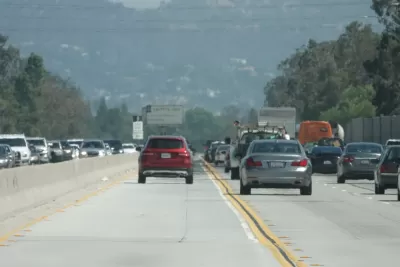
The U.S. Department of Transportation’s Build America Bureau, which promotes transportation infrastructure development projects in the United States by facilitating financing opportunities, finalized a direct loan of $225 million for the Interstate 10 Corridor Project in San Bernardino County, according to a press release posted by InlandEmpire.US on May 2.
Planned by the San Bernardino County Transportation Authority (SBCTA), construction of the approximately 10 miles of express lanes along the I-10 in each direction from the Los Angeles County line to Interstate 15 will start early next year. The express lanes, which should open for service in 2023, will apply congestion pricing to toll-paying single-occupant-vehicles and be free to carpools of three or more occupants.
The low-interest federal loan, which closed on Friday [April 26], is through the Transportation Infrastructure Finance and Innovation Act (TIFIA) and represents about one-fourth of the project’s overall $929 million anticipated cost.
“The closing of the TIFIA loan is a major milestone for the I-10 Corridor Project and underscores the importance of that stretch of interstate to the entire country," said Rep. Pete Aguilar (D-Redlands). "As the Inland Empire’s economy and population continue to grow, it’s important that we find ways to increase mobility throughout the region."
Population projections show the Inland Empire growing from 4.5 million to 7 million people within 30 years.
Tolls make project viable
"The TIFIA loan will be repaid primarily from toll revenues generated by the project," states a Sentinel News Service article on the funding award.
Motorists and legislators may not like tolls, but when the project was planned, there wasn't funding available to widen the interstate with general purpose (unpriced and unmanaged) or carpool lanes.
Former Assemblywoman Cheryl Brown, D-San Bernardino, who introduced the enabling legislation in February 2015 to allow the San Bernardino County Transportation Commission, the predecessor of SBCTA, to build and operate the I-10 toll lanes, did not like the idea of charging motorists to drive on the new lanes.
"Brown at first was opposed to toll lanes, but said she changed her view when she found out gas tax revenue has remained flat and is no longer enough to cover transportation needs," reported Stephen Wall for The Press-Enterprise.
The increase in alternative fuel and higher-mileage vehicles has resulted in drivers paying less in gas taxes, she said. Toll lanes are preferable to raising the gas tax or asking drivers to pay a mileage tax, Brown said. “This is the best alternative,” she said.
She was not alone.
The lack of other funding sources makes toll lanes the only viable option to widen freeways, said San Bernardino County Supervisor Janice Rutherford.
“I’m not happy about it,” she said. “I would rather do without them. But there is no tax money to build more lanes. If you want more space on the freeway, this is it.”
Two years later, the legislature passed SB 1, a 12-cents per gallon gas tax increase, the first hike in the fuel tax since voters approved Proposition 111 in June 1990, adding nine-cents to the gas tax. Last November, California voters rejected a citizens' initiative to repeal the taxes and fees associated with SB 1.
Another critical source of revenue for the $925 million project was Measure I, a San Bernardino County half-cent sales tax measure initially approved by voters in 1989, and extended to 2040 by over 80 percent of voters in 2004. "SBCTA is providing additional credit support of up to $93 million from sales tax proceeds," according to Sentinel News.
Related in Planetizen:
-
Is the Era of the 'Free' Freeway Coming to an End? August 18, 2017
Read the full story: $225 million in funding approved for I-10 Corridor Project

Is the Era of the 'Free' Freeway Coming to an End?
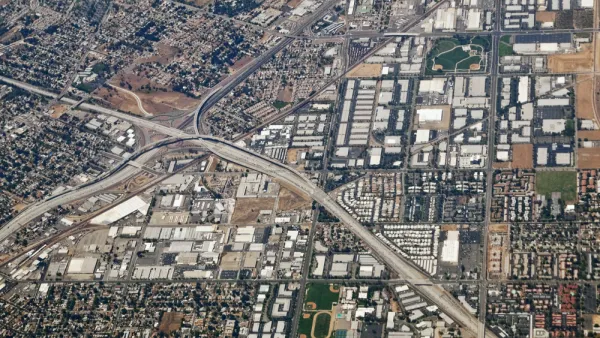
No one's suggesting that freeways will be converted to tollways, but a pattern is emerging that when freeways are widened, express lanes, financed in part by user fees, are being added rather than mixed-flow lanes. Case in point: the Inland Empire.
Train Buffs: Do You Know What a ZEMU Is?
In addition to commuter trains hauled by an electric or diesel-powered locomotive, there are EMUs and DMUs, and come 2021, for the first time in North America, there should be a ZEMU thanks in part to a $30 million California transportation grant.
Electric Vehicles to Lose Important Perk in Southern California
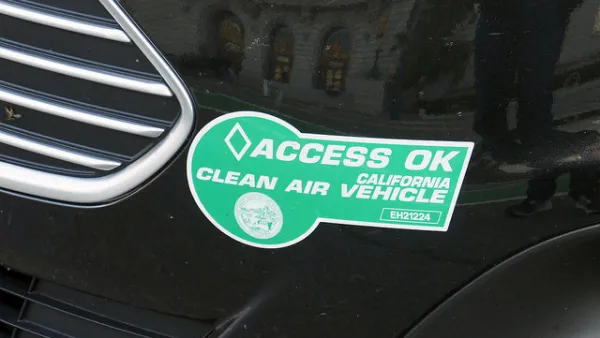
One of the major reasons for purchasing an electric vehicle in California is the ability to use a carpool lane as a solo driver and use an express lane toll-free. The latter perk will soon disappear for solo-occupant EVs on two freeways.

Planetizen Federal Action Tracker
A weekly monitor of how Trump’s orders and actions are impacting planners and planning in America.

California plans to bury El Niño’s downpour
If the state plays its cards right, it may be able to store a billion acre-feet of El Niño’s water in aquifers.

Chicago breaks ground on $3 billion megadevelopment
The new neighborhood, titled Foundry Park, will one day host 3,700 residences.

California High-Speed Rail Authority CEO resigns after $600,000 scandal
Under Ian Choudri, the authority used taxpayer dollars to fund first class flights and trips to nightclubs.

Want to study the Missouri River? Soon, you may need unanimous approval from 10 states
Legislation would require 10 governors’ permission to study or build projects moving water outside the basin.

Desperate measures: Advocates weigh draining Lake Powell to fill Colorado River
Draining the reservoir could reduce evaporation losses by a couple hundred thousand acre-feet.

FREE Course: Walkable City 1: Why Walkability?
After describing his path towards focusing on walkability as the essence of good planning, Jeff Speck marches through his five principal reasons for making more walkable places.
Reinventing Malls: Planning Alchemy—Turning Gray Fields Into Gold
The course focuses on the opportunities and imperatives that shape reinvention of mall sites.

City of Rosemead
Rutgers University, Edward J. Bloustein School of Planning and Public Policy
One Hundred Miles
Hunter College, City University of New York (CUNY)
The Architects Foundation
University of Cincinnati Online
City of Cambridge
Montrose County
The Pocatello Development Authority