University of California, Berkeley researchers have mapped the impact of SB 50, a bill that would allow new density around train stations and bus stops in cities all over the state of California.


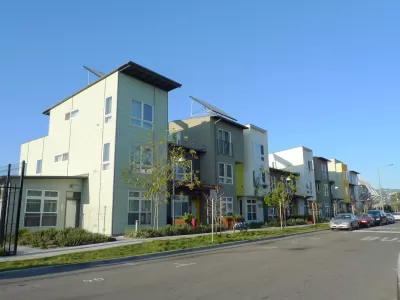
A new interactive mapping tool from the urban Displacement Project and the Terner Center for Housing Innovation at the University of California, Berkeley illustrates the potential impact of SB 50, the statewide transit oriented upzoning bill authored by State Senator Scott Weiner as a follow up to last year's SB 827.
Jenna Chandler reports on the new mapping tool, explaining how to use the map to visualize the changes the bill could clear the way for in the name of creating more housing supply and lowering housing costs around the state.
"The analysis and map look at neighborhoods surrounding 'high-quality' transit stops and categorize them into five neighborhood types based on existing density and income: high density and high income (blue); high density and low income (green); low density and high income (red); low density and low income (yellow); and low density and diverse (purple)," explains Chandler.
"They study takes into consideration how much land is zoned for residential uses, how much is vacant and 'underutilized,' and how many existing buildings are renter-occupied. To help prevent displacement, SB 50 has a provision that exempts buildings that have been occupied by tenants within the past seven years."
Carolina Reid, faculty research advisor for the Terner Center for Housing Innovation, is also quoted in the article providing more insight into the message the team hoped to impart in creating the mapping tool.
FULL STORY: Map shows which LA neighborhoods might be impacted by California transit density bill


SB 827: Part 2
California State Senator Scott Wiener has released the highly anticipated follow up to last year's failed bombshell of a housing bill, SB 827.
Amendments Proposed for California's Landmark Pro-Housing Development Legislation
Amendments are circulating for one of the most-closely watched, and passionately debated, pieces of housing legislation in the country.

Updated: Statewide Upzoning Falls Short Again in California
For the third year in a row, an effort to increase density near transit in statewide in California has stalled in the legislature.

Planetizen Federal Action Tracker
A weekly monitor of how Trump’s orders and actions are impacting planners and planning in America.

The state-sanctioned urbicide of Austin
People don’t kill cities. Freeways do.

US to reduce Colorado River water deliveries to Mexico
A new Colorado Treaty amendment reduces Mexico’s Colorado River water allocation by 250,000 acre feet.

Mamdani overhauls NYC's Vision Zero plan with 100 new policy goals
The overhaul aims to reduce traffic deaths and make streets safer for pedestrians, cyclists and drivers through lower speed limits, new safety infrastructure and more.

Amtrak not solely to blame for New Jersey commuter rail's unreliability, report finds
A new study from the Garden State Initiative found that NJ Transit’s budget grew 20% across a 4 year period, but reliability declined significantly over the same period.

EPA erases limits on planet-warming pollution from power plants
Under Monday’s plan, power plants would still have some limits on how much mercury, arsenic and other contaminants they can emit.

FREE Course: Walkable City 1: Why Walkability?
After describing his path towards focusing on walkability as the essence of good planning, Jeff Speck marches through his five principal reasons for making more walkable places.
Reinventing Malls: Planning Alchemy—Turning Gray Fields Into Gold
The course focuses on the opportunities and imperatives that shape reinvention of mall sites.

Eagle County Government
Harvard University Graduate School of Design
Nashville Planning Department
The Architects Foundation
University of Cincinnati Online
The Pocatello Development Authority
The Urban Renewal Agency of the City of Pocatello
Journal of the American Planning Association