A New York Times article marks the historic significance of congestion pricing—gone are the days of treating roads like they're free while ignoring their costs.


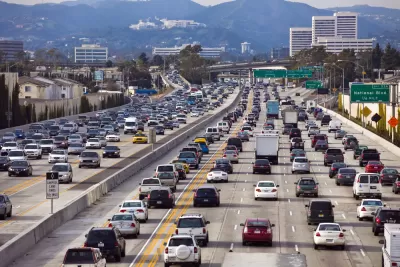
Emily Badger writes on the subject of congestion pricing, the major transportation reform under consideration in Los Angeles and well on the way to implementation in New York City. According to Badger, the idea of charging drivers to enter parts of Manhattan, also known as Cordon Pricing, could enact a generational shift in the conventional thinking about transportation:
Congestion pricing has the potential to significantly change how traffic flows through Manhattan streets, how commuters get around the city, how companies like Uber and Lyft operate.
But most radically, if the policy spreads it could challenge a deeply embedded cultural idea, requiring people to pay for something Americans have long demanded — and largely believe they’ve gotten— free of charge.
Congestion pricing would end the illusion of driving as an entitlement, according to Badger. Instead, congestion pricing treats roads as a valuable and scarce resource.
Badger cites experts in transportation planning, such as Michael Manville, professor of urban planning at the University of California, Los Angeles, Kari Watkins, a professor at Georgia Tech’s School of Civil and Environmental Engineering, Jeffrey Tumlin, a transportation consultant at Nelson\Nygaard, Peter Norton, a historian at the University of Virginia, and more.
The purview of the article draws on a history of treating roads as an entitlement back, before explaining the conditions that have created the political will in 2019 to reform many of the massive entitlements afford cars and drivers since the 1920s and '30s. The final word is left to Manville, who says, "Fortunately, congestion pricing comes with its own built-in solution, which is that it raises a ton of money."
FULL STORY: The Streets Were Never Free. Congestion Pricing Finally Makes That Plain.

NYC’s ‘Rare and Comprehensive’ Public Data Reveals Congestion Pricing's Success
The Metropolitan Transportation Authority’s analytics and data team maintains over 180 regularly updated datasets about the city’s transportation system.
Judge Extends NYC Congestion Pricing Through at Least June 9
A federal judge halted the Trump administration’s effort to kill the program, which remains in limbo as a lawsuit filed by the MTA moves forward.
USDOT Could Pull Federal Funding for New York
The federal government gave the state until May 21 to end new York City’s congestion pricing program or risk losing federal funding and project approvals.

Planetizen Federal Action Tracker
A weekly monitor of how Trump’s orders and actions are impacting planners and planning in America.

The state-sanctioned urbicide of Austin
People don’t kill cities. Freeways do.

US to reduce Colorado River water deliveries to Mexico
A new Colorado Treaty amendment reduces Mexico’s Colorado River water allocation by 250,000 acre feet.

Mamdani overhauls NYC's Vision Zero plan with 100 new policy goals
The overhaul aims to reduce traffic deaths and make streets safer for pedestrians, cyclists and drivers through lower speed limits, new safety infrastructure and more.

Amtrak not solely to blame for New Jersey commuter rail's unreliability, report finds
A new study from the Garden State Initiative found that NJ Transit’s budget grew 20% across a 4 year period, but reliability declined significantly over the same period.

EPA erases limits on planet-warming pollution from power plants
Under Monday’s plan, power plants would still have some limits on how much mercury, arsenic and other contaminants they can emit.

FREE Course: Walkable City 1: Why Walkability?
After describing his path towards focusing on walkability as the essence of good planning, Jeff Speck marches through his five principal reasons for making more walkable places.
Reinventing Malls: Planning Alchemy—Turning Gray Fields Into Gold
The course focuses on the opportunities and imperatives that shape reinvention of mall sites.

Eagle County Government
Harvard University Graduate School of Design
Nashville Planning Department
The Architects Foundation
University of Cincinnati Online
The Pocatello Development Authority
The Urban Renewal Agency of the City of Pocatello
Journal of the American Planning Association