Updates are coming to the Third Street Promenade as it seeks to innovate the retail experience.


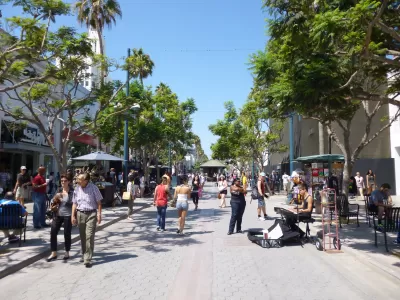
Changes are in store for the Third Street Promenade in Santa Monica, California, reports Merle Ginsberg. In 1989, the pedestrian mall opened after a two-year renovation and it was a model for similar ventures around the world. But it has not received much of an update in the past three decades and sales have declined in recent years.
Downtown Santa Monica, Inc. partnered with the research firm Gehl to find out what improvements could be made to attract visitors. They found that people want moveable chairs and more color, writes Ginsberg:
You can see signs of new life already. Adirondack chairs in yellow, teal, and blue are arranged in groups on the sidewalk. Chairs that spin like tops add some kid-oriented fun—as do new movable platforms covered in fake grass.
With the Expo Line now connecting downtown Los Angeles and Santa Monica, the area has seen an uptick in the number of visitors. The recent redesign efforts are focused on drawing people to the Third Street Promenade but also on getting them to spend time and, ultimately, more money there.
"Right now, public meetings are being conducted to decide which of the Gehl report scenarios will be amenable to the city, property owners, building owners, and of course, the public," says Ginsberg.
FULL STORY: How Santa Monica Is Trying to Lure People Back to the Third Street Promenade

Businesses Oppose Conversion of Parking Structure Into Affordable Housing
Business owners in downtown Santa Monica have filed a lawsuit opposing the city's planned replacement of a parking structure with housing, despite city studies showing that the city's downtown parking supply far exceeds demand.
Funding Remains Uncertain for Sydney's 'Grand Project'
A major plan to improve Sydney's walkability, urban design and public transit system have been applauded throughout the city. The only problem is figuring out how to pay for it.

Judge orders Waymo to stop using 2 Santa Monica charging stations after noise complaints
Neighbors have asked the city to ban the company from using charging stations in residential areas between 11pm and 6am.

Planetizen Federal Action Tracker
A weekly monitor of how Trump’s orders and actions are impacting planners and planning in America.

The state-sanctioned urbicide of Austin
People don’t kill cities. Freeways do.

US to reduce Colorado River water deliveries to Mexico
A new Colorado Treaty amendment reduces Mexico’s Colorado River water allocation by 250,000 acre feet.

5 New England states march closer to 800 megawatt wind energy project
Securing federal approval for the project may be complicated under the Trump administration, which has historically been hostile towards domestic wind power.

Baltimore to break ground on $50 million Transit Priority Project
The project will bring faster bus trips, safer streets and better bike connections to Baltimore.

Airbnb launches $250 million 'last-dollar financing' housing accelerator, makes first investment in Austin
The company will put $6.4 million towards affordable housing development in Texas’ capital.

FREE Course: Walkable City 1: Why Walkability?
After describing his path towards focusing on walkability as the essence of good planning, Jeff Speck marches through his five principal reasons for making more walkable places.
Reinventing Malls: Planning Alchemy—Turning Gray Fields Into Gold
The course focuses on the opportunities and imperatives that shape reinvention of mall sites.

Eagle County Government
Harvard University Graduate School of Design
Nashville Planning Department
The Architects Foundation
University of Cincinnati Online
The Pocatello Development Authority
The Urban Renewal Agency of the City of Pocatello
Journal of the American Planning Association