Architect Larry Kearns argues that re-legalizing accessory dwelling units in Chicago could do a lot to promote affordable housing and economic diversity.


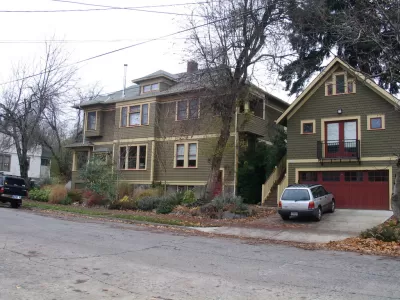
In Chicago, it's currently illegal to build new accessory dwelling units (ADUs or coach houses). Architect Larry Kearns argues that changing this would have several positive effects, including: allowing for the kind of diverse developments that allow people of different income levels to live in the same neighborhoods, and to allow for aging in place for families that want to live near each other, but maintain their own spaces.
"Larry and the architecture firm that bears his name had submitted that document as a tiny house proposal for a “request for ideas” from Mayor Emanuel’s office," Steven Vance writes for Chicago Cityscape. While the mayor's office did not act on that plan, Kearns has not given up on the idea.
In his report on coach houses, Kearns writes, "Resilient neighborhoods, by definition, aren’t dominated by uniformly sized dwellings because residents need choices to upsize and downsize throughout their life." Kearns makes the argument that ADUs could be one good way to create that resiliency and create more types of housing to accommodate a greater variety of needs.
FULL STORY: What a local architecture firm thinks Chicago coach houses could look like


Coach House: Legalize It?
Advocates in the city of Chicago are pushing to legalize Accessory Dwelling Units (ADUs), which currently can only be rented if grandfathered in.
Chicago Coach Houses, Legalize 'Em
Coach houses could provide affordable housing and revenue for home owners if they were more widely permitted in the city.
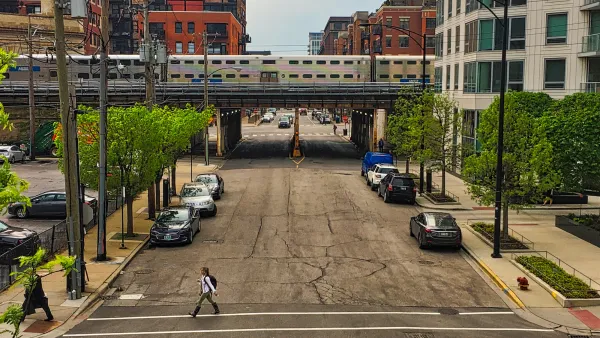
Chicago eliminates parking requirements near transit
In 2025, Illinois barred cities from mandating parking near train and bus stations.

Planetizen Federal Action Tracker
A weekly monitor of how Trump’s orders and actions are impacting planners and planning in America.

The state-sanctioned urbicide of Austin
People don’t kill cities. Freeways do.

US to reduce Colorado River water deliveries to Mexico
A new Colorado Treaty amendment reduces Mexico’s Colorado River water allocation by 250,000 acre feet.

Mamdani overhauls NYC's Vision Zero plan with 100 new policy goals
The overhaul aims to reduce traffic deaths and make streets safer for pedestrians, cyclists and drivers through lower speed limits, new safety infrastructure and more.

Amtrak not solely to blame for New Jersey commuter rail's unreliability, report finds
A new study from the Garden State Initiative found that NJ Transit’s budget grew 20% across a 4 year period, but reliability declined significantly over the same period.

EPA erases limits on planet-warming pollution from power plants
Under Monday’s plan, power plants would still have some limits on how much mercury, arsenic and other contaminants they can emit.

FREE Course: Walkable City 1: Why Walkability?
After describing his path towards focusing on walkability as the essence of good planning, Jeff Speck marches through his five principal reasons for making more walkable places.
Reinventing Malls: Planning Alchemy—Turning Gray Fields Into Gold
The course focuses on the opportunities and imperatives that shape reinvention of mall sites.

Eagle County Government
Harvard University Graduate School of Design
Nashville Planning Department
The Architects Foundation
University of Cincinnati Online
The Pocatello Development Authority
The Urban Renewal Agency of the City of Pocatello
Journal of the American Planning Association