The Los Angeles County Metropolitan Transportation Authority will decide this week whether or not to proceed with separate studies of two ideas that would generate transportation funding from car trips and potentially influence driver behavior.


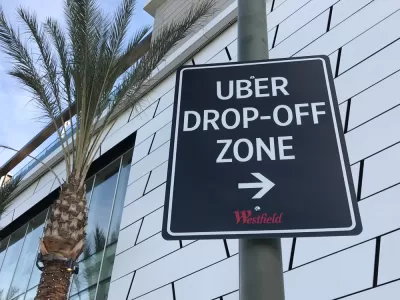
"Transportation officials are considering a tax on Uber and Lyft rides in Los Angeles County, saying the Bay Area tech companies don’t pay their fair share to maintain public streets and exacerbate congestion in a traffic-choked region," reports Laura J. Nelson.
"If designed correctly, Metro’s tax on Uber and Lyft could nudge cost-conscious commuters to carpool or take public transit instead of riding alone with a driver," according to a source at Metro cited in the article.
The ride-hailing fee is still a very speculative idea at the Los Angeles County Metropolitan Transportation Authority, similar to a congestion pricing proposal discussed earlier this year. Nelson is able to report that Metro's early calculation vary from 20 cents to $2.75 per trips. A 20-cent fee could raise $401 million over a decade, and a $2.75 fee could raise $5.5 billion, according to Metro's estimates.
According to Nelson, the idea is one of more than a dozen idea intended to mitigate congestion and fund transportation improvements before the 2028 Summer Olympic Games.
"Metro’s board of directors are scheduled to vote Thursday on whether to approve a study of the ride-hailing tax," according to Nelson.
FULL STORY: L.A. may tax Uber and Lyft rides to curb traffic congestion

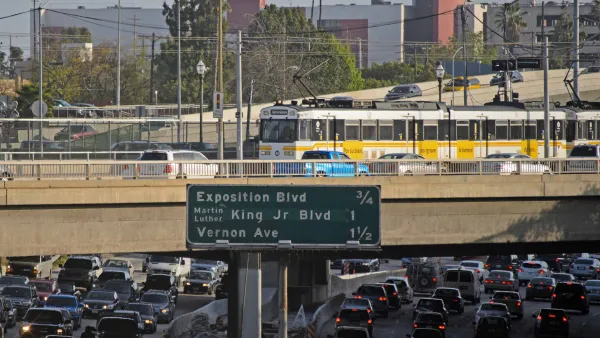
Equity Considerations Delay Congestion Pricing in Los Angeles
After discussing a staff report on road pricing at their Jan. 24 meeting, Los Angeles County Metropolitan Transportation Authority directors paused to weigh the equity implications of charging motorists to drive on roads.
Transit Agency Chief to Propose Congestion Pricing for Los Angeles
Los Angeles Metro CEO Phil Washington will recommend to his board next Thursday that they pursue a congestion pricing program to reduce traffic congestion, improve transit, and subsidize transit fares in Los Angeles in time for the 2028 Olympics.
Congestion Pricing in Los Angeles?
The city of Los Angeles is looking for ways to close a $26.2 billion funding gap for its plan to complete 28 transportation projects by the 2028 Summer Olympics.

The state-sanctioned urbicide of Austin
People don’t kill cities. Freeways do.

US to reduce Colorado River water deliveries to Mexico
A new Colorado Treaty amendment reduces Mexico’s Colorado River water allocation by 250,000 acre feet.

New Jersey’s second-largest city bans standalone data centers
Jersey City will continue to allow co-location facilities, such as those meant for research institutions that store their own data.

Amtrak not solely to blame for New Jersey commuter rail's unreliability, report finds
A new study from the Garden State Initiative found that NJ Transit’s budget grew 20% across a 4 year period, but reliability declined significantly over the same period.

EPA erases limits on planet-warming pollution from power plants
Under Monday’s plan, power plants would still have some limits on how much mercury, arsenic and other contaminants they can emit.

Phoenix announces new on-demand transit service, more frequent RAPID buses
Both new services will launch in October, and are part of Phoenix's Project Effective Access Solutions for Easing Congestion.

FREE Course: Walkable City 1: Why Walkability?
After describing his path towards focusing on walkability as the essence of good planning, Jeff Speck marches through his five principal reasons for making more walkable places.
Reinventing Malls: Planning Alchemy—Turning Gray Fields Into Gold
The course focuses on the opportunities and imperatives that shape reinvention of mall sites.

Eagle County Government
Harvard University Graduate School of Design
Nashville Planning Department
The Architects Foundation
University of Cincinnati Online
The Pocatello Development Authority
The Urban Renewal Agency of the City of Pocatello
Journal of the American Planning Association