Developers are finding out too late that they're required to pay union members a prevailing wages on projects in rezoned parts of New York City.



Joe Anuta reports a big scoop that changes the understanding about the deals made to move rezoning plans through
"In the spring of 2017, the de Blasio administration quietly struck a deal with a union that guarantees its members employment in affordable-housing projects totaling thousands of units across the five boroughs," report Joe Anuta.
The deal was never made public, but the deal was made for a very public reason: it applies to Mayor Bill de Blasio's rezoning of up to 15 neighborhoods to boost density across the city, according to Anuta. "Within each rezoned area, most developments topping 30 units that receive public subsidies must now pay building-service workers a prevailing wage, a deal that steers work to 32BJ [SEIU] members."
According to Anuta, "32BJ repeatedly testified in support of the rezonings without disclosing the pact's existence, and in some cases called for a wage requirement even though it had already secured one."
The problem with the secrecy of the deal: developers are buying sites without being aware of the wage agreement, adding unexpected expenses to proposed projects.
Read the full story: City quietly struck wage deal with building workers union


Advocates Push for Gowanus Rezoning, Stuck in COVID-19 Limbo, to Move Forward
According to advocates, the relative affluence of Gowanus is the reason a plan to rezone the neighborhood must move forward.

Affordable Housing Central to SoHo Rezoning Debate
There's no draft rezoning plan for SoHo yet, but there's plenty of controversy.
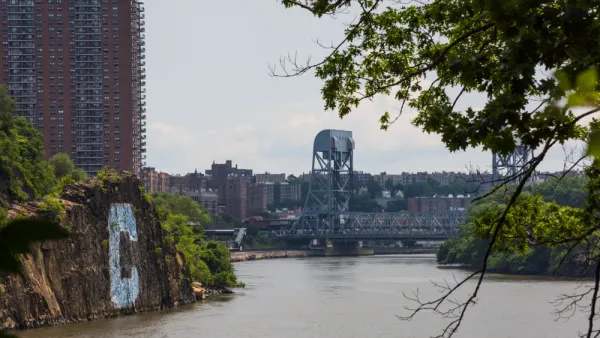
Rezoning Enhances the Changes Already Coming to Manhattan's Northern End
The New York City Council this month approved a rezoning plan for the neighborhood of Inwood, located at the northern tip of Manhattan.

Planetizen Federal Action Tracker
A weekly monitor of how Trump’s orders and actions are impacting planners and planning in America.

California plans to bury El Niño’s downpour
If the state plays its cards right, it may be able to store a billion acre-feet of El Niño’s water in aquifers.

Chicago breaks ground on $3 billion megadevelopment
The new neighborhood, titled Foundry Park, will one day host 3,700 residences.

Satanic Place Names
From streams and lakes to valleys and canyons, I mapped more than 1,000 places named after the Devil.

California High-Speed Rail Authority CEO resigns after $600,000 scandal
Under Ian Choudri, the authority used taxpayer dollars to fund first class flights and trips to nightclubs.

Want to study the Missouri River? Soon, you may need unanimous approval from 10 states
Legislation would require 10 governors’ permission to study or build projects moving water outside the basin.

FREE Course: Walkable City 1: Why Walkability?
After describing his path towards focusing on walkability as the essence of good planning, Jeff Speck marches through his five principal reasons for making more walkable places.
Reinventing Malls: Planning Alchemy—Turning Gray Fields Into Gold
The course focuses on the opportunities and imperatives that shape reinvention of mall sites.

City of Rosemead
Rutgers University, Edward J. Bloustein School of Planning and Public Policy
One Hundred Miles
Hunter College, City University of New York (CUNY)
The Architects Foundation
University of Cincinnati Online
City of Cambridge
Montrose County
The Pocatello Development Authority