The Central SoMa Plan took more than seven years of planning and debate to approve. A new lawsuit, expected to be just the first of many, threatens to erase all that work.


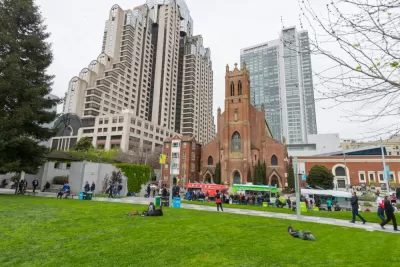
"A nonprofit housing group has filed the first of what is expected to be several lawsuits challenging the rezoning of San Francisco’s Central South of Market area," reports J.K. Dineen.
San Francisco approved the Central SoMa Plan in November and again in December, laying the groundwork for 7,000 housing units and 6 million square feet of office uses, enough space for about 39,000 jobs.
The lawsuit by the Yerba Buena Neighborhood Consortium alleges that the plan's environmental review "didn’t take into account the impact the neighborhood changes would have on public services such as police, fire and recreation," explains Dineen. "In addition, the lawsuit claims that the environmental study neglected to analyze the potential 'grave earthquake dangers' that exist in the Central SoMa neighborhood, much of which is built on fill."
Read the full story: Lawsuit filed challenging San Francisco’s new Central SoMa zoning plan
Planning via Zoom: Legal Scrutiny for Pandemic Realities in New York City
The question of whether a public review process conducted by Zoom is sufficient to approve a sweeping rezoning plan is a matter of no small legal concern in New York City.
Lawsuit Challenges Zoom Hearings on Gowanus Rezoning Plan
Planning departments relying on online public hearing processes will want to keep monitor this lawsuit in New York City.
San Francisco Approved an Expanded Central SoMa Plan
The Central SoMa Plan, which sets development goals for a key swath of Downtown San Francisco, got bigger as it moved through a lengthy approval process.

Planetizen Federal Action Tracker
A weekly monitor of how Trump’s orders and actions are impacting planners and planning in America.

California plans to bury El Niño’s downpour
If the state plays its cards right, it may be able to store a billion acre-feet of El Niño’s water in aquifers.

Desperate measures: Advocates weigh draining Lake Powell to fill Colorado River
Draining the reservoir could reduce evaporation losses by a couple hundred thousand acre-feet.

US buildings threatened, destroyed by fires set to triple by 2060
Researchers found a high fire risk for socioeconomically vulnerable neighborhoods in the American West.

LA residents may be allowed to paint their own crosswalks
Councilwoman Katy Yaroslavsky put out a motion instructing the Los Angeles Department of Public Transportation to study the feasibility of allowing volunteers to paint crosswalks.

Dallas moves to overhaul its zoning code
The city's zoning reform will allow more multi-family and mixed-use developments.

FREE Course: Walkable City 1: Why Walkability?
After describing his path towards focusing on walkability as the essence of good planning, Jeff Speck marches through his five principal reasons for making more walkable places.
Reinventing Malls: Planning Alchemy—Turning Gray Fields Into Gold
The course focuses on the opportunities and imperatives that shape reinvention of mall sites.

City of Rosemead
Rutgers University, Edward J. Bloustein School of Planning and Public Policy
One Hundred Miles
Hunter College, City University of New York (CUNY)
The Architects Foundation
University of Cincinnati Online
City of Cambridge
Montrose County
The Pocatello Development Authority