Bike commuters are increasing in some cities, but overall, fewer Americans are biking to work.


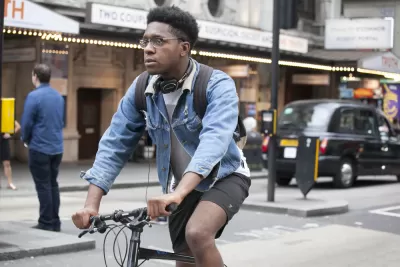
Chris Woodyard reports: "After rising for several years, the percentage of commuters turning to bikes declined for the third year straight, U.S. Census Bureau figures show."
"Nationally, the percentage of people who say they use a bike to get to work fell by 3.2 percent from 2016 to 2017, to an average of 836,569 commuters, according to the bureau's latest American Community Survey….That's down from a high of 904,463 in 2014, when it peaked after four straight years of increases."
According to Woodyard, the decrease is more drastic in some cities than others. Biking to work declined by 50 percent in Tampa and Cleveland, for instance. Bike commuting also decreased in Seattle, Portland, San Francisco, Oakland, and New Orleans. Still, bike commuting increased in Minneapolis, Denver, D.C., and Philadelphia.
Dave Snyder, executive director of the California Bicycle Coalition, is paraphrased in the article, crediting (blaming?) lower gasoline prices and a stronger economy increasing auto sales and decreasing interest in alternative modes of transportation.
FULL STORY: Fewer Americans bike to work despite new trails, lanes and bicycle share programs

Fewer New Yorkers Riding Bikes
A recent report presents evidence that fewer New Yorkers are choosing bikes as an alternative form of transportation.
Congressional Bill Would Offer a Bigger Tax Break for People Who Bike to Work
A bi-partisan bill till early in the federal legislative process would expand a very small tax incentive for people who ride a bike to work.
Study: Transit Not a Panacea for Walkability After All
One of the key assumptions of a new partnership between the planning and public health professions is that transit encourages more active mobility than possible with a car-centric lifestyle. But new research casts doubt on those assumptions.

Planetizen Federal Action Tracker
A weekly monitor of how Trump’s orders and actions are impacting planners and planning in America.

The state-sanctioned urbicide of Austin
People don’t kill cities. Freeways do.

US to reduce Colorado River water deliveries to Mexico
A new Colorado Treaty amendment reduces Mexico’s Colorado River water allocation by 250,000 acre feet.

5 New England states march closer to 800 megawatt wind energy project
Securing federal approval for the project may be complicated under the Trump administration, which has historically been hostile towards domestic wind power.

Baltimore to break ground on $50 million Transit Priority Project
The project will bring faster bus trips, safer streets and better bike connections to Baltimore.

Airbnb launches $250 million 'last-dollar financing' housing accelerator, makes first investment in Austin
The company will put $6.4 million towards affordable housing development in Texas’ capital.

FREE Course: Walkable City 1: Why Walkability?
After describing his path towards focusing on walkability as the essence of good planning, Jeff Speck marches through his five principal reasons for making more walkable places.
Reinventing Malls: Planning Alchemy—Turning Gray Fields Into Gold
The course focuses on the opportunities and imperatives that shape reinvention of mall sites.

Eagle County Government
Harvard University Graduate School of Design
Nashville Planning Department
The Architects Foundation
University of Cincinnati Online
The Pocatello Development Authority
The Urban Renewal Agency of the City of Pocatello
Journal of the American Planning Association