The long-discussed 130th Street Red Line stop gets federal money for planning transit-oriented development to accompany the proposed new station.


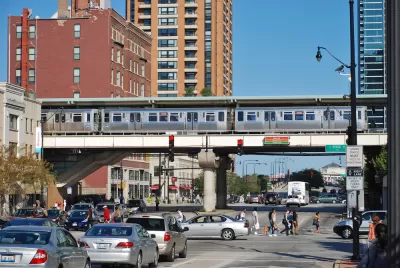
Chicago received $1.48 million dollars for transit-oriented planning around a planned 130th Street Red Line elevated train stop through the U.S. Department of Transportation's Transit-Oriented Development Pilot Planning Program. "This initiative provides funding to local communities to integrate land use and transportation planning with a new fixed guideway or core capacity transit capital investment," John Greenfield writes for Streetsblog Chicago. These funds would aim to get the most out of the new stop in terms of ridership and economic development by allowing more housing near the stop and connecting it to other transit services.
But, will that station ever be built? A great deal of preliminary work is underway including a $21 million contract for planning and this TOD work, but the anticipated $2.3 billion to build the station has not yet been secured. "One possibility for funding the massive Red Line extension construction project would be a new Illinois transportation and infrastructure funding bill, something that governor-elect J.B. Pritzker says he wants to pursue," Greenfield opines. The city would also likely look to secure federal funds, and outgoing mayor Rahm Emanuel has proposed a gas tax increase that could factor into the funding as well.
FULL STORY: $1.48 Million in Federal Funds Awarded for Red Line Extension TOD Planning

Red Line Extension Plans Released in Chicago
A $2.3 billion extension of the CTA's Red Line would be the first extension of a Chicago's "L" line since 1993.
Chicago Transit Increasing Rail Service to Pre-Pandemic Levels
The Chicago Transit Authority is close to returning both rail and bus service to pre-pandemic schedules, with some adjustments for new travel demand.
Chicago Red Line Extension Could Transform the South Side
The city’s transit agency is undertaking its biggest expansion ever to finally bring rail to the South Side.

Planetizen Federal Action Tracker
A weekly monitor of how Trump’s orders and actions are impacting planners and planning in America.

The state-sanctioned urbicide of Austin
People don’t kill cities. Freeways do.

US to reduce Colorado River water deliveries to Mexico
A new Colorado Treaty amendment reduces Mexico’s Colorado River water allocation by 250,000 acre feet.

5 New England states march closer to 800 megawatt wind energy project
Securing federal approval for the project may be complicated under the Trump administration, which has historically been hostile towards domestic wind power.

Baltimore to break ground on $50 million Transit Priority Project
The project will bring faster bus trips, safer streets and better bike connections to Baltimore.

Airbnb launches $250 million 'last-dollar financing' housing accelerator, makes first investment in Austin
The company will put $6.4 million towards affordable housing development in Texas’ capital.

FREE Course: Walkable City 1: Why Walkability?
After describing his path towards focusing on walkability as the essence of good planning, Jeff Speck marches through his five principal reasons for making more walkable places.
Reinventing Malls: Planning Alchemy—Turning Gray Fields Into Gold
The course focuses on the opportunities and imperatives that shape reinvention of mall sites.

Eagle County Government
Harvard University Graduate School of Design
Nashville Planning Department
The Architects Foundation
University of Cincinnati Online
The Pocatello Development Authority
The Urban Renewal Agency of the City of Pocatello
Journal of the American Planning Association