Since a city judge determined the legality of the long controversial Housing Affordability and Livability Agenda, Seattle has been able to move forward with the plan to allow new density around the city.



The political saga of the Housing Affordability and Livability Agenda (HALA) plan continues in Seattle, where the City Council is expected to approve in March 2019.
The headlines of a series of recent articles in the Seattle Times by Danny Westneat and Daniel Beekman focus on the upzoning included in the HALA plan. Westneat describes the plan thusly: a "sweeping plan to upzone 27 Seattle neighborhoods to create taller, denser housing."
Here, Beekman describes the HALA: "The plan would upzone parts of 27 neighborhoods and a number of commercial corridors but would affect only 6 percent of lots now zoned for single-family houses. It would allow developers with projects in those areas to build one or several stories higher while requiring them to include or pay for some low-income apartments."
Westneat writes to dig into the political complications of upzoning in much more detail. And as a Seattle Times columnist, Westneat also offers a take on those political complications: i.e., expect complications. "The obvious peril with making a deal without public input, and also calling it 'grand,' is that there’s not much daylight for the plebeians to come along and have meaningful input into how it’s carried out," writes Westneat.
Meanwhile, Beekman has been covering the resolution and way forward from a recent legal challenge to the HALA plan's environmental review.
In an article dated November 21, Beekman reported that "Seattle’s environmental review of a plan to allow larger buildings and impose affordable-housing requirements in the urban cores of more than two dozen neighborhoods was almost entirely adequate," according to the ruling of the city’s administrative-law judge.
Then, in an article dated December 3, Beekman reports on the proceedings of the first meeting of the City Council on the subject of the plan since the judge's decision, when the council laid out a timeline for remaining work on the project. First to complete is some "additional analysis only on how the upzones plan would impact historic sites," which is expected to wrap up in January. Then, "[c]ouncil members would propose and discuss changes to the plan in January and February, and the council would hold a public hearing in late February," according to Beekman.
FULL STORY: Political trouble was ‘baked into the cake’ of Seattle’s sweeping upzoning plan


Seattle Gives Final Approval to 27 Upzones
An historic moment for planning in Seattle: Density bonuses for affordable housing are now allowed all over the city as Seattle implements a big piece of its long-percolating Mandatory Housing Affordability plan.
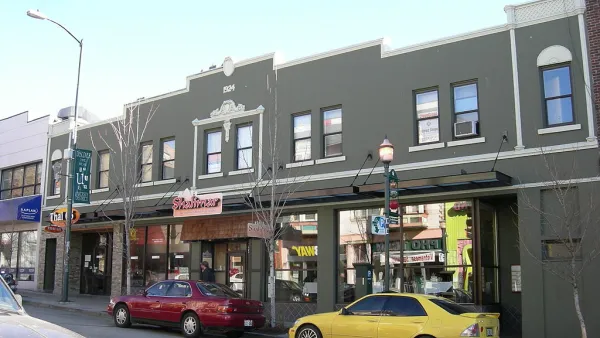
Debating the Future of One of Seattle's Pedestrian-Friendly Gems
The corridor along University Way is currently exempt from the wave of upzoning implemented by the city's Mandatory Housing Affordability program, but that exemption is only temporary.

Upzoning of Seattle's Single-Family Zoning Called a 'Disappointing Half-Measure'
A critical analysis of a proposal that would incrementally increase density in parts of Seattle.

Planetizen Federal Action Tracker
A weekly monitor of how Trump’s orders and actions are impacting planners and planning in America.

The state-sanctioned urbicide of Austin
People don’t kill cities. Freeways do.

US to reduce Colorado River water deliveries to Mexico
A new Colorado Treaty amendment reduces Mexico’s Colorado River water allocation by 250,000 acre feet.

5 New England states march closer to 800 megawatt wind energy project
Securing federal approval for the project may be complicated under the Trump administration, which has historically been hostile towards domestic wind power.

Baltimore to break ground on $50 million Transit Priority Project
The project will bring faster bus trips, safer streets and better bike connections to Baltimore.

Airbnb launches $250 million 'last-dollar financing' housing accelerator, makes first investment in Austin
The company will put $6.4 million towards affordable housing development in Texas’ capital.

FREE Course: Walkable City 1: Why Walkability?
After describing his path towards focusing on walkability as the essence of good planning, Jeff Speck marches through his five principal reasons for making more walkable places.
Reinventing Malls: Planning Alchemy—Turning Gray Fields Into Gold
The course focuses on the opportunities and imperatives that shape reinvention of mall sites.

Eagle County Government
Harvard University Graduate School of Design
Nashville Planning Department
The Architects Foundation
University of Cincinnati Online
The Pocatello Development Authority
The Urban Renewal Agency of the City of Pocatello
Journal of the American Planning Association