Wisconsin taxpayer will be paying the bill for the deal to bring Foxconn to Racine "for decades, if not generations, to come."


Bruce Murphy devotes feature-length attention to the evolution of the deal that brought a massive Foxconn manufacturing plant to Racine County, in southeastern Wisconsin.
The original deal, written on the back of a napkin, offered Foxconn $3.1 billion, "far and away the largest in Wisconsin history and the largest government handout to a foreign company ever given in America," writes Murphy. Since the deal was announced in July 2017, that subsidy has ballooned to $4.1 billion.
But what seemed so simple on a napkin has turned out to be far more complicated and messy in real life. As the size of the subsidy has steadily increased to a jaw-dropping $4.1 billion, Foxconn has repeatedly changed what it plans to do, raising doubts about the number of jobs it will create. Instead of the promised Generation 10.5 plant, Foxconn now says it will build a much smaller Gen 6 plant, which would require one-third of the promised investment, although the company insists it will eventually hit the $10 billion investment target. And instead of a factory of workers building panels for 75-inch TVs, Foxconn executives now say the goal is to build “ecosystem” of buzzwords called “AI 8K+5G” with most of the manufacturing done by robots.
The article documents that growing size the subsidies offered in the deal, as well as the contraction of the new facility promised in return for the subsidies. That's only part of the story, however, as concerns grow about the environmental externalities of the future Foxconn plant. Wisconsin has exempted Foxconn from the state's environmental rules, "allowing it to discharge materials into wetlands and reroute streams during construction and operation" and also "[exempting] the company from doing an Environmental Impact Statement." Lee Bergquist reported in March that the plant "would rank among the highest in southeastern Wisconsin for pollutants that create smog, also known as ozone pollution."
All of the debate and concern over the size of the state's subsidy to Foxconn, and the reality of what it might get in return, is in context of the impending gubernatorial election, in which Gov. Scott Walker is seeking a third term in office.
FULL STORY: WISCONSIN’S $4.1 BILLION FOXCONN BOONDOGGLE

Concerns Raised About Skyrocketing Bill for Wisconsin's Foxconn Deal
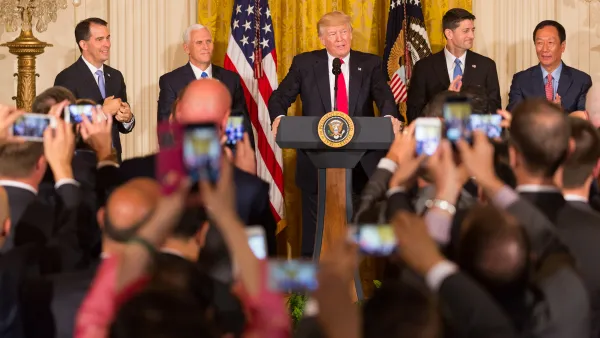
Governor Scott Walker and Foxconn Chair Terry Gou will sign a contract today that will pave the way for the Taiwan-based company to build a large manufacturing plant in Racine County.
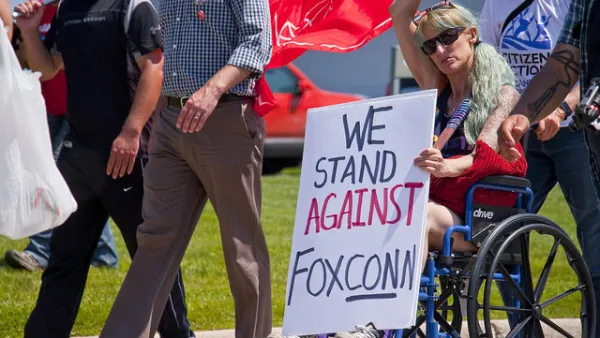
Foxconn, Wisconsin Strike a New Deal
A new chapter in the cautionary tale.
Wisconsin Canceling its Checks to Foxconn
The Republican Party once touted a deal to bring Foxconn to Wisconsin as evidence of their commitment to bringing manufacturing jobs back to the U.S., but the deal has soured, potentially beyond rescue.

Planetizen Federal Action Tracker
A weekly monitor of how Trump’s orders and actions are impacting planners and planning in America.

The state-sanctioned urbicide of Austin
People don’t kill cities. Freeways do.

US to reduce Colorado River water deliveries to Mexico
A new Colorado Treaty amendment reduces Mexico’s Colorado River water allocation by 250,000 acre feet.

Mamdani overhauls NYC's Vision Zero plan with 100 new policy goals
The overhaul aims to reduce traffic deaths and make streets safer for pedestrians, cyclists and drivers through lower speed limits, new safety infrastructure and more.

Amtrak not solely to blame for New Jersey commuter rail's unreliability, report finds
A new study from the Garden State Initiative found that NJ Transit’s budget grew 20% across a 4 year period, but reliability declined significantly over the same period.

EPA erases limits on planet-warming pollution from power plants
Under Monday’s plan, power plants would still have some limits on how much mercury, arsenic and other contaminants they can emit.

FREE Course: Walkable City 1: Why Walkability?
After describing his path towards focusing on walkability as the essence of good planning, Jeff Speck marches through his five principal reasons for making more walkable places.
Reinventing Malls: Planning Alchemy—Turning Gray Fields Into Gold
The course focuses on the opportunities and imperatives that shape reinvention of mall sites.

Eagle County Government
Harvard University Graduate School of Design
Nashville Planning Department
The Architects Foundation
University of Cincinnati Online
The Pocatello Development Authority
The Urban Renewal Agency of the City of Pocatello
Journal of the American Planning Association