A new chapter in the cautionary tale.



Foxconn Technology Group and the state of Wisconsin have reached a new deal, reducing tax breaks for a scaled-back project planned for Racine County in southeast Wisconsin, reports Scott Bauer for the Associated Press.
The terms of the deal, negotiated with Wisconsin Economic Development Corp., are still unannounced, but they follow a historic tax deal negotiated with the company in 2017, and touted as a major political victory for former Gov. Scott Walker and former President Donald Trump, before falling well short of expectations. The original deal promised $4 billion in tax breaks from the state, and concessions in environmental regulations, in return for the construction of a $10 billion manufacturing facility once promised to employ as many as 13,000 people.
A press release from the office of Wisconsin Gov. Tony Evers announced the new deal.
Read the full story: Foxconn, Wisconsin reach new tax break deal for scaled-back project
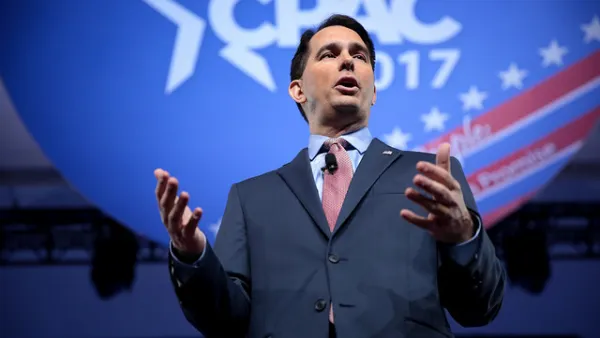
Another EPA Rollback, Tailor-Made for Gov. Walker and Southeast Wisconsin
Politics and economics win over public health in Racine County as the EPA exempted the area around the Foxconn's massive facility from meeting stricter ozone pollution standards, saving the company from investing in smog-reducing equipment.
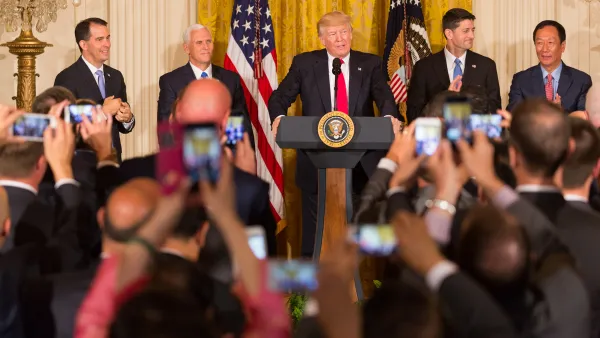
Wisconsin Canceling its Checks to Foxconn
The Republican Party once touted a deal to bring Foxconn to Wisconsin as evidence of their commitment to bringing manufacturing jobs back to the U.S., but the deal has soured, potentially beyond rescue.

Foxconn Changes its Mind (Again)
Foxconn has reversed course, reinstating plans to build a manufacturing plant in Wisconsin after casting doubt on the idea earlier this week.

Planetizen Federal Action Tracker
A weekly monitor of how Trump’s orders and actions are impacting planners and planning in America.

California plans to bury El Niño’s downpour
If the state plays its cards right, it may be able to store a billion acre-feet of El Niño’s water in aquifers.

Desperate measures: Advocates weigh draining Lake Powell to fill Colorado River
Draining the reservoir could reduce evaporation losses by a couple hundred thousand acre-feet.

Mamdani’s pied-à-terre tax survives legal challenge
A panel of judges found that the plaintiffs failed to demonstrate injury as a result of New York City's implementation of the tax.

Eastern Nebraska is running out of electricity
Data centers and electrification are straining eastern Nebraska’s grid, throttling economic development.

Seattle passes record-breaking transit services expansion
Proposition 1 will double the city’s transit tax to add 95,000 more bus trips and preserve 180,000 bus trips annually.

FREE Course: Walkable City 1: Why Walkability?
After describing his path towards focusing on walkability as the essence of good planning, Jeff Speck marches through his five principal reasons for making more walkable places.
Reinventing Malls: Planning Alchemy—Turning Gray Fields Into Gold
The course focuses on the opportunities and imperatives that shape reinvention of mall sites.

City of Rosemead
Rutgers University, Edward J. Bloustein School of Planning and Public Policy
One Hundred Miles
University of Michigan School for Environment and Sustainability (SEAS)
Hunter College, City University of New York (CUNY)
The Architects Foundation
City of Cambridge
Montrose County
The Pocatello Development Authority