A new study sheds light on what actually convinces drivers to slow down and stop for pedestrians.


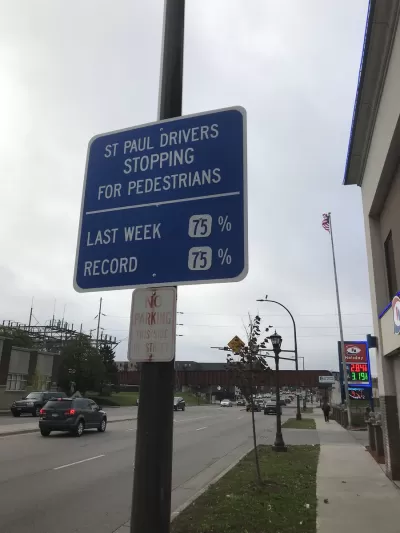
Angie Schmitt reports on the findings of an analysis by Nichole Morris, director of the HumanFIRST Laboratory at the University of Minnesota, of drivers yielding at crosswalks around St. Paul.
Morris and her team initially found yielding rates were dreadful: Only 32 percent of drivers stopped. But they were able to improve that number more than double that using “human factors psychology,” which is focused on altering group behavior.
Human factors psychology includes other jargon-y sounding terms like "social norming" and "implied surveillance." But Schmitt interviews Morris in person to clarify more of the concepts behind this tool for convincing drivers to slow and even stop for the safety and right of way of pedestrians.
Read the full story: To Get Drivers to Yield, St. Paul Uses Psych Trick


Let’s End Traffic Stops
The technology to make traffic enforcement obsolete is becoming available. But in the U.S. willing to use it?

'20 Is Plenty' in the Twin Cities
The first 20 mile per hour speed limit signs have been installed this week in the Twin Cities.

Twin Cities to Lower Speed Limits
Minneapolis and St. Paul are teaming up, with new authority granted by the State legislature, to lower speed limits in both cities.

Planetizen Federal Action Tracker
A weekly monitor of how Trump’s orders and actions are impacting planners and planning in America.

Northwest rail fans eager for Sept. 30 debut of Amtrak’s Airo fleet
Get ready for that new train smell and more seats. But they won’t go faster or run more frequently on the Cascades route in Washington and Oregon.

Trump is considering data centers on 6 states' public land — some state officials say they had no idea
If the administration approves the proposed projects, data center and data center-related developments will cover 17,600 acres of public land.

After decades of planning, Sacramento gains new light rail station
Trains will arrive every 15 minutes during peak hours and every 30 minutes during non-peak hours.

Massive tunnel-boring machine breaks ground on Gateway Project
The Trump administration revoked funding for the project in October 2025, and then restored it earlier this year.

Airo trainsets begin service on Amtrak Cascades route
The trains feature panoramic windows, complementary wifi and over 300 seats per train set.

FREE Course: Walkable City 1: Why Walkability?
After describing his path towards focusing on walkability as the essence of good planning, Jeff Speck marches through his five principal reasons for making more walkable places.
Reinventing Malls: Planning Alchemy—Turning Gray Fields Into Gold
The course focuses on the opportunities and imperatives that shape reinvention of mall sites.

City of Thousand Oaks
City of Wisconsin Rapids
Harvard University Graduate School of Design
The Architects Foundation
University of Cincinnati Online
Northern Illinois Transit Authority (NITA)
The Pocatello Development Authority
The Urban Renewal Agency of the City of Pocatello