A change of nomenclature shifts focus to the self-determination of residents relocating from the coast of Louisiana as rising seas inundate their homes.


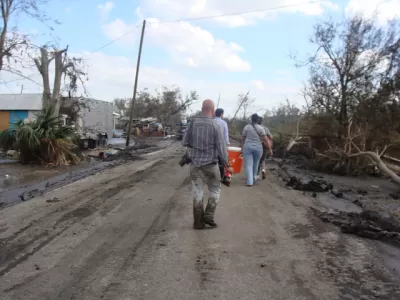
Matthew D. Sanders writes of Isle de Jean Charles, a remote island community along the furthest stretches of southeastern Terrebonne Parish in Louisiana:
This is the setting of the first federally funded, climate-change induced community resettlement project—a $48.3 million effort to create a model for managed retreat at a scale not previously attempted. The Island is disappearing and this federal investment will ultimately determine whether the Island community disappears along with it, or whether it can experience a rebirth in a higher, drier, upland location.
A key message portrayed in this article, compared to previous media coverage of the Isle de Jean Charles resettlement project, addresses a question of nomenclature. Instead of "climate change refugees," planners working on the project prefer the term "climate change pioneers."
"They’re not refugees," writes Sanders. "They are pioneers who have willingly volunteered to take a proactive approach in the face of the sobering reality that the Island—their Island—will not withstand the impacts of future storms yet to come." That pioneering spirit is evident in the work residents are putting into the project, "collaborating with a project team of state officials, planners, engineers and architects to plan the look, feel, function and composition of the new community, but also to outline an appropriate and dignified 'long goodbye' for their Island."
Read the full story: Don’t Label Them Climate Change Refugees, Says a Louisiana Planner, They’re Pioneers

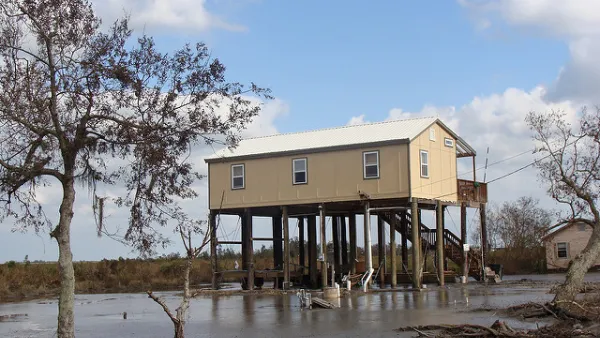
'America’s First Climate Refugees' Are Still on the Island
The 99 residents of Isle de Jean Charles have $48 million to relocate together, but that doesn’t make it easy.
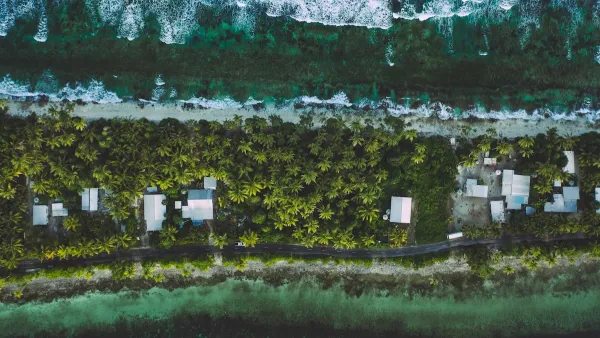
Sea Level Rise is Drowning This Pacific Island Nation; They Have a Plan
The nation of Tuvalu has created an ambitious plan to relocate its entire population and preserve key cultural and historic resources as rising seas threaten to wipe it out within three decades.
Atlantic Coast Infrastructure at Risk from Sea Level Rise
New research reveals that some coastal areas are sinking by as much as 5 millimeters per year, which could threaten key infrastructure.

Planetizen Federal Action Tracker
A weekly monitor of how Trump’s orders and actions are impacting planners and planning in America.

California plans to bury El Niño’s downpour
If the state plays its cards right, it may be able to store a billion acre-feet of El Niño’s water in aquifers.

Desperate measures: Advocates weigh draining Lake Powell to fill Colorado River
Draining the reservoir could reduce evaporation losses by a couple hundred thousand acre-feet.

California city breaks ground on transit connector
The project includes three mobility hubs and a pedestrian bridge.

After public outcry, Massachusetts city releases housing development tracker
Cambridge’s tracker currently shows 250 housing projects in various stages of development.

40 years after approval, Chicago breaks ground on new park
The park honors Jean Baptiste Point du Sable, the city’s first permanent non-native settler.

FREE Course: Walkable City 1: Why Walkability?
After describing his path towards focusing on walkability as the essence of good planning, Jeff Speck marches through his five principal reasons for making more walkable places.
Reinventing Malls: Planning Alchemy—Turning Gray Fields Into Gold
The course focuses on the opportunities and imperatives that shape reinvention of mall sites.

City of Rosemead
Rutgers University, Edward J. Bloustein School of Planning and Public Policy
One Hundred Miles
Hunter College, City University of New York (CUNY)
The Architects Foundation
University of Cincinnati Online
City of Cambridge
Montrose County
The Pocatello Development Authority