At the center of the EPA's newly proposed Affordable Clean Energy rule is doing away with a permitting process known as New Source Review that requires coal power plants to add scrubbers and other expensive pollution control equipment when upgraded.


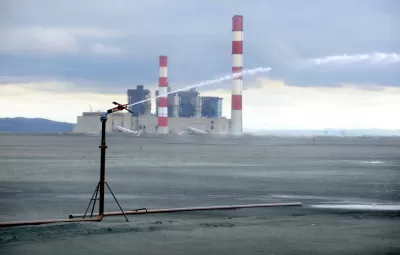
On Aug. 21, U.S. Environmental Protection Agency Acting Administrator Andrew Wheeler proposed his agency's replacement for President Obama's Clean Power Plan rule: the Affordable Clean Energy (ACE) rule that has been shown would result in up 1,400 premature deaths annually. Several states are expected to sue if the rule becomes law.
"The E.P.A. program at the center of this debate, called the New Source Review, is not well known to the public but it has had an enormous impact over the past two decades on air quality in the United States," reports Eric Lipton for The New York Times. "The basic premise is that anytime a plant expands or becomes a 'new source' of emissions, restrictions kick in."
On the plus side of New Source Review, a 1977 amendment to the Clean Air Act, is the benefit to public health and the environment. On the negative side are the costs that utilities must pay if they upgrade their older plants to make them run more efficiently.
Under current rules, such major retrofits of old plants often come with a big demand: The owners must also spend hundreds of millions of dollars to upgrade the air-pollution equipment to the best available technology, including scrubbers [technically called flue gas desulfurization], a clean-air device that played a major role in ending the acid-rain crisis of the 1970s and that removes millions of tons a year of a pollutant blamed for respiratory disease.
Case in point: Gerald Gentleman Station in Sutherland, Neb., the state’s largest power generating plant which started operating in 1979.
"In recent years, Gerald Gentleman Station has been recognized by Platts Power magazine as the lowest cost coal-fired producer in America," notes Nebraska Public Power District, the state's largest utility that owns and operates the plant which "consists of two coal-fired generating units, which together have the capability to generate 1,365 megawatts of power." The utility doesn't state that the low cost comes at a price.
"The plant lacks both scrubbers for sulfur oxides and what is known as selective catalytic reduction [pdf] for nitrogen oxides," adds Lipton. "As of 2017, its two power units were emitting more than 21,000 tons of sulfur dioxide per year, according to E.P.A. data."
Sulfur oxides are harmful to the human respiratory system, particularly for children, older people and people with asthma. They can also react with other contaminants to create so-called particulate matter, which can penetrate deeply into the lungs and cause additional health problems.
If the ACE rule becomes law, it would enable NPPD to upgrade the plant so as to run more efficiently and extend it's life without spending an estimated $1.5 billion for modern pollution control devices, reports Lipton.
An E.P.A. spokesman, Michael Abboud, defended the policy change, saying in a statement it was designed to benefit the environment and intended “to further encourage efficiency improvements at existing power plants.”
The coal and power plant industries have long been lobbying for changes like this. They argue the current rules discourage them from spending money to make older power plants operate more efficiently because it would also trigger hundreds of millions of dollars in demands for new pollution controls.
Planetizen posts dating back to 2001 and 2002 describe actions by U.S. Environmental Protection Administrator Christine Todd Whitman under President George W. Bush to weaken the rule, though she revealed in her memoir that she had acted on pressure from the administration, particularly Vice President Dick Cheney, to do so.
FULL STORY: E.P.A. Rule Change Could Let Dirtiest Coal Plants Keep Running (and Stay Dirty)

'Affordable Clean Energy Rule' Proposed to Replace Clean Power Plan
On Tuesday, EPA released its new rule to regulate emissions from existing power plants, essentially leaving it to the states to determine appropriate emissions levels rather than setting actual standards each state has to meet like the current rule.
It's Official: Obama's Clean Power Plan Has Been Replaced by the Trump Administration
It took less than a year for the EPA to finalize the Affordable Clean Energy rule, which will allow older coal-burning plants to continue operating, in the Trump administration's most consequential environmental rollback accomplished to date.
The Far-Reaching Consequences of Remaking the Mercury Emissions Rule
The EPA intends to review the rulemaking process behind the mercury rule, the subject of a landmark Supreme Court ruling in 2015, to place more value on a rule's compliance cost to industry and less to its beneficial impact on human health.

Planetizen Federal Action Tracker
A weekly monitor of how Trump’s orders and actions are impacting planners and planning in America.

The state-sanctioned urbicide of Austin
People don’t kill cities. Freeways do.

US to reduce Colorado River water deliveries to Mexico
A new Colorado Treaty amendment reduces Mexico’s Colorado River water allocation by 250,000 acre feet.

Mamdani overhauls NYC's Vision Zero plan with 100 new policy goals
The overhaul aims to reduce traffic deaths and make streets safer for pedestrians, cyclists and drivers through lower speed limits, new safety infrastructure and more.

Amtrak not solely to blame for New Jersey commuter rail's unreliability, report finds
A new study from the Garden State Initiative found that NJ Transit’s budget grew 20% across a 4 year period, but reliability declined significantly over the same period.

EPA erases limits on planet-warming pollution from power plants
Under Monday’s plan, power plants would still have some limits on how much mercury, arsenic and other contaminants they can emit.

FREE Course: Walkable City 1: Why Walkability?
After describing his path towards focusing on walkability as the essence of good planning, Jeff Speck marches through his five principal reasons for making more walkable places.
Reinventing Malls: Planning Alchemy—Turning Gray Fields Into Gold
The course focuses on the opportunities and imperatives that shape reinvention of mall sites.

Eagle County Government
Harvard University Graduate School of Design
Nashville Planning Department
The Architects Foundation
University of Cincinnati Online
The Pocatello Development Authority
The Urban Renewal Agency of the City of Pocatello
Journal of the American Planning Association