The Daily Source of Urban Planning News

BLOG POST
Stuck, Part II: Why Do People Move (Or Not Move)?
Yes, Americans are moving a lot less, but why? In this part of my post, I drill down to try to unearth some of the reasons. It turns out they're complicated.

EV Chargers Now Outnumber Gas Pumps by Nearly 50% in California
Fast chargers still lag behind amidst rapid growth.

Affordable Housing Renovations Halt Mid-Air Amidst DOGE Clawbacks
HUD may rescind over a billion dollars earmarked for green building upgrades.

Has Anyone at USDOT Read Donald Shoup?
USDOT employees, who are required to go back to the office, will receive free parking at the agency’s D.C. offices — flying in the face of a growing research body that calls for pricing parking at its real value.

FEATURE
Placekeeping: Setting a New Precedent for City Planners
How a preservation-based approach to redevelopment and urban design can prevent displacement and honor legacy communities.

EPA Terminates $116 Million in Grants for Reducing Emissions from Construction Materials
C-MORE grants were earmarked for industry trade groups and universities.
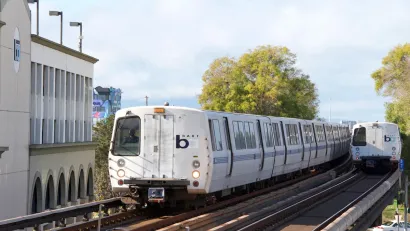
BART Closes $35 Million Deficit
Cost control and revenue generation measures prevented service cuts.

The New Parisian Hearse is a Bicycle
Sleek, silent, and sustainable, a green trip to the graveyard has hit the streets of the French capital.

How Smart Street Lights Can Help Cities Achieve Sustainability Goals
Switching to energy-efficient LEDs and using tech to program when and how street lighting operates can save cities millions in electricity expenses and bring down carbon emissions.

NOAA: Southwest ‘Megadrought’ to Persist
Roughly 40 percent of the 48 lower U.S. states are currently in some state of ‘abnormally dry conditions.’

BLOG POST
Americans May Be Stuck — But Why?
Americans are moving a lot less than they once did, and that is a problem. While Yoni Applebaum, in his highly-publicized article Stuck, gets the reasons badly wrong, it's still important to ask: why are we moving so much less than before?

Jersey City Program Offers Battery Swaps for Electric Bikes and Scooters
Residents can swap depleted batteries for fully charged ones as well as charge and park their devices at two pilot sites.

Research: Walkability Linked to Improved Public Health
A study reveals that the density of city blocks is a significant factor in communities’ walkability and, subsequently, improved public health outcomes for residents.

Report Outlines Strategies for Resilient Wildfire Recovery in LA
Project Recovery offers a roadmap for rebuilding more sustainable and climate-resilient communities after wildfires and other disasters.

New Executive Order Renews Attack on Public Lands
An order issued late last week pushes for increased mineral extraction on federally owned public lands.

Study: Larger Vehicles Lead to More Congestion
New research links large SUVs to lower traffic throughput.

Connecticut Assembly to Reconsider TOD Bill
The ‘Work, Live, Ride’ bill would prioritize funding for designated transit-oriented zones to encourage denser development near transit.

New Jersey Affordable Housing Law Turns 50
The Mount Laurel Doctrine tasks each city and town with creating enough affordable housing to meet their needs, but half a century after its passage, the law still faces opposition in some parts of the state.

NYC Outdoor Dining Won’t Include Booze — For Now
Hundreds of restaurants will be unable to serve alcohol in their outdoor dining areas this summer due to a delay in permitting.

San Francisco Turns On California’s First Speed Cameras
The city is the first in the state to use automated traffic enforcement to reduce speeding and traffic deaths.
City of Thousand Oaks
City of Wisconsin Rapids
Harvard University Graduate School of Design
The Architects Foundation
University of Cincinnati Online
The Pocatello Development Authority
The Urban Renewal Agency of the City of Pocatello

FREE Course: Walkable City 1: Why Walkability?
After describing his path towards focusing on walkability as the essence of good planning, Jeff Speck marches through his five principal reasons for making more walkable places.
Reinventing Malls: Planning Alchemy—Turning Gray Fields Into Gold
The course focuses on the opportunities and imperatives that shape reinvention of mall sites.