Unsafe pedestrian infrastructure makes walking to school dangerous or impossible for a growing number of American students.


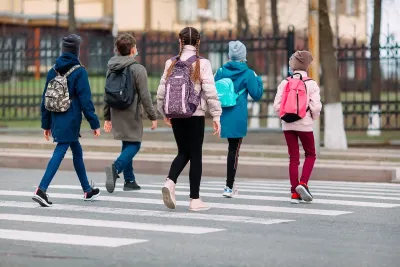
Fewer kids are walking to school now than they did decades ago — and that's largely due to unsafe pedestrian infrastructure, writes Evan Porter in an article for Upworthy.
"The number is at about 11% today, down from about half of all kids under 15 in the 1960s. Even more staggering, back then nearly 90% of kids who lived less than a mile from school would walk or bike on a daily basis."
Porter points to the experience of a YouTuber who attempted to walk from his childhood home to his elementary school and encountered a series of obstacles, including a lack of sidewalks, poison ivy and a crosswalk-less intersection.
According to Porter, "Edinger’s journey racked up over 2 million views on YouTube and had people racing to the comments to weigh in. It quickly became apparent that this was not just an issue in Edinger’s hometown or even New Jersey." All over the country, the responsibility for building and maintaining sidewalks is relegated to private property owners, and low city budgets force cuts to essential infrastructure. Meanwhile, bigger and faster cars pose more danger, particularly to small children.
Porter concludes, "Getting more kids walking and biking to school will take a massive culture shift. Communities that are less hostile to pedestrians, schools that are close to the neighborhoods they serve, and yes, parents that train and trust their kids to do the walk on their own once they know the way."
Read the full story: Man tries to walk 1 mile to school and immediately finds out why parents don’t let kids do it

Why Walk Scores Don’t Tell the Whole Story
A popular measure of walkability only measures proximity, not safety or comfort.
How Seattle Achieved Safe Routes to School Goal
SDOT has installed safety improvements at more than 260 public schools since 2015.
Pedestrian-Friendly Cities: The Impact of Walkability Grants
Explore how walkability grants are transforming cities into pedestrian-friendly environments, enhancing urban livability, boosting local economies, and improving public health.

Planetizen Federal Action Tracker
A weekly monitor of how Trump’s orders and actions are impacting planners and planning in America.

Amtrak, CN end decades-long dispute with eight-year agreement
The new operating agreement establishes an updated framework for the companies to work together, including processes to resolve disputes.

Northwest rail fans eager for Sept. 30 debut of Amtrak’s Airo fleet
Get ready for that new train smell and more seats. But they won’t go faster or run more frequently on the Cascades route in Washington and Oregon.

LAX SkyLink opening delayed again, contractor won’t commit to new deadline
The project was supposed to open its doors to the public in 2023.

Caltrain may slash over one-third of its stations
If Bay Area voters reject two transit tax measures, Caltrain, BART and AC Transit will see steep service cuts.

A 'dangerous' precedent: North Carolina successfully pressures communities into voting for toll roads
Two mayors resigned from the Charlotte Regional Transportation Planning Organization after it voted in favor of the toll roads.

FREE Course: Walkable City 1: Why Walkability?
After describing his path towards focusing on walkability as the essence of good planning, Jeff Speck marches through his five principal reasons for making more walkable places.
Reinventing Malls: Planning Alchemy—Turning Gray Fields Into Gold
The course focuses on the opportunities and imperatives that shape reinvention of mall sites.

City of Thousand Oaks
City of Wisconsin Rapids
Harvard University Graduate School of Design
The Architects Foundation
University of Cincinnati Online
The Pocatello Development Authority
The Urban Renewal Agency of the City of Pocatello