Among the San Francisco Bay Area's 27 transit systems, one rail line stands out for recovered pre-pandemic ridership: the Sonoma-Marin Area Rail Transit District. Now it's headed 9 miles north to Healdsburg.


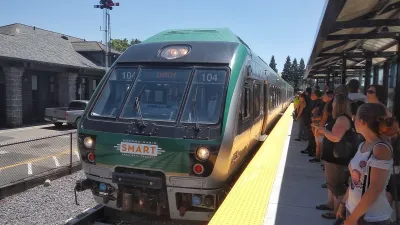
“Bay Area public transit has reached a milestone: One of its 27 operators has fully recovered the ridership it had before the pandemic, with another agency poised to join it soon,” reported Ricardo Cano for the San Francisco Chronicle on Feb. 16, 2024. “And they’re both agencies that, largely, don’t transport people to San Francisco’s downtown offices.”
Cano was reporting on ridership gains made by the Sonoma-Marin Area Rail Transit District which operates the SMART train, a commuter rail service that began operation August 25, 2017, between the two North Bay counties.
“SMART... carried more than 1.1 million passengers in fiscal 2025, 32% higher than the previous year and almost 50% above 2019 levels, the district said,” noted Pete Young for Local News Matters on Sept. 24 in his report on the district's announcement of the award of a construction contract for the line's extension.
The Sonoma-Marin Area Rail Transit District’s board has awarded a $21.7 million contract for the first stage of the railroad’s extension from Windsor to Healdsburg in northern Sonoma County.
The contract with Stacy and Witbeck/Herzog, A Joint Venture, calls for construction of the nine-mile route to begin in January and be finished by late 2028, SMART said in a news release.
Rolling stock
SMART runs “nine two-car Nippon Sharyo DMU [a model of diesel multiple unit passenger train designed and manufactured by Nippon Sharyo for the North American market] trainsets,” according to Wikipedia, which can easily be confused with diesel light rail trains, as Planetizen's first post on the rail line illustrates: “North Bay Approves Diesel Light Rail Ballot Measure,” November 5, 2008.
About 500 miles south of the SMART line is the Sprinter line, considered diesel light rail, in north San Diego County, California, that also uses DMU rolling stock.
Economic impact
The addition of the Healdsburg station “will make it easier than ever for visitors to enjoy Sonoma County’s wine country sustainably — while helping businesses thrive,” notes the SMART release on Sept. 19.
Funding challenge
A major challenge confronting SMART is reauthorization of its quarter-cent sales tax, set to expire in 2029. No North Bay counties were included in the recent legislation authorizing a Bay Area sales tax measure for the November 2026 ballot. A group has been formed that plans to put a measure on the June 2026 ballot, reported Adrian Rodriguez for the Marin Independent Journal on June 13.
Hat tip to Metropolitan Transportation Commission news headlines.
Read the full story: SMART making tracks to Healdsburg with building of 9-mile spur to begin in January

New Bay Area Commuter Rail Service Begins Today
Sonoma-Marin Area Rail Transit (SMART) train is set to start service Friday, running between Sonoma and Marin Counties in the Bay Area. Future extensions are planned that to take it to Larkspur for ferry service to San Francisco.
When Carpool Lanes Cause Mayhem
A newly widened Bay Area freeway serves as a reminder of the futility of HOV lanes. There are better ways to manage and mitigate traffic.
Bay Area's Newest Commuter Rail Service on Display
The Northwestern Pacific RR served Marin and Sonoma counties and the North Coast in the 1890s. The route of the new SMART train, while not as long, will run in the same right-of-way, starting next year. One new train was on display in San Rafael.

Planetizen Federal Action Tracker
A weekly monitor of how Trump’s orders and actions are impacting planners and planning in America.

California plans to bury El Niño’s downpour
If the state plays its cards right, it may be able to store a billion acre-feet of El Niño’s water in aquifers.

Chicago breaks ground on $3 billion megadevelopment
The new neighborhood, titled Foundry Park, will one day host 3,700 residences.

Satanic Place Names
From streams and lakes to valleys and canyons, I mapped more than 1,000 places named after the Devil.

California High-Speed Rail Authority CEO resigns after $600,000 scandal
Under Ian Choudri, the authority used taxpayer dollars to fund first class flights and trips to nightclubs.

Want to study the Missouri River? Soon, you may need unanimous approval from 10 states
Legislation would require 10 governors’ permission to study or build projects moving water outside the basin.

FREE Course: Walkable City 1: Why Walkability?
After describing his path towards focusing on walkability as the essence of good planning, Jeff Speck marches through his five principal reasons for making more walkable places.
Reinventing Malls: Planning Alchemy—Turning Gray Fields Into Gold
The course focuses on the opportunities and imperatives that shape reinvention of mall sites.


City of Rosemead
Rutgers University, Edward J. Bloustein School of Planning and Public Policy
One Hundred Miles
Hunter College, City University of New York (CUNY)
The Architects Foundation
University of Cincinnati Online
City of Cambridge
Montrose County
The Pocatello Development Authority