How smart planning — and ample designated parking — can end conflicts over shared scooters.


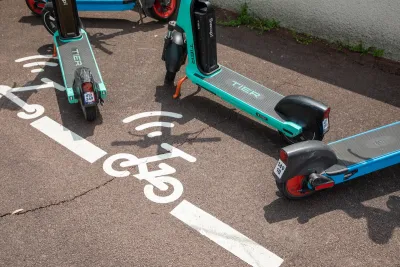
A new guide from the University of Oregon's Urbanism Next Center offers best practices and recommendations for managing shared e-scooter parking in cities. Kea Wilson describes the guide’s key recommendations in Streetsblog USA.
Since dockless scooters rolled out, the ability to leave them ‘anywhere’ has been a problem, with entire social media accounts dedicated to photos of scooters in unlikely, inconvenient, and sometimes dangerous places. The authors of the study argue that cities can prevent this “by rolling out clear, easy-to-follow parking rules and great infrastructure to match.”
The guide recommends, first and foremost, “ample scooter parking everywhere they might expect someone to ride” — dedicated racks or parking zones spaced out every 200 or so meters. It also suggests using scooter parking as daylighting “by locating scooter corrals directly on street corners, rather than letting a car park there and block the view of oncoming road users.”
According to Nathan Pope, senior city planner for Denver DOT, “If you're concerned about scooter riding on the sidewalk, well, the best place is to give them a dedicated, separated place from cars and pedestrians. The solutions here work for the person riding, but also for the person who doesn't use as well.”
Read the full story: How To End Your City’s Fight Over Scooter Parking Once and For All
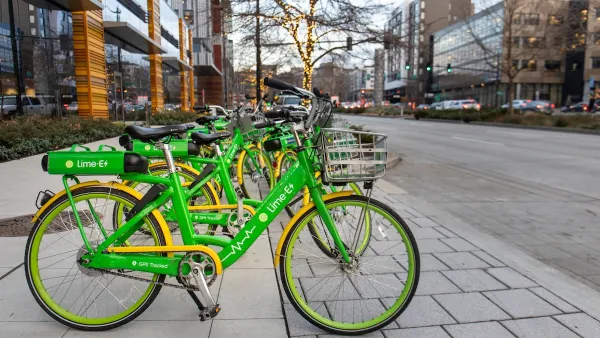
Seattle Sees Strong Bike Share, Scooter Ridership
The city’s shared bikes and e-scooters provided half as many trips as a $2 billion tunnel.
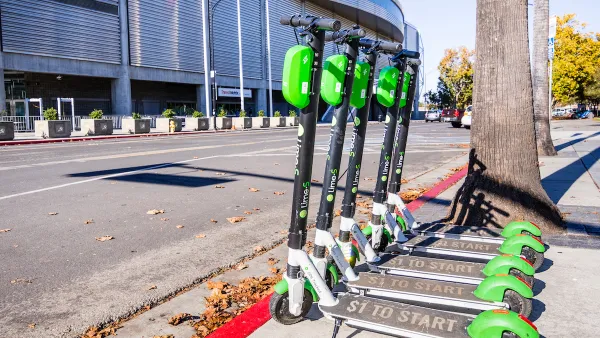
The State of E-Scooters in the US
Eight years after shared e-scooters were first introduced in US cities, the industry still teeters on the edge of success, hindered in part by limited infrastructure.
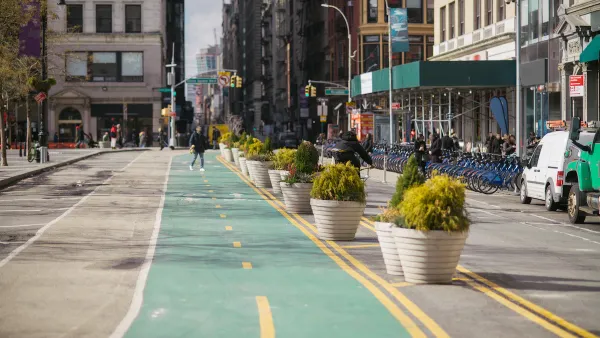
Leading Micromobility Trends for 2024: From Urban Streets to Regional Implementation
The proliferation of micromobility as a viable transportation mode offers the opportunity for cities to reimagine how they allocate public space.

Desperate measures: Advocates weigh draining Lake Powell to fill Colorado River
Draining the reservoir could reduce evaporation losses by a couple hundred thousand acre-feet.

Eastern Nebraska is running out of electricity
Data centers and electrification are straining eastern Nebraska’s grid, throttling economic development.

Malls are becoming the midtowns of the future
Mall and office park redevelopments are a generational opportunity to create new nodes of urbanity.

One Kentucky town’s secret to affordable housing
The Smoketown Community Land Trust has already built seven affordable homes for community members.

Houston gains petal-shaped cooling infrastructure to make streets more ‘delightful’
The city has installed the pavilions along 15 blocks in Houston.

After years of opposition to light rail, this L.A. city wants a $200 million station
Cerritos officials want the Southeast Gateway Line, a planned 14.5-mile light rail route through Los Angeles County, to stop in their city.

FREE Course: Walkable City 1: Why Walkability?
After describing his path towards focusing on walkability as the essence of good planning, Jeff Speck marches through his five principal reasons for making more walkable places.
Reinventing Malls: Planning Alchemy—Turning Gray Fields Into Gold
The course focuses on the opportunities and imperatives that shape reinvention of mall sites.

City of Rosemead
Rutgers University, Edward J. Bloustein School of Planning and Public Policy
One Hundred Miles
University of Michigan School for Environment and Sustainability (SEAS)
Hunter College, City University of New York (CUNY)
The Architects Foundation
City of Cambridge
Montrose County
The Pocatello Development Authority