The system made the switch to faster, more modern all-electric trains in September.


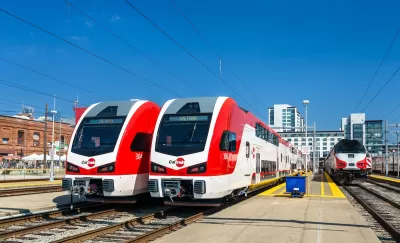
Northern California’s Caltrain saw a 54 percent increase in ridership year-over-year in October 2024, reports Kate Talerico for Mass Transit. The agency recently switched to all-electric trains.
“Total ridership on the commuter rail line between San Francisco and the South Bay increased 17% between August — the last month of primarily diesel service — and October, the first month of all-electric. Weekend ridership — with service every 30 minutes rather than every hour — grew by 38%.” Bay Area Rapid Transit (BART) also saw an increase in ridership.
According to Talerico, “Caltrain’s new trains are not only more environmentally friendly than their diesel forerunners, they’re also faster. Whereas a diesel train running express could get commuters between San Jose and San Francisco in an hour and five minutes with stops at seven stations, the new trains stop at 11 stations and make the journey in just 59 minutes.”
The new trains also feature on-board Wi-Fi, power outlets, and digital displays.
Read the full story: CA: Caltrain ridership soars to highest levels since COVID with new electric trains

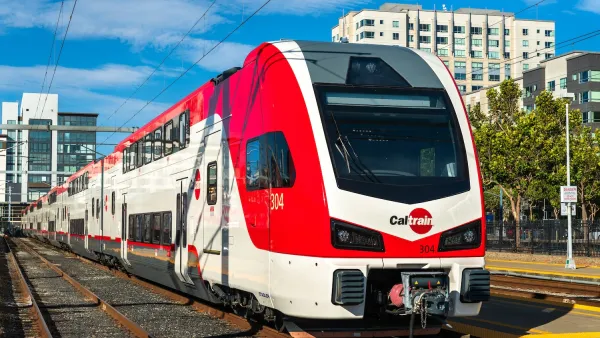
Passengers Flock to Caltrain After Electrification
The new electric trains are running faster and more reliably, leading to strong ridership growth on the Bay Area rail system.

Caltrain Introduces Electric Train Fleet
The Bay Area agency will switch to all electric trains by the end of September.
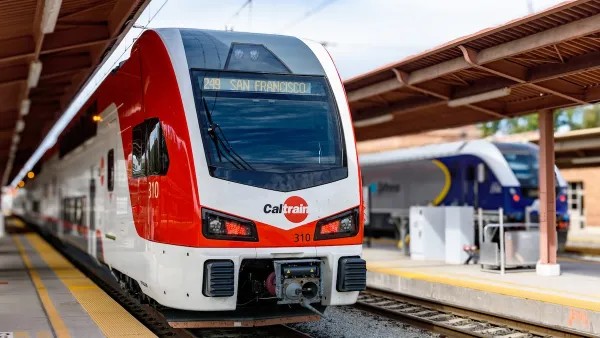
Electric Caltrain Will Earn $1 Million/Year Returning Power to the Grid
The train returns 23% of the power it generates to the state’s grid, powering homes and businesses along its route.

Planetizen Federal Action Tracker
A weekly monitor of how Trump’s orders and actions are impacting planners and planning in America.

California plans to bury El Niño’s downpour
If the state plays its cards right, it may be able to store a billion acre-feet of El Niño’s water in aquifers.

Chicago breaks ground on $3 billion megadevelopment
The new neighborhood, titled Foundry Park, will one day host 3,700 residences.

Satanic Place Names
From streams and lakes to valleys and canyons, I mapped more than 1,000 places named after the Devil.

California High-Speed Rail Authority CEO resigns after $600,000 scandal
Under Ian Choudri, the authority used taxpayer dollars to fund first class flights and trips to nightclubs.

Want to study the Missouri River? Soon, you may need unanimous approval from 10 states
Legislation would require 10 governors’ permission to study or build projects moving water outside the basin.

FREE Course: Walkable City 1: Why Walkability?
After describing his path towards focusing on walkability as the essence of good planning, Jeff Speck marches through his five principal reasons for making more walkable places.
Reinventing Malls: Planning Alchemy—Turning Gray Fields Into Gold
The course focuses on the opportunities and imperatives that shape reinvention of mall sites.

City of Rosemead
Rutgers University, Edward J. Bloustein School of Planning and Public Policy
One Hundred Miles
Hunter College, City University of New York (CUNY)
The Architects Foundation
University of Cincinnati Online
City of Cambridge
Montrose County
The Pocatello Development Authority