The policy, which stems from the gas embargo of the 1970s, makes intersections more dangerous for pedestrians.


In a segment for NPR, Ally Schweitzer highlights a growing movement to ban right turns on red, a 1970s policy that leads to more pedestrian deaths and injuries.
Schweitzer notes Washington, D.C.’s recent decision to prohibit cars from turning right on red lights, adding that San Francisco, Cambridge, Massachusetts, and other cities are doing the same.
According to San Francisco city supervisor Dean Preston, “We saw an 80% decrease in close calls and a 70% decrease in vehicles blocking or encroaching the sidewalks during red lights” after making the change in that city’s Tenderloin district.
Road safety advocates say turning right on red increases the likelihood of car-pedestrian collisions and forces drivers into crosswalks. According to a 2023 Fast Company article, “A 1982 study found that the new policy triggered a sharp increase in crashes involving conflicts between a pedestrian or cyclist and a right-turning vehicle. In Ohio, for instance, such collisions rose 57% for pedestrians and 80% for cyclists; in Wisconsin, the figures were 107% and 72%, respectively.”
If driving through an intersection without stopping may be more fuel-efficient, American cities could consider traffic circles and roundabouts as another option for maintaining traffic flow and reducing congestion.
FULL STORY: More cities are banning right turns on red in response to rising pedestrian deaths

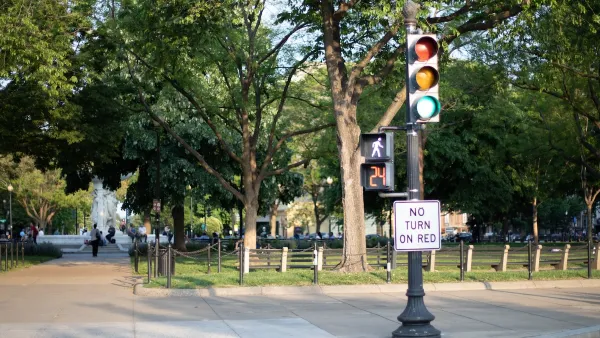
Why Right Turns on Red Are Bad for Traffic Safety
The practice creates dangerous conditions for pedestrians, cyclists, and anyone crossing in front of turning vehicles.
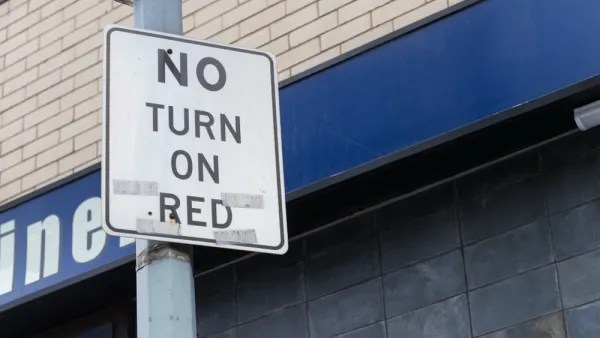
Banning Right Turns on Red: Lessons From Atlanta
How road safety activists passed a law that could make roads much safer.
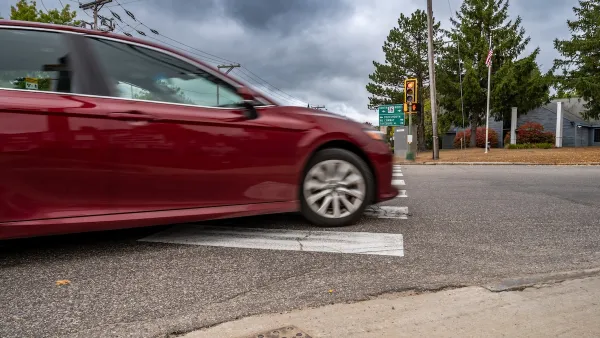
Banning Right Turns on Red Just One Step Toward Vision Zero
Experts caution that blanket bans on right turns on red make only a slight contribution to reducing fatal crashes, and other interventions are needed to bring down traffic fatalities.

Planetizen Federal Action Tracker
A weekly monitor of how Trump’s orders and actions are impacting planners and planning in America.

The state-sanctioned urbicide of Austin
People don’t kill cities. Freeways do.

US to reduce Colorado River water deliveries to Mexico
A new Colorado Treaty amendment reduces Mexico’s Colorado River water allocation by 250,000 acre feet.

5 New England states march closer to 800 megawatt wind energy project
Securing federal approval for the project may be complicated under the Trump administration, which has historically been hostile towards domestic wind power.

Baltimore to break ground on $50 million Transit Priority Project
The project will bring faster bus trips, safer streets and better bike connections to Baltimore.

Airbnb launches $250 million 'last-dollar financing' housing accelerator, makes first investment in Austin
The company will put $6.4 million towards affordable housing development in Texas’ capital.

FREE Course: Walkable City 1: Why Walkability?
After describing his path towards focusing on walkability as the essence of good planning, Jeff Speck marches through his five principal reasons for making more walkable places.
Reinventing Malls: Planning Alchemy—Turning Gray Fields Into Gold
The course focuses on the opportunities and imperatives that shape reinvention of mall sites.


Eagle County Government
Harvard University Graduate School of Design
Nashville Planning Department
The Architects Foundation
University of Cincinnati Online
The Pocatello Development Authority
The Urban Renewal Agency of the City of Pocatello
Journal of the American Planning Association