A promise to fund 1,200 tiny homes for unhoused residents in four cities as a way to rapidly and cost-effectively provide shelter has yet to yield tangible results, but projects are moving ahead in some cities.


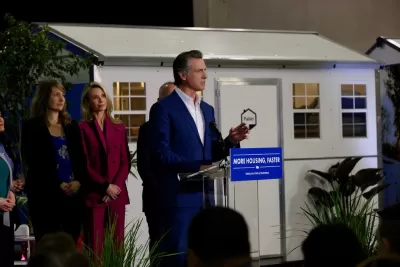
Despite a promise from California Governor Gavin Newsom to distribute 1,200 ‘tiny homes’ for unhoused people a year ago, none of the units have yet materialized, reports Marisa Kendall in CALmatters. According to Kendall, only 150 units have been ordered.
There have been multiple delays and about-faces, over everything from the way the state is funding the units to the ability of local cities and counties to find places to put them. The state has suggested the delays are the fault of local governments. But tiny homes have failed to materialize even when local leaders moved quickly to approve a project site.
The governor’s original plan called for delivering 500 tiny homes to Los Angeles, 350 to Sacramento, 200 to San Jose, and 150 to San Diego County. Then, the state decided to send the city cash grants instead, leaving cities with a funding gap. In San Jose, the city will cover the difference to proceed with opening its tiny home project in 2025. In other cities, sites haven’t yet been selected.
The six tiny home manufacturers selected by the state expressed surprise they haven’t received many orders. “Several said they had to design new products specifically to meet the state’s strict requirements for everything from vapor-resistant light fixtures to emergency exit lighting.”
FULL STORY: Newsom promised 1,200 tiny homes for homeless Californians. A year later, none have opened


Michigan Capital's $640K ‘Pod’ Homes for Homeless Residents not Approved for Winter Use
Lansing officials approved a plan to purchase 50 modular micro-housing units as emergency shelter for the city’s unhoused residents.

The 120 Year Old Tiny Home Villages That Sheltered San Francisco’s Earthquake Refugees
More than a century ago, San Francisco mobilized to house thousands of residents displaced by the 1906 earthquake. Could their strategy offer a model for the present?
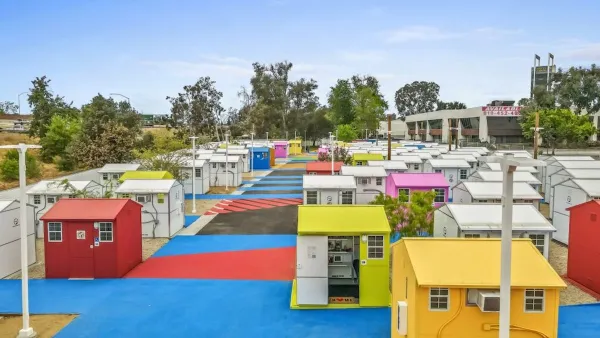
Tiny Homes are a First—but not Last—Step in Ending Homelessness
Cities are trying to stretch affordable housing funds to meet the demand for both short- and long-term housing.

Planetizen Federal Action Tracker
A weekly monitor of how Trump’s orders and actions are impacting planners and planning in America.

The state-sanctioned urbicide of Austin
People don’t kill cities. Freeways do.

US to reduce Colorado River water deliveries to Mexico
A new Colorado Treaty amendment reduces Mexico’s Colorado River water allocation by 250,000 acre feet.

LA Metro’s ultimatum: no extra buses for LA28 if federal funding isn’t imminently secured
If Metro does not provide additional buses, LA28 organizers will have to find a new way to manage Olympic traffic. LA28’s budget does not include a line item for transit.

Colorado’s Largest Data Center Could Rise Next to Homes — Without a Public Hearing
The proposed campus would consume 11 times the power of Denver International Airport; as it has across the country, opposition mounts.

5 New England states march closer to 800 megawatt wind energy project
Securing federal approval for the project may be complicated under the Trump administration, which has historically been hostile towards domestic wind power.

FREE Course: Walkable City 1: Why Walkability?
After describing his path towards focusing on walkability as the essence of good planning, Jeff Speck marches through his five principal reasons for making more walkable places.
Reinventing Malls: Planning Alchemy—Turning Gray Fields Into Gold
The course focuses on the opportunities and imperatives that shape reinvention of mall sites.

Eagle County Government
Harvard University Graduate School of Design
Nashville Planning Department
The Architects Foundation
University of Cincinnati Online
The Pocatello Development Authority
The Urban Renewal Agency of the City of Pocatello
Journal of the American Planning Association