The agency says the program is designed to be more accessible to smaller and underresourced communities.


A new federal grant program dubbed Community Change Grants is making roughly $2 billion in funding available to communities for projects that address environmental justice, reports Ysabelle Kempe in Smart Cities Dive.
The program seeks to address criticism that climate funding is “difficult to access” for underresourced communities through technical assistance and a rolling application process.
“The grants can be used to support a wide range of efforts, the EPA said, including workforce development, indoor air pollution reduction and deployment of low- and zero-emissions technologies.” The grants are open to local governments and nonprofit organizations.
The EPA says it used public input to craft the program based on the needs of smaller communities and organizations. “The oral presentation opportunity, for example, is a new format ‘responsive to community requests to engage with EPA in more accessible ways,’ the agency said.”
Read the full story: EPA announces $2B for local environmental justice projects

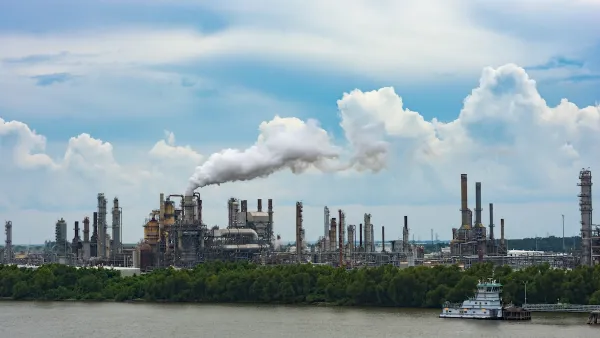
Court Bars EPA Probes in Louisiana’s ‘Cancer Alley’
A federal court ruling effectively prevents the Environmental Protection Agency from pursuing civil rights claims in one of the nation’s most polluted regions.

Judge Halts EPA Action in ‘Cancer Alley’ Civil Rights Case
EPA investigations into violations of the Civil Rights Act in Louisiana’s “Cancer Alley” were ruled as “federal overreach.”
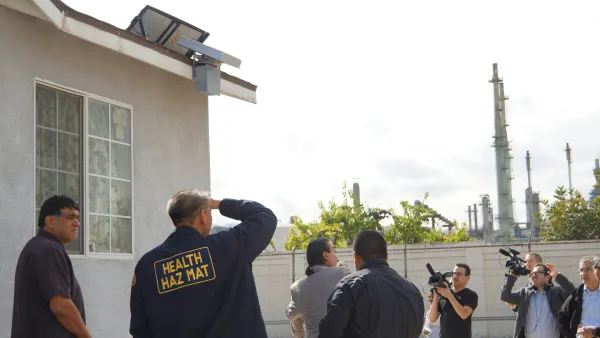
The EPA's Lackluster Environmental Justice Record
The Center for Public Integrity has released a report criticizing the EPA's environmental justice competence. In only 12 cases has the agency taken official action on behalf of communities affected disproportionately by polluters.

Planetizen Federal Action Tracker
A weekly monitor of how Trump’s orders and actions are impacting planners and planning in America.

California plans to bury El Niño’s downpour
If the state plays its cards right, it may be able to store a billion acre-feet of El Niño’s water in aquifers.

Chicago breaks ground on $3 billion megadevelopment
The new neighborhood, titled Foundry Park, will one day host 3,700 residences.

Move over, LA: St. Louis gears up for Olympics, invests millions in downtown redevelopment
The Missouri city will host the 2028 Olympic soccer group stage and knockout matches.

Satanic place names
From streams and lakes to valleys and canyons, I mapped more than 1,000 places named after the Devil.

California High-Speed Rail Authority CEO resigns after $600,000 scandal
Under Ian Choudri, the authority used taxpayer dollars to fund first class flights and trips to nightclubs.

FREE Course: Walkable City 1: Why Walkability?
After describing his path towards focusing on walkability as the essence of good planning, Jeff Speck marches through his five principal reasons for making more walkable places.
Reinventing Malls: Planning Alchemy—Turning Gray Fields Into Gold
The course focuses on the opportunities and imperatives that shape reinvention of mall sites.

City of Rosemead
Rutgers University, Edward J. Bloustein School of Planning and Public Policy
One Hundred Miles
Hunter College, City University of New York (CUNY)
The Architects Foundation
University of Cincinnati Online
City of Cambridge
Montrose County
The Pocatello Development Authority