Pandemic-era busways are speeding up bus service by as much as 39 percent.


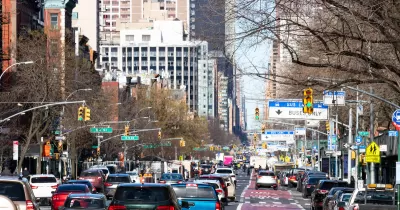
An article by Streetsblog NYC staff assesses the success of four New York City busways created during the de Blasio administration and made permanent under Mayor Eric Adams.
According to the article, “Bus speeds have improved along all four routes, though the magnitude of the improvement varies by time and location. The biggest overall increases were on 181st Street, where buses now run 30 percent faster during all peak periods eastbound and 39 percent faster westbound.”
The article details how each busway has impacted bus speeds, with some faring better than others. “The top performer among the 2021 busways is on Manhattan's West 181st Street between Broadway and Amsterdam Avenue,” where rush hour bus speeds increased by 30 percent on eastbound buses and 39 percent on westbound buses. Meanwhile, buses on Jamaica Avenue in Queens are only moving 8 percent faster at evening rush hour.
The busways are enforced by cameras, some fixed and some mounted on buses. “Asked about the number of violations issued by fixed-location cameras, the city Department of Transportation provided a total number of violations issued on all four busways for the month of September — 13,217. The agency did not provide a breakdown by route, making it impossible for Streetsblog the gauge their effectiveness.”
FULL STORY: Eyes on the Street: How Are De Blasio’s Pandemic Era Busways Doing?

NYC Bus Service Hindered by Congestion
Sharing lanes with car traffic may make it impossible for the MTA to increase service frequency.
New York City’s Buses Are Speeding Up
New York City’s Metropolitan Transportation Authority is renewing efforts to create more bus lanes and dedicated busways in the city.
UPS trucks blocked NYC bus lanes 25,000 times last year
The city recorded 843,000 bus lane violations in 2025.

Planetizen Federal Action Tracker
A weekly monitor of how Trump’s orders and actions are impacting planners and planning in America.

The state-sanctioned urbicide of Austin
People don’t kill cities. Freeways do.

US to reduce Colorado River water deliveries to Mexico
A new Colorado Treaty amendment reduces Mexico’s Colorado River water allocation by 250,000 acre feet.

5 New England states march closer to 800 megawatt wind energy project
Securing federal approval for the project may be complicated under the Trump administration, which has historically been hostile towards domestic wind power.

Baltimore to break ground on $50 million Transit Priority Project
The project will bring faster bus trips, safer streets and better bike connections to Baltimore.

Airbnb launches $250 million 'last-dollar financing' housing accelerator, makes first investment in Austin
The company will put $6.4 million towards affordable housing development in Texas’ capital.

FREE Course: Walkable City 1: Why Walkability?
After describing his path towards focusing on walkability as the essence of good planning, Jeff Speck marches through his five principal reasons for making more walkable places.
Reinventing Malls: Planning Alchemy—Turning Gray Fields Into Gold
The course focuses on the opportunities and imperatives that shape reinvention of mall sites.

Eagle County Government
Harvard University Graduate School of Design
Nashville Planning Department
The Architects Foundation
University of Cincinnati Online
The Pocatello Development Authority
The Urban Renewal Agency of the City of Pocatello
Journal of the American Planning Association