A federal judge on November 13 dismissed a lawsuit the Orange County city filed against the state and the Southern California Association of Governments in March in an attempt to exempt itself from state housing laws.


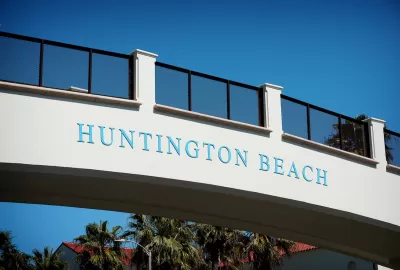
Huntington Beach, the fourth largest city (<200,000) in Orange County, the state's third largest county after Los Angeles and San Diego, has been at the center of state vs. city housing controversies in recent years.
[Most recent in Planetizen: Huntington Beach Mounts Legal Challenge to State-Mandated Density, February 27, 2023]
To put the November 13 ruling into context, it's helpful to go back to March 9 when the city filed its lawsuit against the state and the Southern California Association of Governments, the region's metropolitan planning organization (MPO) in charge of determining the Regional Housing Needs Assessment, in the U.S. Central District of California in Santa Ana, the county seat. Hours earlier, state Attorney General Rob Bonta had filed suit against Huntington Beach in state court (Superior Court of Orange) for “violating state housing laws,” particularly SB 9 (2021) and laws permitting the development of accessory dwelling units.
“Though the two disputes were unrelated, it was hard not to see one as payback for the other,” reports Hillel Aron for Courthouse News Service on November 14.
The 59-page federal complaint [pdf] called the state's actions “an unbridled power play to control all aspects of the City Council’s land use decisions in order to eliminate the suburban character of the City and replace it with a high-density mecca."
November 13 ruling—South Lake Tahoe connection
“In his 15-page opinion [pdf], U.S. District Judge Fred Slaughter ruled Huntington Beach lacked standing to bring the suit under Article III of the Constitution, citing the 1980 Ninth Circuit opinion in City of S. Lake Tahoe v. California Tahoe Regional Planning Agency,” adds Aron.
[South Lake Tahoe appealed the decision to the U.S. Supreme Court that year which denied hearing the case.]
“This precedent precludes political subdivisions of a state like plaintiff city of Huntington Beach from asserting constitutional challenges to the validity of a state law in federal court," wrote Slaughter.
“Huntington Beach also contended the state’s housing orders violated state environmental laws and the California Constitution,” reported Bob Egelko for the San Francisco Chronicle on Nov. 14. “But Slaughter said those claims were not based on any established California legal precedent and could be considered only in a state court.”
City Attorney Michael Gates said Huntington Beach would appeal the ruling to the 9th U.S. Circuit Court of Appeals.
California lawsuit status
The state's lawsuit against Huntington Beach filed on March 9 was paused by an Orange County Superior Court judge on November 3 until the city's lawsuit against the state in federal court was decided, reported Michael Slaten for The Orange County Register the next day.
City Attorney Michael Gates called the judge’s decision “a huge loss” for the state and said the decision can’t be appealed.
“The state is stuck and can’t take any further action against the city for failure to adopt a housing element,” Gates said.
That was November 4. Attorney General Rob Bonta gets the last word.
“We filed [pdf] a motion [on May 1] to dismiss Huntington Beach's federal lawsuit because we believed it was meritless. We are pleased that the court agreed,” said Attorney General Bonta in a statement on November 14.
"With this behind us, we look forward to prosecuting our state case against Huntington Beach. Everyone must do their part to address California's housing crisis."
Hat tip to Bob Egelko, courts reporter for the San Francisco Chronicle.
Read the full story: Huntington Beach loses effort to dodge California housing requirements


Housing Litigation by California Attorney General Yields Results
A landmark state lawsuit will be settled if the Huntington Beach City Council approves an amended specific plan that increases housing. The lawsuit was enabled by 2017 legislation strengthening California's 50-year-old housing element law.

New California Governor Follows Up Tough Housing Rhetoric with Action
Gov. Gavin Newsom, only weeks into his new office, had warned cities that his office would hold them accountable for failing to meet their housing requirements. On Friday, he directed Attorney General Xavier Bacerra to sue Hungtinton Beach.
Huntington Beach Mounts Legal Challenge to State-Mandated Density
The Orange County beachfront community has had enough of the California State Legislature’s preemption of local zoning laws.

Planetizen Federal Action Tracker
A weekly monitor of how Trump’s orders and actions are impacting planners and planning in America.

California plans to bury El Niño’s downpour
If the state plays its cards right, it may be able to store a billion acre-feet of El Niño’s water in aquifers.

Chicago breaks ground on $3 billion megadevelopment
The new neighborhood, titled Foundry Park, will one day host 3,700 residences.

Satanic Place Names
From streams and lakes to valleys and canyons, I mapped more than 1,000 places named after the Devil.

California High-Speed Rail Authority CEO resigns after $600,000 scandal
Under Ian Choudri, the authority used taxpayer dollars to fund first class flights and trips to nightclubs.

Want to study the Missouri River? Soon, you may need unanimous approval from 10 states
Legislation would require 10 governors’ permission to study or build projects moving water outside the basin.

FREE Course: Walkable City 1: Why Walkability?
After describing his path towards focusing on walkability as the essence of good planning, Jeff Speck marches through his five principal reasons for making more walkable places.
Reinventing Malls: Planning Alchemy—Turning Gray Fields Into Gold
The course focuses on the opportunities and imperatives that shape reinvention of mall sites.

City of Rosemead
Rutgers University, Edward J. Bloustein School of Planning and Public Policy
One Hundred Miles
Hunter College, City University of New York (CUNY)
The Architects Foundation
University of Cincinnati Online
City of Cambridge
Montrose County
The Pocatello Development Authority