In the wake of serious pedestrian injuries and a federal investigation, state agencies have barred the driverless taxi company from continuing to operate.


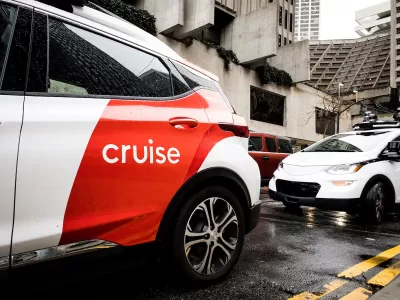
Days after the National Highway Traffic Safety Administration (NHTSA) announced an investigation into several crashes involving Cruise autonomous vehicles, two California state agencies suspended the licenses of the company’s driverless cars, reports Levi Sumagaysay in CALmatters.
The Department of Motor Vehicles and the California Public Utilities Commission grounded the roughly 150 Cruise driverless cars operating in San Francisco, suspending their licenses and prohibiting them from carrying passengers. Sumagaysay notes that “The suspensions do not affect Cruise’s ability to test its vehicles with safety drivers, according to the DMV,” but the cars are not allowed to carry passengers even with safety drivers.
The move comes just months after the Public Utilities Commission permitted the company to test hundreds of its vehicles in San Francisco over the protests of local officials. Autonomous taxi services remain a hotly contested topic in California, touching on issues from road safety to equity to labor.
Read the full story: Two state agencies ground Cruise driverless cars for public safety

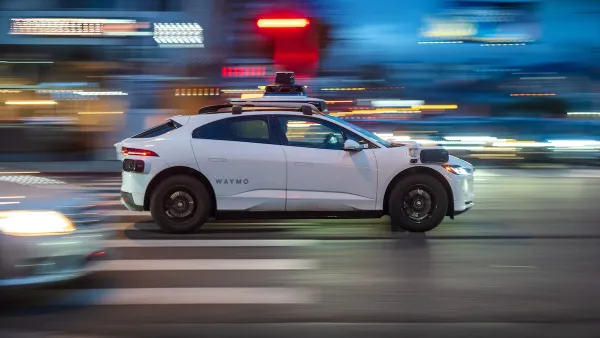
Seattle's Plan for Adopting Driverless Cars
Equity, safety, accessibility and affordability are front of mind as the city prepares for robotaxis and other autonomous vehicles.
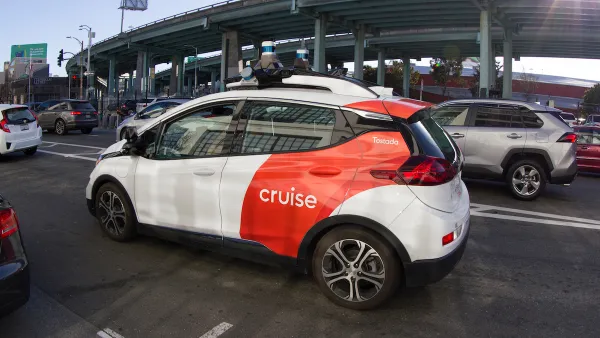
Feds To Investigate Autonomous Car Crashes
The NHTSA has opened an investigation into Cruise self-driving cars after four separate incidents that injured pedestrians in San Francisco.

California Approves Autonomous Cars Over Local Concerns
Despite repeated calls from San Francisco officials to slow the deployment of self-driving cars, a state commission approved expanded access to San Francisco streets.

Planetizen Federal Action Tracker
A weekly monitor of how Trump’s orders and actions are impacting planners and planning in America.

California plans to bury El Niño’s downpour
If the state plays its cards right, it may be able to store a billion acre-feet of El Niño’s water in aquifers.

Chicago breaks ground on $3 billion megadevelopment
The new neighborhood, titled Foundry Park, will one day host 3,700 residences.

Satanic Place Names
From streams and lakes to valleys and canyons, I mapped more than 1,000 places named after the Devil.

California High-Speed Rail Authority CEO resigns after $600,000 scandal
Under Ian Choudri, the authority used taxpayer dollars to fund first class flights and trips to nightclubs.

Want to study the Missouri River? Soon, you may need unanimous approval from 10 states
Legislation would require 10 governors’ permission to study or build projects moving water outside the basin.

FREE Course: Walkable City 1: Why Walkability?
After describing his path towards focusing on walkability as the essence of good planning, Jeff Speck marches through his five principal reasons for making more walkable places.
Reinventing Malls: Planning Alchemy—Turning Gray Fields Into Gold
The course focuses on the opportunities and imperatives that shape reinvention of mall sites.

City of Rosemead
Rutgers University, Edward J. Bloustein School of Planning and Public Policy
One Hundred Miles
Hunter College, City University of New York (CUNY)
The Architects Foundation
University of Cincinnati Online
City of Cambridge
Montrose County
The Pocatello Development Authority