Despite repeated calls from San Francisco officials to slow the deployment of self-driving cars, a state commission approved expanded access to San Francisco streets.


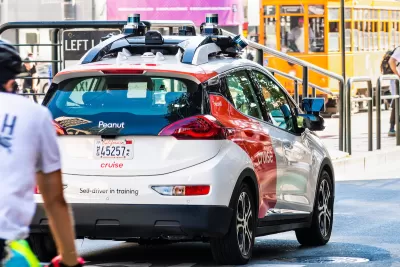
The California Public Utilities Commission approved the further deployment of Cruise and Waymo self-driving cars in San Francisco, reports Lynn La in CALmatters. “After six-and-a-half hours of public comment, the commission voted 3-1 to permit the two companies to expand their driverless car operations, enabling them to charge passengers for driverless rides without a human safety driver present, at all hours.”
Planetizen has documented the ‘mayhem’ (in the words of city officials) caused by autonomous cars in San Francisco, where cars have blocked traffic and crashed into emergency response scenes. While proponents of autonomous cars say the vehicles will make roads safer, incidents like this Tesla crash highlight how far the technology still has to go.
According to a Washington Post article by Trisha Thadani and Jeremy B. Merrill, “Aaron Peskin, president of the San Francisco Board of Supervisors and a frequent critic of the self-driving cars, said he, Mayor London Breed and members of the city’s transportation agencies planned to meet after the vote to ‘discuss next steps.’ He said it is ‘likely’ the city would file for a rehearing, which would be a precursor to litigation against the commission.”
FULL STORY: Driverless cars to fill the streets of San Francisco

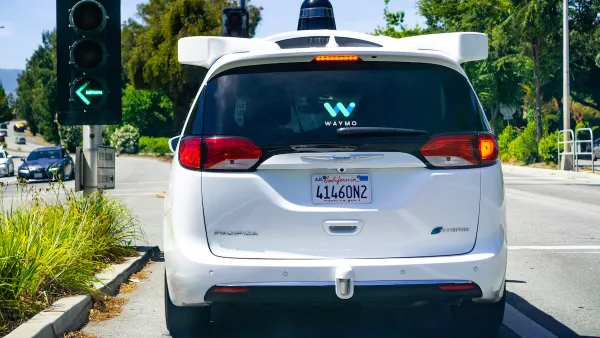
Advice for Autonomous Cars
Drivers for Uber and Lyft in San Francisco express their concerns and advice for self-driving taxi services.
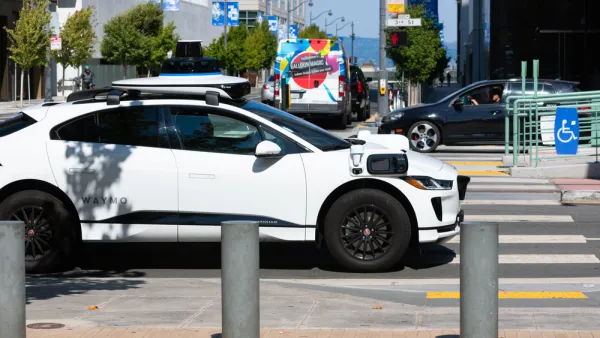
Driverless Cars Blocking Buses, Traffic in San Francisco
Footage from buses and trains show self-driving cars from Waymo and Cruise frequently make unscheduled stops, blocking transit vehicles and causing traffic snarls.
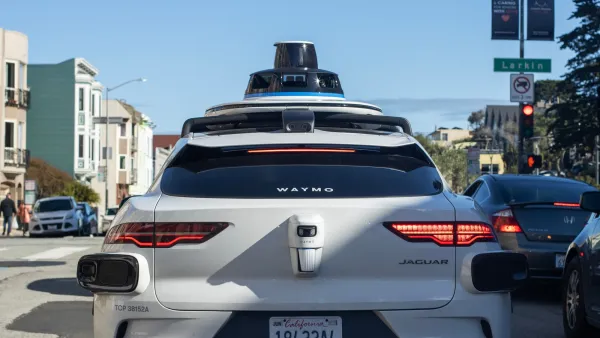
San Francisco Power Outage Leaves Waymos Stranded at Intersections
The company says its vehicles are trained to treat non-functional traffic lights as four-way stops, but videos show Waymos stopped on city streets during a major outage on Saturday.

Planetizen Federal Action Tracker
A weekly monitor of how Trump’s orders and actions are impacting planners and planning in America.

The state-sanctioned urbicide of Austin
People don’t kill cities. Freeways do.

US to reduce Colorado River water deliveries to Mexico
A new Colorado Treaty amendment reduces Mexico’s Colorado River water allocation by 250,000 acre feet.

5 New England states march closer to 800 megawatt wind energy project
Securing federal approval for the project may be complicated under the Trump administration, which has historically been hostile towards domestic wind power.

Baltimore to break ground on $50 million Transit Priority Project
The project will bring faster bus trips, safer streets and better bike connections to Baltimore.

Airbnb launches $250 million 'last-dollar financing' housing accelerator, makes first investment in Austin
The company will put $6.4 million towards affordable housing development in Texas’ capital.

FREE Course: Walkable City 1: Why Walkability?
After describing his path towards focusing on walkability as the essence of good planning, Jeff Speck marches through his five principal reasons for making more walkable places.
Reinventing Malls: Planning Alchemy—Turning Gray Fields Into Gold
The course focuses on the opportunities and imperatives that shape reinvention of mall sites.

Eagle County Government
Harvard University Graduate School of Design
Nashville Planning Department
The Architects Foundation
University of Cincinnati Online
The Pocatello Development Authority
The Urban Renewal Agency of the City of Pocatello
Journal of the American Planning Association